Volley
> A ball thrown up into fired and glazed sheets and caught again. There is no paddle: the screen is a pane, and you return the ball with a hand on it.
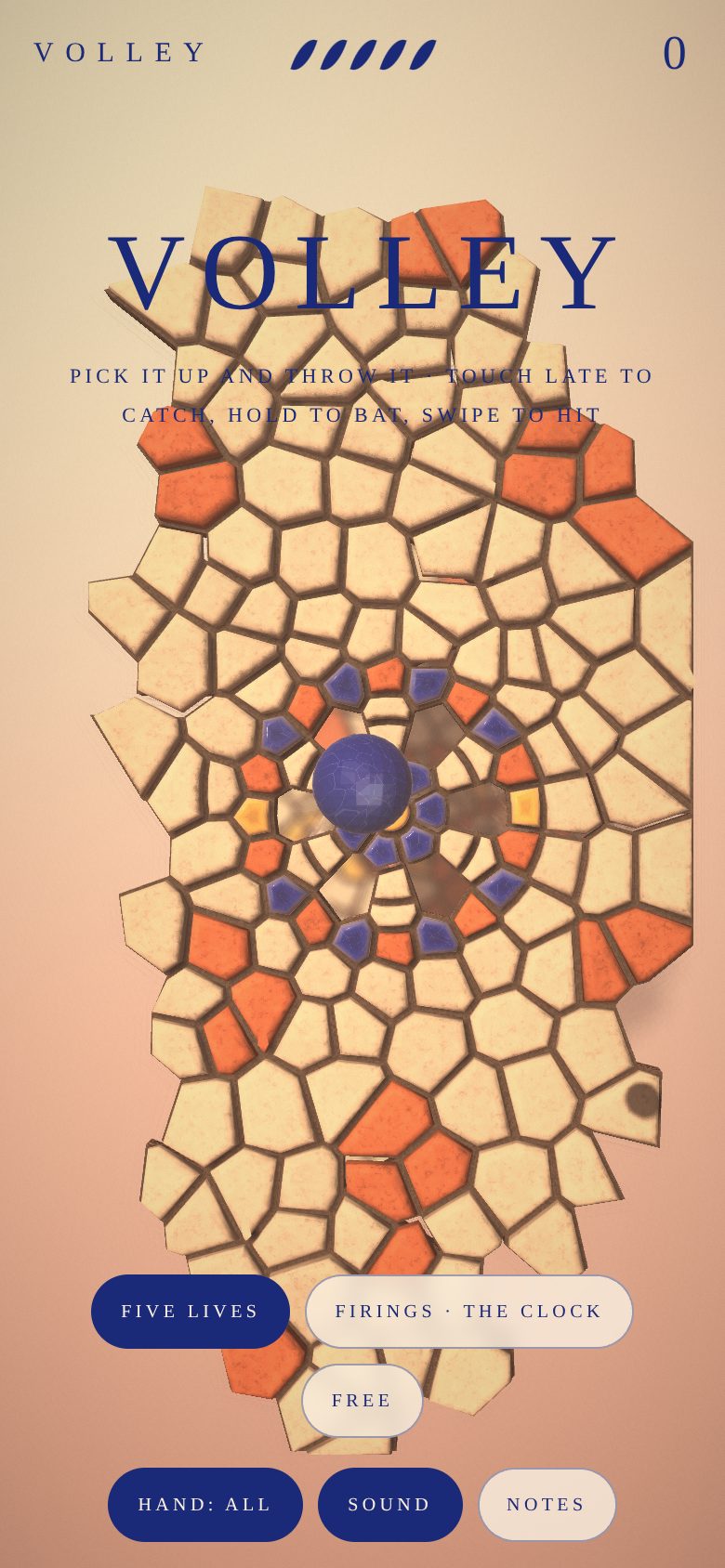
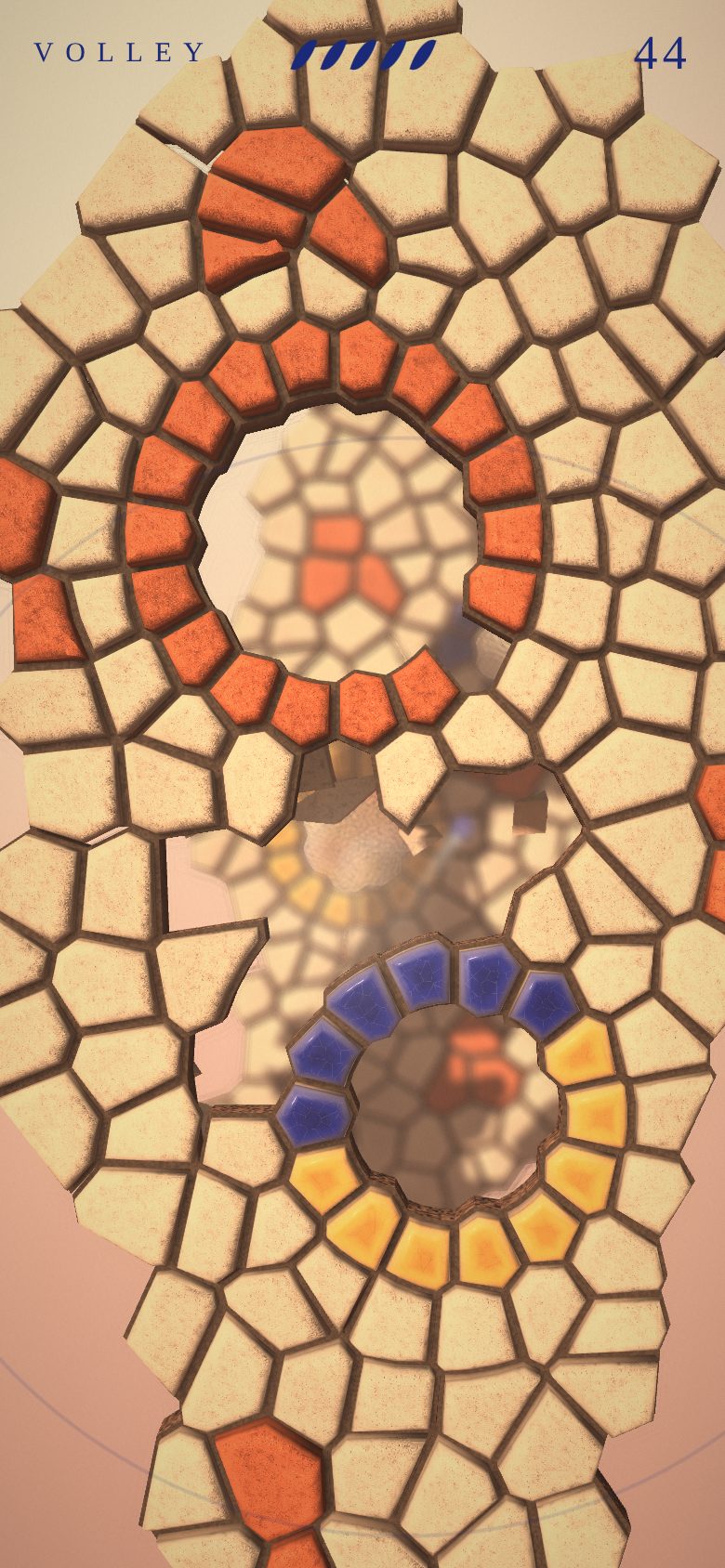
You are lying on your back, throwing a bouncy ball up at what hangs above you: sheets of fired clay, tiled and glazed, one behind another, each with holes through it. The ball breaks the tile it strikes and falls back; wherever it comes back through the pane, a hand has to be there. Break most of a sheet and the rest of it gives way, and you rise to the next. Every six sheets is a firing, with its own clays, glazes and air; its first sheet, a great rosette, is its door.
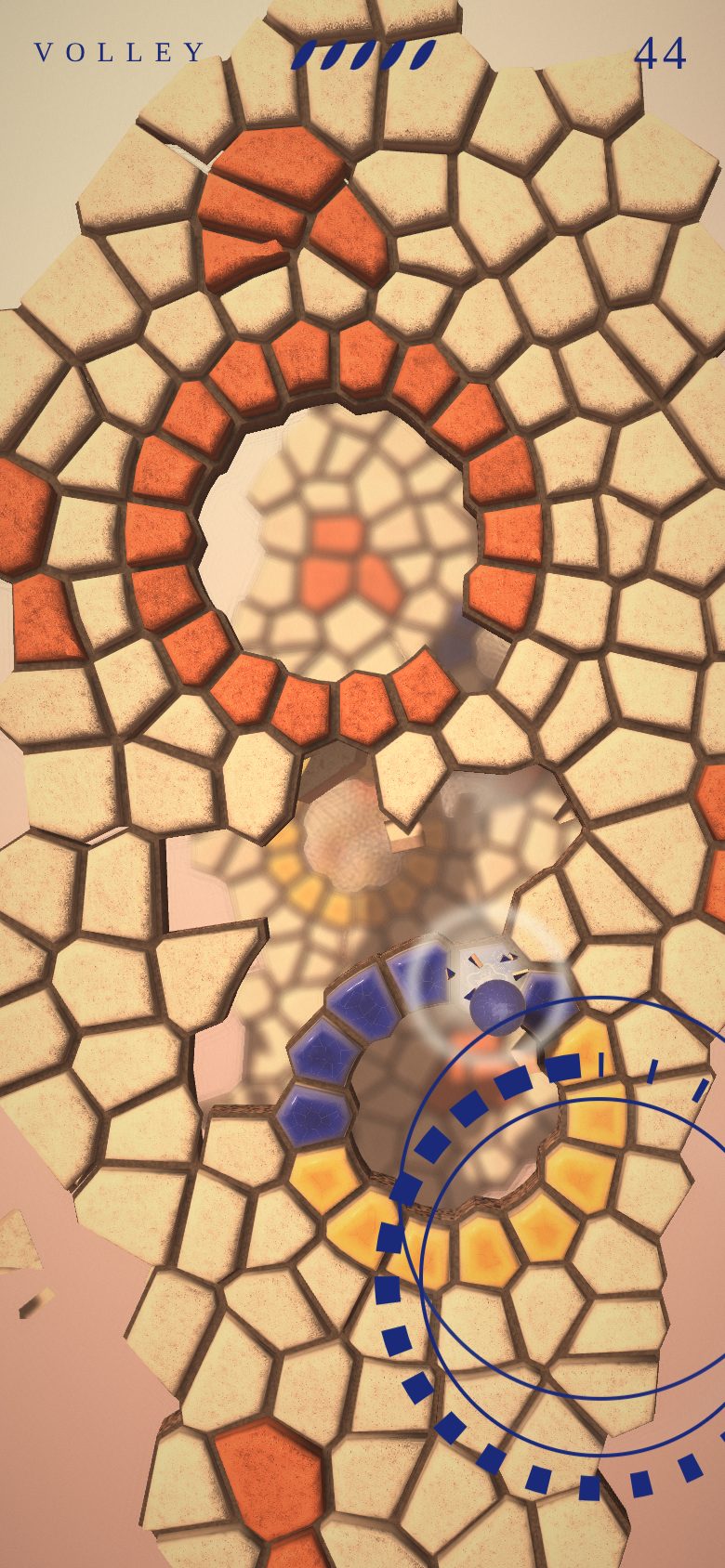
Touch the pane to pick the ball up, and let go to throw it: a flick is a hard throw that way, a plain lift is a toss straight up. The ring that closes on the pane is where the ball is going to come through.
The rules
Chosen before the first throw (and kept in the address as rules=):
- Five lives (
lives): a ball let through is one of five gone; each firing reached gives one back. When they're gone, it's how far you got; and you can go again from the last firing reached, at its door, as Switchback puts a fall back at its last checkpoint (a run gone on from a firing isn't kept as a best). - Firings, against the clock (
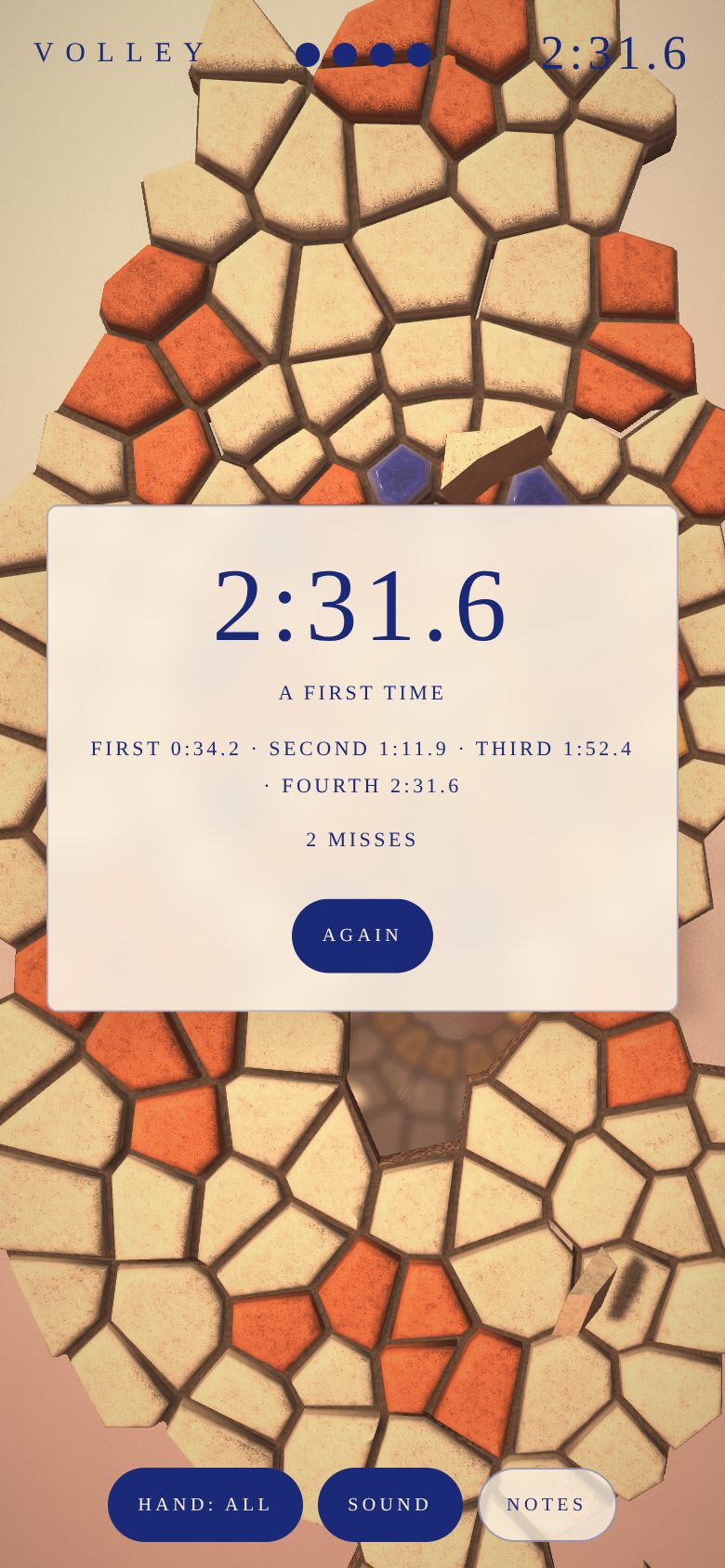
run): four firings, no lives. A ball let through costs two seconds and is put back in your hand; the clock runs from the first throw to the last sheet of the fourth firing giving way. Each firing finished is a split, shown against your best as you pass it; the end is a card with the time, the splits and the misses. Bests are kept by seed and hand, in this browser. - Free (
free): nothing counted, nothing lost; a way to look.
Sheets and tiles
A sheet is one fired thing, not a wall of parts. It is a Voronoi figure: a scatter of sites, each site's nearest ground a tile, so every tile is a flat-sided, convex piece that fits its neighbours, and the ball meets it as the solid it is. The figure is drawn by where the sites go:
- Rings. Sites set evenly round a circle make a ring of tiles, each a straight-sided segment of it.
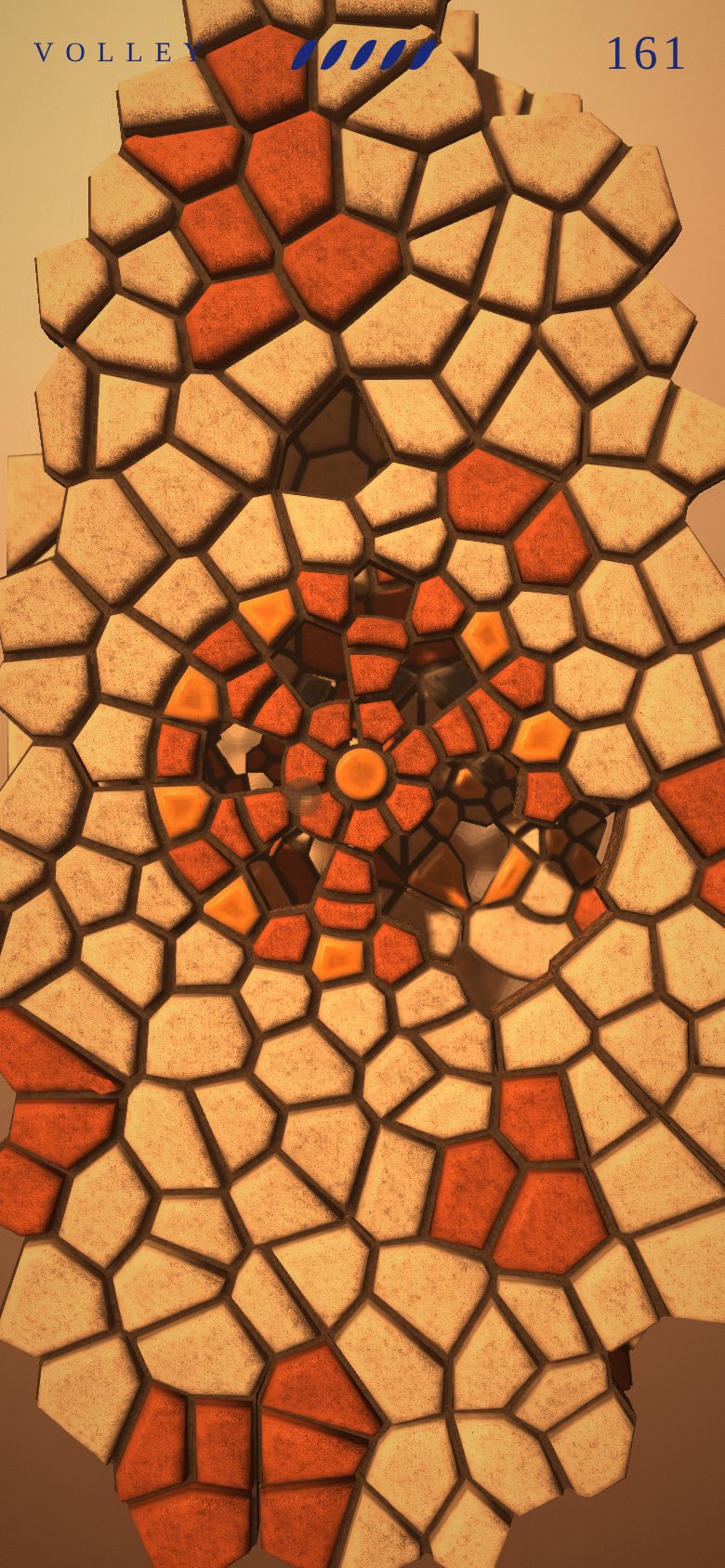
- A rosette: a hub, a band of glaze round it, petals (a ring of sites on the petals' axes and one between, as many rows and petals as keep the tiles about square), a rim, and a collar of body to close it. Open, the petals are holes between spokes; closed, they're tiles with holes between.
- A fan: half a rosette, standing on a line; fans in a row are a frieze.
- A ringed hole: a ring of sites left out inside a ring of glazed tiles.
- The body round the motifs: a jittered grid of sites, broken into irregular tiles like any fired thing, with patches of the other clay.
Sites left out still divide the ground. Each tile's edges that run round a motif's centre are bent to the arc round it, so a ring of tiles is a ring and a ringed hole is round; the same edge seen from the tile on its other side bends the same way. Past the sides of the way the sheet runs on as a frame the ball can't reach, far enough that the nearest sheet fills the screen; its outer edge, ragged, only shows on the sheets further off.
How a tile is made. A sheet is a slab of clay with tiles set in it. Each tile is its outline moved in by the grout's half-width: a face, tilted a little off the sheet's plane so no two catch the light alike; its rim rounded over in a quarter-round, the light running round it; its sides down into the grout. Under it, its bed: the same outline unmoved, meeting its neighbours' as the grout's dark floor, and running back as the slab, whose crumbling walls show in the holes and wherever a tile has gone.
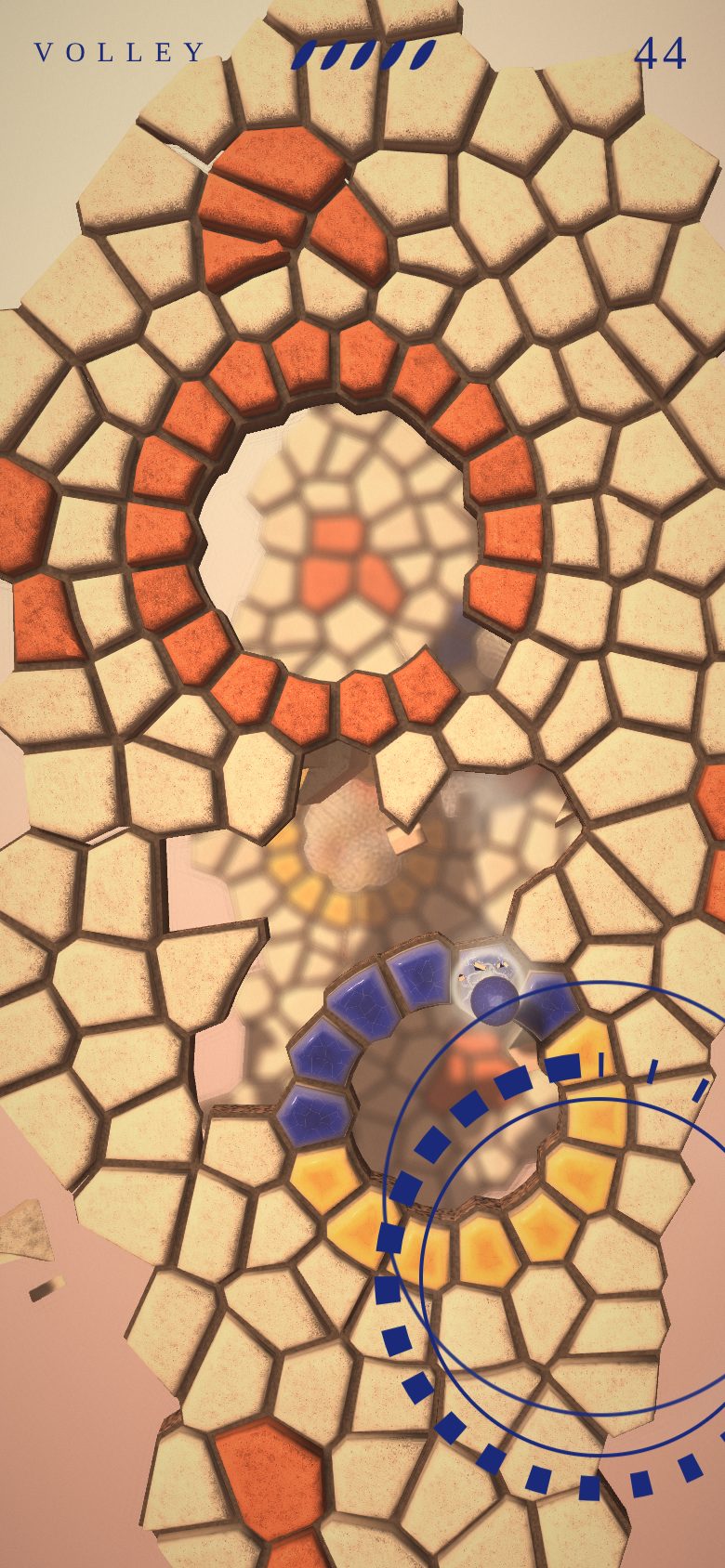
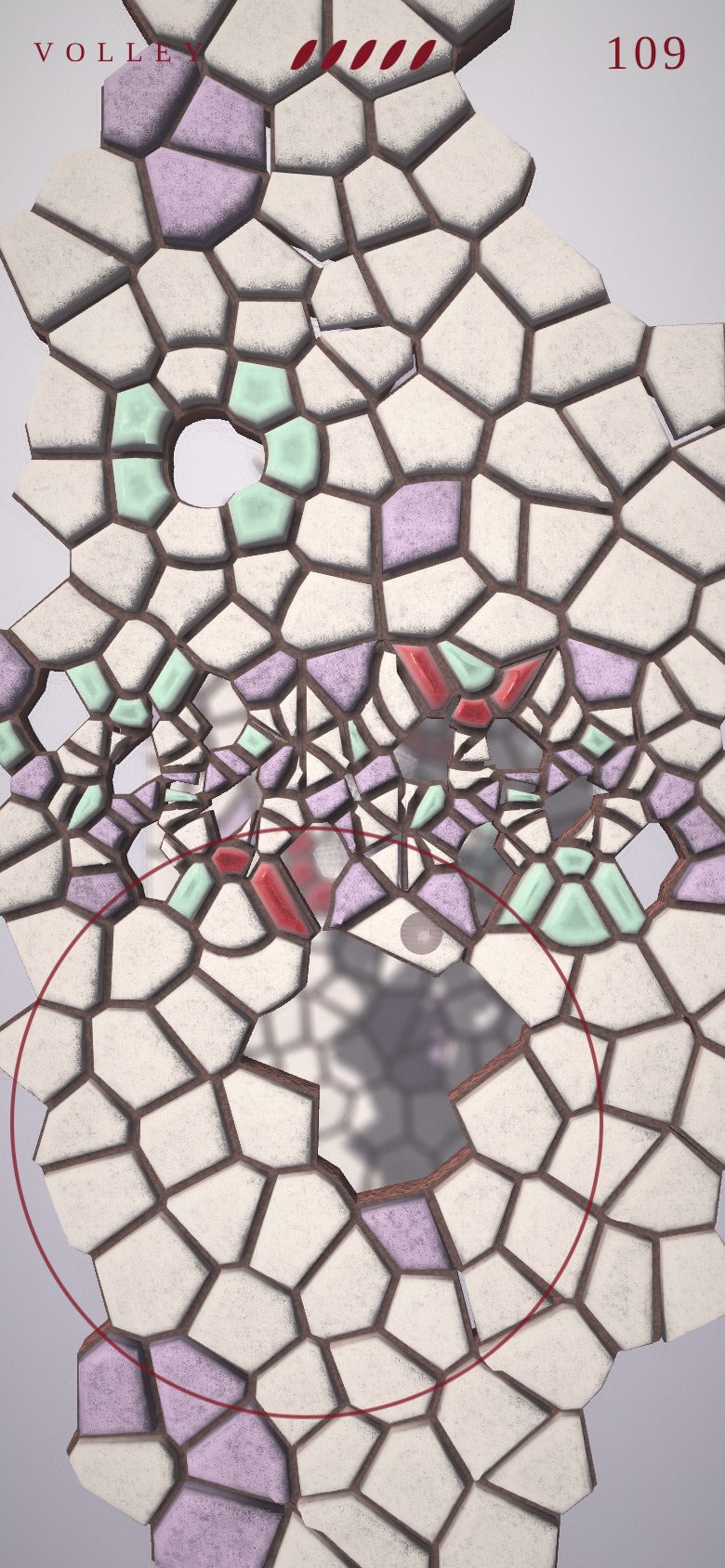
What each tile is made of: the body, another clay, a soft glaze (glossy, breaks like the body), or a hard glaze (takes two blows, crazes at the first, and always turns the ball). Glaze goes in bands: round hubs, along rims, round holes; the hard one more often the further in.
- Struck, a tile breaks, and the ball comes off it and falls.
- Struck hard and square, it bursts and the ball goes on through, a fifth slower, and the tiles round the place go with it: the harder the throw, the bigger the hole, and one good throw can go through two sheets.
- Three fifths of a sheet broken (or twelve tiles, if that's fewer) and the rest gives way, outward from where it was last struck.
Blows
Every blow shows where it landed: a flash, the tiles round it jolted (a ripple runs out through them, pushed back and sprung forward), and the ball squashed against what it met (it squashes off the sides and off your hand too, as hard as it was pushed, and springs back). A hard glazed tile struck and not broken spalls chips of glaze toward you, and keeps the mark: knocked in a little and tilted away from where it was struck, a crater down to the clay there, a ring crack round it and cracks running out across the glaze. One more blow and it goes.
Firings
Three so far, in turn from the seed: lapis (cream body, terracotta, a soft ochre glaze, a hard lapis one, a warm peach air), celadon (porcelain and lilac, celadon, oxblood the hard glaze, a pale grey air) and tenmoku (bisque and terracotta, amber, the black hard glaze, a deep amber air). The ball is glazed in the firing's own, and the page's ink and the hand's ring take its colour. They came from four imagined pictures of the game, each answering static/volley-brief.md (which describes the game with no picture in it).
The ball
- It falls back. Thrown up, it slows all the way; if it meets nothing it stops, hangs, and comes down again as fast as it left. Nothing else brings it back.
- The nearest sheet is eight away. The pane comes to rest that far short of the nearest sheet still standing: about the height a plain toss reaches, and far enough that a ball coming straight back off it takes around six tenths of a second to reach you (it was under a fifth, nearer).
- How hard is how high. How fast your finger is going is how hard the ball goes, and so how far up it gets.
- It comes down harder off a tile: the nearer the sheet, the quicker and sharper the volley.
- It can come down on top of the sheet it went through, and break its way back.
- It spins. The sideways motion of your finger leaves the ball spinning that way, and the spin bends its flight for about a second, or until a bounce takes most of it off.
- The four sides of the screen are sides: it comes off them, keeping nine tenths.
One hand
What a finger is to the ball is decided at the moment the ball lands on it, by two things: whether the finger is moving, and how long ago it touched down.
| as the ball lands, the finger is | it is | and the ball |
|---|---|---|
| still, and only just down (under a third of a second) | a catch | stops under the finger and stays there; thrown when you let go, the way and as hard as the finger is then moving |
| still, and long down | a pad | springs back by where on the pad it landed (off the middle, straight up; off the rim, sharply away), about as hard as it came |
| moving, and only just down | a swipe at it | leaves the way the finger was going, as hard as it was going; the most the ball can be turned |
| moving, and long down | a bat being moved | leaves partly the finger's way and partly by where it landed: turned less than half as much as by a swipe at it |
A finger left on the pane is a bat, and will keep the ball up on its own. Sliding it to get under the ball turns the return into a hit. Lifting off and coming down late is a catch, which is the one that needs timing, and buys you the time to look and throw.
The ring under your finger shows which of these it would be right now: round it, an arc of dashes grows (small at first, bigger as it goes) as the touch settles, from nothing (a catch) to all the way round (a bat); a moving finger's ring is dashed and wider (a hit). A mouse with no button down is a long-held finger; pressing is touching down.
hand (shown when the ball isn't in play) steps through the one hand and each of the three alone (pad, swipe, catch), for comparing; each keeps its own best.
Reading it
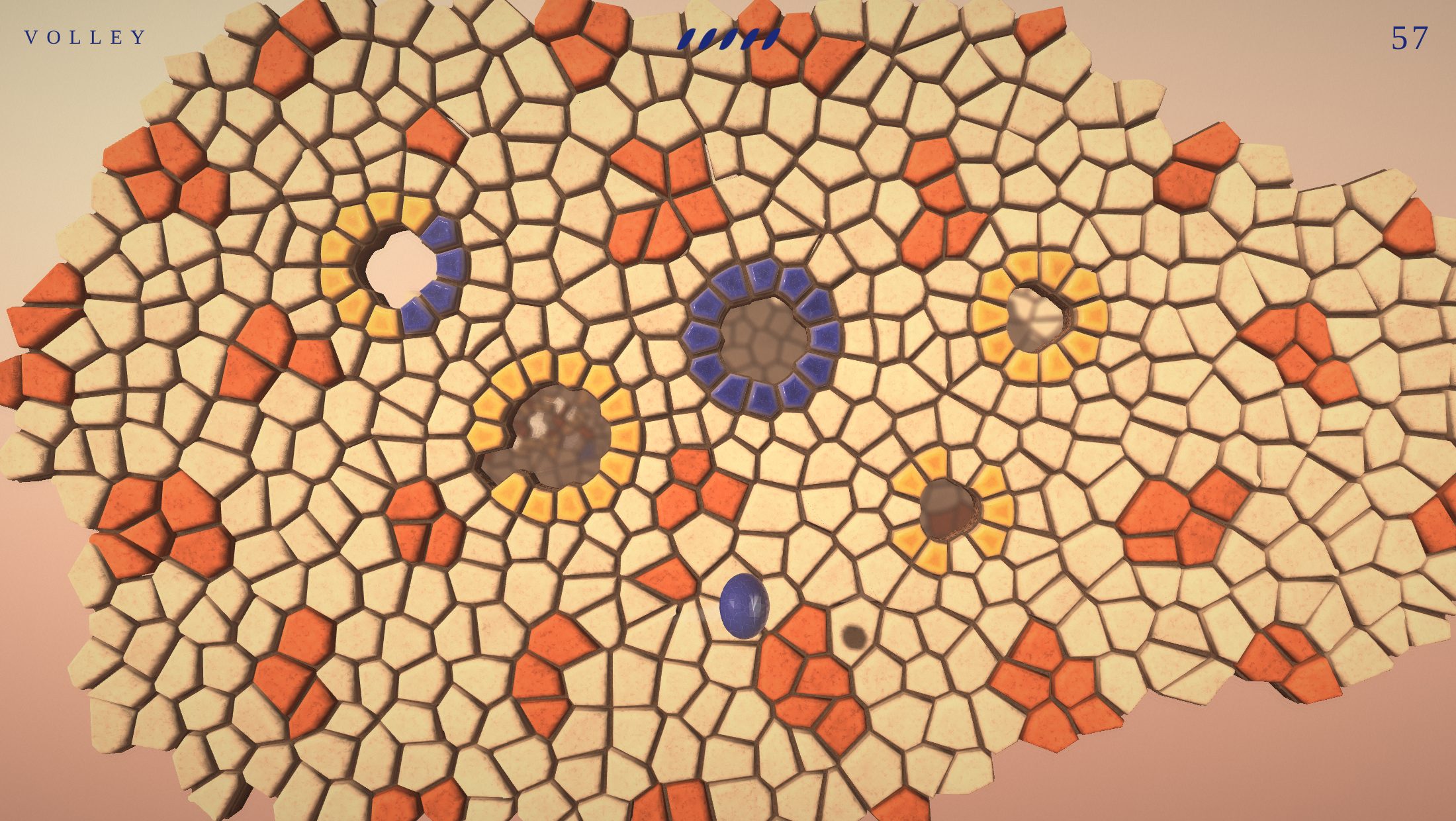
- Shadows. One low, warm light from behind your shoulder, and it casts: each sheet's holes fall on the sheet behind, and so does the ball. The gap between the ball and its shadow is its height off that sheet.
- Focus. The nearest sheet still standing is sharp, and everything nearer; what's beyond it goes out of focus the further beyond it is, so the sheet you're working on stands out from the ones to come.
- Haze. Everything further is paler, into the sky's own colour, so sheets sort themselves by depth.
- The ring on the pane, from a second and a third before the ball comes through. It knows the whole flight: the fall, the sides, the spin, and the tiles in the way, by the game's own rule, so it knows as soon as the ball leaves your hand whether it will come back off the sheet or burst through it (and from behind it, whether it will break back through toward you), and where it will come down either way; even whether the sheet will give way under it.
guide=0takes it away. - Sound. Fired clay, placed left and right and quieter with distance: a crack for a break, a lower burst for a ball going through, a ring for glaze, a rumble when a sheet goes.
- Never hidden. Behind a sheet the ball is drawn faintly through it.
How it is made
client/volley/sheet.tsmakes the sheets: the motifs as sites, the Voronoi figure of them, each tile's outline and what it's made of.client/volley/sim.tsis the game and nothing else: a falling, spinning sphere against convex prisms and four sides, in fixed steps of 1/240 s, everything random from the seed; the rules, the clock and the checkpoints. Hands are given to it as points on the pane with a velocity and an age. It also holds the stand-in player. Tested on its own indevtools/volley.test.mjs.client/volley/draw.tsdraws it. A tile is its face, its rim rounded in three steps with smooth normals, its sides, and its bed (the grout's floor and the slab's wall); a piece in the air is a sharp prism (it's broken); the ball is faceted. A sheet's mesh is made again when a tile of it changes; the sheets beyond the nearest two, out of focus anyway, are made plainer (square rims). What a face is made of is worked out where it's drawn: the body sugary and porous, specked, pitted, its grains glinting; a glaze pooled on the face and thinning to the body over the rounded rim, orange-peeled so its highlights break up, crazed, with the sky's gradient and a broad and a hard reflection of the light in it; the grout dark; the slab's walls crumbling clay; a struck tile's crater and cracks from where it was struck (each tile's vertices carry that point). The ripple of the latest blows and the ball's squash are done where the vertices are placed. A shadow map from the one light; haze into a sky gradient; a shoulder on the brightness alone, so the hues hold. It's drawn antialiased to a texture, then through the lens: a 24-tap gather in a disc, each tap counted only if its own blur reaches that far, so what's sharp in front never smears onto what's blurred behind. No assets, no libraries.client/volley/main.tsis the fingers, the blows (their flashes, their ripples, the chips they spall, the ball's squash), the pieces in the air (a struck tile chips into a few, a burst one into many, a fallen sheet's mostly in chips), the ball's wake, the dust, the sound and the words.static/volley-brief.mddescribes the game with no picture in it, for anyone who wants to imagine it differently. This look began from four such imaginings.
node cells/lab/devtools/volley-hit.mjs stages a blow that doesn't break and shoots it just after and a second later.
Flags
seed (a number, or a name like moss-ford-7), rules (lives, run, free), hand (all, or pad, swipe, catch alone), auto (the stand-in plays), t (run on this many seconds first, the stand-in playing), still (and hold there), guide=0, mute, preview (the index's card). window.__volley.probe() reports the game and the renderer.
Before this
Six earlier versions are in the repository's history: a court seen from behind a dragged paddle; a tunnel of block slabs with three separate hands and an arcade ball; the same with a ball that fell down the screen; the same with the fall turned toward you and the hands made one; the first sheets, plaster in irregular shards, without motifs, firings or rules; and the first fired sheets, their tiles flat-faced with chamfered rims, loose, the sky between them.