Bamboo · 竹径
A run through a wild moso bamboo grove on an endless mountainside, drawn as a lit picture with ink on it: held close to the eye, giving out to the page.
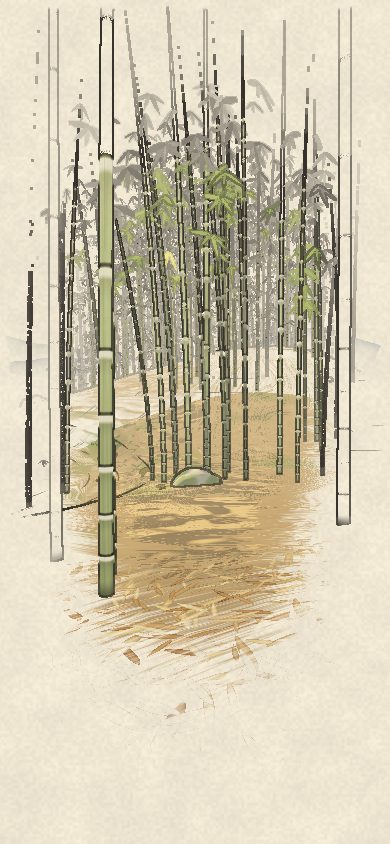
Running
- Hold anywhere and you run: a fast lope of about 7 m/s, gathering speed in a second or so. Let go and you ease to a stop.
- Drag left and right to turn, up and down to look: directly, a screen's width (portrait) about half a turn, so a sharp turn is one swipe. Arrow keys work too.
- Two fingers zoom: pinch wider to look closer (up to 4×), on the point between your fingers (it stays under them as you zoom); move both fingers together to pan; the focus goes to what you're zoomed on. Let go and it eases back out to where you're looking. While you pinch you neither run nor turn.
- Rolls come as they do: after a hard landing (impact over 5 m/s) with way on (over 3 m/s) and room to go on into (no culm in the way for 1.8 m, the footing near level or falling away downhill);
rolls=1forces one on every landing with pace, to watch them. Off an edge at pace onto open ground the run will choose an ambitious leap, pushed out harder and higher and landing further out where there's room to roll, when it lands as cleanly as the plainer one, so the big leaps and their rolls come where the land invites them. A roll is seen as a tumble: the view turns over forward once in the roll's 0.8 s, the eye low, coming back right way up (tumble=0for the dip it was: the eye sinking and the view tipping down). - A touch that starts by dragging is a look, not a run: moved 12 px within its first 150 ms, you stand where you are and turn and look round (at a rim, say, without stepping off it); hold the finger still there (within 6 px for 350 ms) and the look becomes a run, the way you're now facing. A touch that starts still runs.
- You own where you're going; the run owns the footwork. Your heading is only ever what you turn: nothing in the run turns it for you, not a trail, a rim or a face. The body may go a little off your line and comes back to it; gaze goes where the next foot's going. A few times a second the run looks for a way along your heading, in this order:
- a move straight through: a leap across a cleft, down onto a ledge below (a bound reaches further the faster you're going, up to nearly four metres, and down a couple), a hop up, a chain of crowns;
- else the clearest way within a narrow corridor round your line (a little over half a radian each side), each way costing more the further it's off: no culm in its path for nine metres (a stand seen coming and gone round, not met), no face to climb, no drop too far to take;
- else you're at the limit: you brace and stop there, still facing where you meant, and it's for you to turn. (Left to itself,
autoturns toward the more open side the way a person would.) It weaves you between the stands. The grove has its own runs, winding lanes where it's thinner (the ways a deer would take), and the run finds them. It would rather go over a stone than round it.
- It sees what's coming and commits to a move, a second or two ahead, takeoff to landing (
runner.ts):- a root or a small stone is skipped. The steps before it shorten to meet it, and you keep your pace.
- a broad low stone: you gather and hop up onto its crown.
- from a crown, you leap to a foothold on the next if one's in reach: a stone's crown, or a top of the rock. Footholds are found among patches on each crown (its middle and round it, each with room to stand). Each is rated by how far it turns you, how near an easy bound it is, how much room it gives, how much it asks to rise or brake, and how well it sets up what comes after it. So a route goes across and up and down, not only straight on. The candidates are one list of contacts (the pads and crowns round, and level spots with room found along your way and a little either side), and each landing is also judged by what it gives: how far it runs on along the way and how wide it is. The best few are then tried for clearance: the body's flight, as an arc, at the shins and at the chest, must not pass through the rock (a lip in the way, or an overhang over it), as well as no culm. The flight checked is the one the takeoff will really throw (its time from your pace, raised to clear what it must), and its feet must also stay above any stone or top along the way (unless it's a hop up onto something higher, which springs up first and over the lip, so only the faces judge it). The same flight check refuses a planned hop or leap (not a climb, which goes up the face on purpose) and a chained next leg re-read on landing.
- The approach is part of the move. The landing is read when the move is chosen, often a second or more before the takeoff. As you come, the eye goes toward it: down to it, and a little to the side if it's a leap to the side. Over the last two strides your steps adjust and your pace eases toward what the jump wants: slowing for a short high one, pressing on for a long one. Then the move's own last foot is planted, short of the takeoff by as far as you're carried over it. The body loads onto that foot and turns on it, through its stance, as deep and as long as the jump asks: a skip's barely, a long rising leap's deep. The takeoff is that same foot's release, when its stance is done; no foot of its own.
- A chained landing is a real support: the landing foot bears the weight and turns it toward the next, and the next leap is its release. You really slow on it, more for a turn, so the stride and the view go by what you're doing, not a pace you've left behind. The push takes the speed back up. Running straight on, it's a crisp touch; turning, or rising, it's a longer, deeper load. A crown's falling side isn't skimmed over: past where you were aiming and a hand's breadth over it, a foot reaches down onto it.
- off an edge, you step down or leap. That depends on your speed and where you'd come down: the clearest, flattest landing.
- What a contact does is what you asked of it, not how hard you came down: going on along your line, a crown is a bound (a brief touch, the pace carried); turned toward another way, a redirect (the foot takes the weight, the body's turned onto the new way only as far as the foot's borne it, held over the foot, the incoming speed absorbed and pushed out the new way); let go, a settle (you come down on it and stop there, braked as hard as stopping within what's under you asks). A flight under way always carries on and keeps to the surface it was aimed at (steering in the air bends it only as far as it still comes down there); the next launch is yours to decline: let go and no move not yet sprung is taken.
- The place shapes the pace. A move onto a small surface with nothing after it is a precision landing: the approach brakes to what its flight carries, and its landing isn't taken further to suit your speed. Only a bound on (something after it, or room) carries the pace through. Whether a surface is cramped is by the room it gives (how far it runs on level along your way, how wide), on rock as on earth. Two footholds on one rock are taken only across a step in it, never down a slope you'd run.
- A chain stays yours. The next of a chain is read again from where you really came down (its way from there, still in reach, still clear); turned off your line in the air, or while the landing foot still bears you, it's let go and looked for again. Steering in the air bends the flight by as much as you've turned since you left the ground, no more (a chain's zig off your line isn't pulled back to it), and the landing it'll come to is foreseen again as you steer. A move whose own way is clear is taken even if what comes after it isn't (that's looked for again from where it lands). A foot loaded standing still still springs when its stance is done.
- Moves ahead are provisional. Turn off a move's way (by a third of a radian) before its last foot's planted and it's dropped and looked for again along where you're going now. Once planted, the foot and the flight are committed.
- In the air you can still lean the flight toward where you're going now, a little (up to 0.3 rad a flight), so a turn shows at once and the landing's met already turning.
- A chain run straight carries its speed; only turning on a crown brakes you, as much as it turns you.
- Uphill. A strong runner drives up a hillside: the grade takes half a lope off at most (a 0.5 grade a quarter), and a steep hillside is climbed, not walked round; only land steeper than about 50° counts as a face.
- Going as you come to it. At pace you leave an edge a stride or so back from the lip (0.2 m + 0.12 m per m/s, up to 1.2 m, as far back as the top runs level, never so close it's passed before the takeoff), not stepped off at the last moment; a climb takes a longer run-up (0.8 m + 0.15 m per m/s from the face), and goes up from a stand too (to 4.6 m), so you're never stuck at the foot of a wall you could get up. A hop or climb rises as high as its lip needs and no higher (its time from that rise), and one that passes over its landing still above it takes a hand to the lip and comes down on the top, not over it.
- Momentum on the rock. Across the tops of rock the hill's grade below doesn't slow you, and you drive off each foot (the pace comes back quickly between bounds). A move's approach never brakes you: it presses on toward your lope, gathering pace into the move (only a precise one, onto a small surface with nothing after it, brakes to what its flight carries). A bound pushed off a contact in a chain gives back pace too, up to a metre a second a push, so a line of bounds gathers speed rather than only spending it. A hop's takeoff comes earlier the faster you're going (up to about two metres back), a hop or leap with more pace than its flight carries lands further along the same top (uneven as rock is: a hand's height either way, not steep, is still the same top), and a drop taken faster goes further. The faster you go, the longer the bound that's easy (about three metres at six metres a second): short fussy ones at pace are avoided. A running hop reaches higher than a standing one (most of two metres at a lope).
- What to land on is looked for, along the way you're going and a little either side, not only the pads set out on each block; and an edge nothing was planned for is bounded across to the foothold beyond if there is one, else stepped off carrying your speed.
- A face higher than a step is never something you're lifted onto: you meet it and stop, braced, unless you're going at it with a move. Stopped, you still look for a way (a hop up out of a pocket). A crack is only stepped over where there's a top as high on its far side.
- Up what a body shouldn't get up: a face beyond a hop, to about four and a half metres, with a top to come out on, is climbed at a run: up it, a foot kicked off the stone, and over its top.
- Off the edge, never down it: at a rim you don't stop and lower yourself; a drop to a dozen metres is leapt, out from the face with your pace (at least five metres a second), onto the flattest clear landing it reaches, and a hard landing with way on and room ahead (on rock or earth) goes into a roll. Only with nowhere to come down is the edge a limit.
- What's underfoot and what's in the way are what's drawn (
footing.ts). You stand on a stone's own top, the same lump the renderer draws, turned and scaled as it is. The culms are taken as they really go: leaning, or now and then a young one bowed right over by snow, its arc reaching across a trail. You duck under one passing at head height. You step over one at your shins. You go round, or squeeze past, one at your hips. Through a gap narrower than your shoulders you turn them and lean through. A culm close by brushes you aside with a rustle. - Landings are felt by how hard you come down: your speed into the surface across its slope, how fast you're going, and what's ahead.
- An ordinary landing gives at the knees and comes back.
- A heavy one sinks, pitches you forward and costs speed, then a few short steps.
- Onto a stone, or into a tight place, you brace and stagger.
- Hard and fast onto a clear run down, you go down into a low roll, the horizon held, and come up running.
- Every step is a foot set down (
runner.tsContact). It has a place a little ahead and to its side, the height and slope there, what it's on, how long it bears the weight and how hard it's met. Each is met in its own way:- a plain plant, or soft earth;
- a step up onto something higher;
- a check, braking downhill or slowing;
- a quick touch on a stone;
- the push before a takeoff;
- a landing. Every landing is a foot set down too, starting its stance as a step's does. The feet carry the body. It sinks onto each foot as hard as it's met, is pushed up off it (more for a step up), and falls toward the next. Its height goes from foot to foot. Down, it drops onto the next foot at once; up, it waits for it, takes the weight where it was and drives up over that foot's stance. A higher footing just ahead gets a foot put up onto it, so a raised stone lifts you by the step onto it, not before. The weight shifts over the foot that's bearing it. The eye shows all this rather than a set rhythm, and the gaze stays steady.
- In the air the stride's rise and fall is gone, but not the speed: the view stays as wide as your pace through the air. The landing is a foot set down, the hardest, and the stride starts again from it.
- The ground sets the pace: uphill slows you, downhill quickens you.
- It feels its speed: the view widens the faster you go, on the ground or through the air; you lean into a turn.
- The sound comes with your first touch. Your footfalls are the same contacts, heard as they're met:
- soft earth is a low knock and the litter shifting;
- a step up is firm, with a scuff held as the weight goes up onto it;
- a check is a heavier attack and a short scrape;
- a quick stone touch is dry, gone at once;
- the push before a takeoff is firm, with a scuff as it leaves;
- stone on a stair or boulder is crisp, and a root a knock. Over these you hear a landing's thud (heavier the harder) with its footing's sound over it, a rustle as you brush a culm, the air past your ears rising with your speed, and the wind in the leaves when a gust comes through.
The chase
chase=fox, chase=runner or chase=stir: something crosses your way, a little ahead. Stay with it as long as you can. Catching it isn't promised. A runner or a stir comes and goes; a fox never does: there's one, in the grove from the start, behind you and off to a side, and it stays in your world all the while.
- A fox (
presence.ts): one trunk, fuller at the shoulder, with the deep chest under its front and a white bib at the throat. A narrow snout and tall dark-backed ears. Long legs, dark below (the fore with the elbow behind; the hind with the thigh's mass, the stifle forward, the hock behind). A thick brush nearly as long as its body, white at the tip, that swings after it. Its coat is painted as a brush lays it (render.ts): strokes along each part the way its fur lies, a darker one down the back, a pale one catching the light, and at its edge the strokes break off dry, so its outline is fur rather than a shell. It walks, trots (diagonal pairs) and gallops (the hind pair, then the fore) by its speed. Each foot is set down on the ground under it (the slope, a stone's top, a root), drawn back while it bears weight, then lifted and swung forward. Over what it can't step (a rise, a stone, a culm bowed low across its way, an edge) it bounds, in the sheet's phases (targets/07-fox.jpg): it gathers (the hind feet coming right under, the hips sinking), springs from there into a flight it's committed to (forelegs tucked, hind legs streaming back, the body tilted with its rise), reaches its forefeet down for the contact (nose down, rear high), and absorbs it through the shoulders, a landing you can hear. When it stops to listen, it looks back over its shoulder, and turns its body if you're further round than its neck goes; its ears prick and its brush hangs. On the ground it never rises or falls more steeply than it steps; where there's no way it can take, it stops and turns, never slipping through.- It's wary of you by what it can tell of you. It sees you coming (the more the faster you come, the nearer, the less there is between you) and hears you (your running, your landings). It goes from a trot to a run to flight. Once it has got away (or climbed a stone, calm enough to look) it stops to listen and looks back. Quiet a long while somewhere open, it lies up, and if you come slowly it lets you come close; run at it and it's gone. So staying with it is restraint as much as speed: near enough to read it, far enough not to drive it off.
- It never leaves you. Calm, it keeps you in its world: from far off it comes back, arcing in from the side, never straight at you; round you it keeps on round at a distance (fifteen to twenty-odd metres), at a walk, stopping on heights to watch you; too near and it edges off. Out of each other's sight a while (lying up somewhere you can't see it, too) it gets restless and comes in closer until it has you in view again. So losing it isn't an end, only a state: the chase goes on, and it ends only when it lets you come right up to it, and starts again when it gets up and goes. Sent somewhere far off by an address, it's quietly somewhere behind you, out of sight, never set down in front of you.
- A runner: someone with their own way to go, along the trails, at about your pace, legs and arms as a runner's go. They don't wait for you. Now and then they pause to check the way, and a kilometre or so on they reach where they were going and stop there.
- A stir: nothing to see. The grove moves where it passes high in the canopy: the stems bend away and the leaves hiss.
Where it has passed, the grove keeps moving a moment: the culms it brushed, the canopy it went through, still swaying and settling. You can follow it by that even with the sound off. Its footfalls are louder on stone, and its landings thud.
Contact has some give (chase.ts), and it's what you can actually perceive:
- seen: some of its body in view and readable. It's not behind the land, a stone or the culms between you; it's big enough on the screen to make out; and the drawing still describes it there (its colour or its ink reaches that far, as the renderer judges it);
- traced: hidden, but you can follow its route. You heard it (only with the sound on, and less through a gust or over your own running), or you saw the grove move where it passed, in view and not behind anything. You believe it's where the last of these came from, carried on the way you've seen it going, never the way it's really going unseen;
- searching: the cues have stopped, and the last of them is fading. There's still time to find it again;
- lost: you no longer have a credible direction. While it's still near, see it or hear it again and the chase is on again.
The end comes once it's well away (or long gone), or when it has let you come up to it. You slow, the grove settles, and a quiet line says so ("the fox has gone", "the fox let you come close"); no score. A while later, something else crosses your way.
With auto, the run chases it by itself, steering only by what it has perceived. pose=walk|trot|gallop|gather|bound|contact|absorb|listen|lie with still holds the body just ahead, side on (posed= metres away), to see how it's made. node cells/lab/devtools/bamboo-fox.mjs puts the sheet's six (trot, gather, bound, contact, absorb, listen) above the same six held in the grove, in devtools/bamboo/gates/fox.jpg. node cells/lab/devtools/bamboo-chase.mjs [seeds] runs situations on land laid by hand:
- a fox behind a boulder isn't seen, and stepping out it is;
- heard behind you, it's traced, while with the sound off it goes to searching and then lost;
- coming fast in the open alarms it, coming slowly or behind a rock keeps it calmer, and stopping calms it;
- lying up, it lets you walk up to it but not run;
- across a row of stones it bounds and lands, with no pops in height.
It then runs chases on the mountain against a pursuer that knows only what it has perceived, checking every presence's movement is honest over every second and every step.
What you meet
Mostly the grove. But now and then:
- a trail: a sparse network of them crosses the mountain, each worn the way feet would rather go: routed over the land so it keeps to the contour and bends where the hill does, taking a slope on only where it must. Roots cross it here and there, from the bank side, half in the earth. Giants stand right at its edge; below it, where the hill falls away, the grove thins, so the way looks out over the valley, its far ranges blue in the mist. Its cut bank is bare red-brown earth, roots run across it and stones stand in it, ferns along its top. The trails run on from one stretch of the mountain into the next and meet here and there. A trail along your line draws the body a little toward it, and running along one is a little quicker; it never turns you. Each is cut into the slope as a bench, the bank rising on its uphill side.
- a flight of steps: where a trail climbs steeply (a cliff band, mostly), it's a flight of stones laid by hand, each its own width and a little off line and askew, boulders left standing beside it here and there as it was cut through them; where a flight turns, it turns round a great boulder on the inside of its bend. Your stride shortens to the treads.
- a cliff band: here and there the rock breaks through and the land steps up five to nine metres along a winding rim. A rock face you can't climb stops you at its foot, facing it, unless a trail's stair takes you up; it's for you to turn along it. Off its top, a drop of up to three metres you step or leap down, and land as hard as it was. A bigger one stops you at the rim, with the valley beyond, unless there's a ledge to come down on, or a top across a cleft to leap to.
- a gust: every so often one comes through the grove, and you see the tops bend over before it reaches you.
In three minutes of running the run covers about a kilometre at a mean of 4.4 to 5.7 m/s (the mountain's steep), on a trail for a few per cent of it (node cells/lab/devtools/bamboo-run.mjs [seconds] [seed] checks that it never runs through a culm, never stalls for long, and keeps up its pace, and counts its moves and landings). It runs in fixed steps of 1/120 s, so the pace and the landings are the same however fast the frames come. node cells/lab/devtools/bamboo-crown.mjs takes one crown three ways, the same approach each time and only your input different: still going straight on (a running bound: a brief touch, the pace carried through), turned in the air toward a crown off to the side (a redirect: the foot takes the weight, the turn goes with the stance, the speed absorbed and pushed out on the new way onto that crown), and let go in the air (a settle: down on the crown and stopped there, no launch after). node cells/lab/devtools/bamboo-ridge.mjs runs the cliff tops a playtest found janky (seed 1, near -710, -414, straight on without turning, for 15 s): it must keep a mean above 4.5 m/s, never stall, and bound at least four times in its first four seconds. node cells/lab/devtools/bamboo-flow.mjs [seeds] audits what the rock offers a runner: round ten crests per seed it grids the footing at 0.2 m into tops (level surfaces clear of the ground, joined across steps a runner runs over), runnable ones (a stance 0.8 m across fits), slivers (none fits), links (a bound between two runnable tops) and lines (three tops linked keeping about one way). Today about 86% of the tops' area is runnable and there are about 14 lines per window; the slivers left are mostly strips along the lip between a column's tiers and along tops' edges. The rock's carving leaves every shelf, shoulder and joint step a stance deep (0.8 m) or not at all, and a climb goes only onto a top that deep (never up a fin to sail off its far side), clearing the lip it lands over rather than the highest tier behind it. node cells/lab/devtools/bamboo-course.mjs runs it straight at things laid by hand: a root and a stone, a broad boulder, a chain of stones, three drops (a moderate one, a big one onto open ground, a big one into culms), a bowed culm, a narrow gap, terraces stepping up and a diagonal chain of offset stones. It checks that each one changes the body, as the list above says, and that your way is still yours at the end. It checks the feet too:
- every move's landing is read a quarter second or more before its takeoff;
- the last plant loads as deep as the move asks (a skip's shallow, a hop's or leap's deeper);
- a chained landing is a real, short support before the next push;
- every landing starts a stance;
- every takeoff but a drop is the release of the foot planted for it, after it's loaded (one push foot per move, never one of its own at the takeoff);
- up a step the body rises with the foot set on it, not before;
- terraces are met as steps up;
- on open ground the body rises and falls over each foot.
It prints, for each course, how early each landing was read, each load against its demand, each support, the body's travel and the efforts its feet were met with.
The mountain
Long steep-sided ridges and the valleys between (half the hillside steeper than one in three), endless (where a rim or a rock face bars the way ahead, you're held there till you turn): built where you are and a little way round, 32 m at a time, as you run, and let go behind you. The same seed is the same mountain wherever you go.
The rock
Where the rock breaks through, it's built as rock (rock.ts), not drawn onto a slope.
The geology is one field across the mountain, varying smoothly (never by cells):
- a bedding plane: its tilt, its spacing, where its planes fall;
- a grain: the yaw of its joints.
Every block takes its up from the bedding and its tier heights from the planes that cross it. So bedding runs on from one mass to the next, offset a little where a column has slumped. A fallen fragment is a piece of the tier it came from, with the same proportions and bedding, toppled.
An escarpment stands where a cliff band breaks through.
- Columns stand on anchors along the rim. An anchor is chosen the same way whichever chunk asks: a rim point is kept if it outranks every other within 2.6 m. So a chunk's edge doesn't crowd or gap them.
- Coverage: each column reaches halfway to its neighbours, so together they cover the band.
- Neighbours: each pair decides between them, so both sides agree:
- most meet;
- some leave a cleft, with a floor ramping up to a block set at its back;
- some are one mass across both, with no joint between their tops.
- Tiers: a few meaningful breaks through the whole height of a formation, as many as its height carries (one to three), each at the bedding plane nearest an aim at deliberately unequal heights, never just the lowest planes found (which left the upper part one tall slab). The lower stand out as ledges, a middle one is now and then set back under the lip above, and crests are broken.
- The ground is cut only where the rock stands (under a block, down to the foot) or in a cleft's floor. Elsewhere the land keeps its own rise, so nothing's cut that isn't covered. A trail's stair still cuts through between columns.
Out on the slope there are two kinds:
- a rooted outcrop: a big slab tipped back into the hill (fractured as the escarpment's tiers are, by a joint, a bed or a wedge gone, once or twice by its height: never one bare box standing over you), its neighbours along the same joints, a wedge broken off below, fragments;
- running crowns: low flat tops stepping along the contour, a way a fox could take.
A block is a prism stood on its bedding over its own outline: a rectangle with some of its corners broken off, so four to eight sides, its faces cut obliquely where a corner went. Its top is drawn in and dropped toward the faces it's broken to, so it's a top in facets, not one plane. It's chamfered round its top edge (the worn edge). Its faces are flat, each lit as one plane: a face's normal is the face's own (a quad's, from its diagonals), never its triangles', so a face whose corners are nudged off one plane doesn't light as two facets. A tier is fractured, not stacked. Each tier's mass is split by recursion along what rock breaks on (carve()):
- a joint across it, one side often set back and its top worn down, and a joint that ends partway down (the lower part left whole);
- a bedding plane, the part below jutting out as a shelf or tucked in under the one above;
- a wedge gone from its front corner, its size kept: the block fallen at the foot is that missing wedge.
Some faces are left whole, so the breaks read against them. The crest breaks into shoulders and steps, not one blade.
Into the drawing, feature by feature. The rock doesn't fade along one line across the frame. The paper is the stone's own bare face, so each part of it gives way in its own manner and at its own place:
- a face in the sun goes to the open paper first, with an edge of its own running along the block's bedding (its own layers), not a soft fog or a round blot;
- a side turned away keeps its wash (its light, past its colour) and a few strokes across it;
- the foot, where a block meets the ground, holds its colour longest, with its contact stroke;
- a crest or a lip carries on as a fine contour past the colour;
- a deep joint, where one mass meets another, contracts into a weighted, broken stroke that lasts;
- the culms' shadows across a lit face linger pale on the paper after its colour's gone;
- here and there a lit patch is left far out on its own, so there's no single frontier.
Where the land's own cut is rock, it breaks the same way, in patches, never in level bars.
Which lines are drawn is decided by the structure, never by chance; chance only varies how each is laid (its breaks, length, weight). A crest or lip, a foot and a deep joint are always drawn. A top's side is drawn where the mass ends against nothing (its silhouette) or steps up or down more than 0.45 m from the one beside it, never between two level tops. A block's front corner is drawn only where the mass turns against the air. The hatching on a side turned from the sun is only on a side plane seen edge-on (a recess's side, a flank), never ruled across a broad face. The ground's cut follows its own outline, and its ink is its own edges, each known for what it is: crest, side, joint, foot. Nothing grows under rock, and a cleft's floor is scree, not moss.
Everything agrees on the same faces:
- Footing (
footing.ts) stands on the blocks' own upward faces. A crack between two blocks narrower than a foot is stepped over. - Pads: each block offers footholds, with the block, the slope and the room round each. The run plans its leaps across them, with the stones' crowns.
- Sight asks the rock's faces (
rockBetween), so what's under an overhang or across a cleft is seen past as it is. - Light: the land's light is baked with the rock's tops, so the columns shade the foot and close a cleft's sky.
- Drawing: each block asks one place (its anchor) how far it's drawn, so it's drawn whole, never triangle by triangle.
- Colour:
- a broad face says its plane and little else: a quiet grey varying slowly over it in the face's own frame, and a fine grain. Nothing between: no medium bumps, no cellular chips, and no height standing in for shade. Its seams are the geometry's own (a tier's joint, a cleft, a recess, a shoulder), never painted on;
- its colour is by what the stone is: a fallen piece a paler, fresh break; the back of a cleft damp and dark; water stains running down the steep faces from the ledges; the worn edges lighter;
- moss grows in patches where a top holds it (more on a ledge, in a cleft), sometimes spilling down a damp run, never on a worn edge;
- its ink in colour is its underside only; its edges are drawn as strokes. In clay there's no relief at all on the rock, so clay is a clean check of the forms.
- Ink (
strokes.ts) comes from the blocks' own edges, and where rock stands the land's slope-made cliff marks give way to these:- a column's crest, firmest (most of a block's other edges are left quiet: a few side edges and joints, where the drawing wants them);
- a ledge's lip;
- the top's sides, lighter;
- the joints, up from the ground;
- its contact with the soil.
The checks: node cells/lab/devtools/bamboo-rock.mjs [seed] [chunks] checks that every system agrees:
- shapes are all different;
- anchors are the same whichever chunk asks;
- nothing is cut that isn't covered;
- every cleft has its floor and back;
- tops offer pads with their block;
- a line through a column is stopped and one over it isn't;
- the rock's edges are inked.
Under it, the run leaps a cleft to the top across it, won't drop onto a ledge it couldn't leave, turns right round at a dead end, and if held a while lowers itself down a face. ?clay&grove=0 shows the forms alone.
The grove
- Culms: moso, thick and pale, in stands, as a grove grows from its runners: clumps of a few to a dozen or more, with open floor between them, each stand of an age (young and pale, or old and dull), stoutest toward its middle. Now and then one old giant stands beside a trail, the one the eye goes to. Each culm has its own girth and height (the stoutest are the tallest) and its own lean, downhill toward the light and out over a way beside it. Its internodes lengthen up the culm. Young culms are pale celadon with fresh white powder under each node; old ones are duller and olive, patched with lichen. Below a way, on the side where the slope falls away, the grove is sparser, so the walk looks out between them.
- Sprays: the leaves come in sprays of three to five blades (个 and 介) along the upper part of every culm, so the ceiling is high. Small sprays at shin and knee height are scattered through the grove, thicker along a trail's edges.
- The floor is composed as a few grounds in broad patches, not one carpet of equal leaves, so the next few metres read at once and the leaves reward a closer look where they've gathered:
- compressed: a trail's trodden bed, pale earth matted with a few flattened leaves; the way is the lightest thing on the floor;
- settled: most of the floor, old litter matted down into one quiet mid tone;
- loose: drifts of fallen leaves, warm and lit, each its own, where they've been caught: against the foot of a block or a stone (its uphill side most), in the ground's hollows (both baked with the land as
gather), swept to a trail's sides, and in broad patches; - humus: the dark damp earth showing, in patches and where it's steep. Only a loose leaf stands out to the eye, carries relief, and gets its edge inked, and the ink goes to clusters rather than to every leaf. Where the colour gives out, the litter still breaks into single leaves on the paper, not a smear. Leaves lie on a stair's treads too.
- Stones: boulders fallen under the cliffs and at the foot of a trail's bank, mossy on top.
- Rock: a cliff's face is grey stone streaked down its fall, inked with broken strokes down it.
- Wind: every culm sways a little on its own. Every so often a gust comes down the slope: you see the tops bend over upslope before it reaches you, then the sprays stream.
How it's drawn
Three passes, after Labyrinth's, and the land's own strokes laid in the world:
- The shadows: the culms, their leaves, the boulders and the steps near you, seen from the sun (or the moon), so their shadows stripe and fleck the litter, the steps and each other. The canopy's shade is the leaves' own. The sun is low and warm, so the shadows run long, and shafts of light come through when you run toward it.
- The picture: each surface lit in its own colour.
- Culms: olive-celadon, dry-brushed down their length, darker just under each node, a band of white powder there.
- Sprays: dark ink-green in shade, glowing gold-green with the sun behind them.
- Litter: a carpet of fallen leaves.
- Stone: worn, warm. Beside the colour, each surface hands on its own marks, the ink it calls for:
- a culm's node ticks, darkest at its edges as the eye sees them, dry-brush strokes down its shaded side, and ink pooled at its foot;
- a spray's blade edges, its blades filled in ink where the colour's given out;
- each near fallen leaf's edge;
- a trail's edges;
- the strokes down a rock face;
- a crack across a step.
- The land's strokes (
strokes.ts): marks the mountain's features call for, laid as ribbons on it, so each stays where it is as you run and the mountain still reads when its colour's gone: a trail's edges, broken, firmer where the bank's cut deep; a rim along the top of a bank's cut and hachures down it in small groups; a flight's strings along its sides and a stone's front edge now and then; a cliff's rim and strokes down its face; a few contours along the hillside and short strokes down the fall where it's steep enough to show; where a stone meets the ground. Each is turned to the eye, held to a least width on the screen by its kind (a rim most), lighter with distance, and left out whole by its pick where the drawing thins, never faded. A rim holds over the colour; a contour's only for the paper. - The page: the outlines, found where the depth jumps or one thing meets another, inked on the side that's in front; a culm's breaks just under each node, as a brush lifts there. They lighten with distance, so a far culm is a fine grey line.
The grove
Moso is a running bamboo: its culms come up one by one along rhizomes under the floor, so a stand is a few crooked lines of them, a culm every half metre to two, now and then two close together, the parent stoutest and its offspring along the run less so, with open floor between the runs. Young shoots of the last year or two stand thin and short among the rest (with the papery sheaths they grew in still on their low nodes); a culm's height goes with its girth; now and then a giant stands beside a trail. Most stand near straight, some lean, a few lean hard, mostly down the hill or out into a gap, and a stand leans a little together; every culm's top bows over under its leaves, the leaners most. Its branches come off the nodes of its crown side to side, rising and arching out, the lower ones longer and flatter, and its leaves hang in bunches along their outer half and at their ends, with a tuft at the tip. Each blade is its own: its angle off the twig, its length, curl and droop, and its turn along its length, so one shows its face to the light and the next its edge. Only some blades get an ink edge, and only on one side. Close to, a node is two rings (the sheath's scar, the branch ridge above it) with the pale powder band under it, a dark scar where a branch was below the crown, fine lines down the culm, moss and soil at its foot.
The light
The sun's light is real where it can be: the culms', stones' and steps' shadows from a shadow map near you; the land's own shadows (a cliff, a ridge, a bank shading the slope under it) and how much of the sky each point of the ground sees (its hollows, the foot of a bank) baked with each piece of the land as it's laid, by marching toward the sun and round the horizon over its heights, and darker again where it meets a stone, a step or a culm's foot. The shade under the canopy is real too. The leaves cast it: each spray's blades go into the same shadow map as the culms, the steps and the boulders, so near you the light on the floor is the true shadow of what hangs overhead, moving as the leaves move. Beyond the map's reach, each piece of land knows how much leaf is over each metre of its ground (from where its sprays really hang). There, the light is broken into flecks only as much as that cover closes, and the sky's light under a closed stand is dimmer than in a clearing. Each material has its own relief, drawn in the shader as a height in its own lie (its normal tipped by how the height changes across the screen, so it needs no maps or tangents) with the dark of its creases: the litter's leaves as thin blades lying one on another with the soil dark in the gaps; a bank's clods with cracks between and grooves down it where the rain runs; rock's bedding, ledge over ledge, each undercut dark, and its fractures; a stone's pitting and a crack or two; a step's tooling; a culm's node ridge, the groove above it and the fine grooves down it; a leaf's midrib. Every rise is spread over a few pixels wherever it's seen from, and the finest fade first, so nothing flickers. No fine relief tips a surface more than about 35°: a jump in a height across a pixel isn't a cliff, and its slope would be a dark dash. The bare floor is never flat either: a broad swell, lumps of earth, pebbles proud of it and, down a trail, the ruts feet have worn; and a boulder has broad weathered facets and chips as well as its pits. Its height darkens its own hollows and lifts its crowns, in the sun and in the shade alike, so it reads under the canopy too. Each describes one surface. The litter's colour, relief and creases share one measure of how much it covers, so a trail's worn middle is bare earth to the light as well as to the eye. A boulder's crack is a single field in the stone's own body: the ink draws it, the light finds it as a crease, and its dark gathers there. Each feature fades by the footprint of its own coordinates, so a steep face loses its detail as soon as the level does. relief (with the light, 0–8, 3 by default) sets how strong it all is.
The layers
How it's drawn is a stack of layers laid from the paper up, after Labyrinth's print, each with its own dials, and none moving another (client/bamboo/layers.ts):
- page: where every layer is measured from. Each thing asks one measure, how far out it is: from the focus (where you're going and looking: the ground the eye's line meets past the culms crossing it, kept between 7 and 30 m, moved to slowly) across the frame, 1 at every edge (top and bottom as much as the sides: it's measured near-square), and in depth (
depth: sooner for things far beyond the focus, a little for things much nearer); or in the world, 1 atdistancemetres; whichever is further. The land is asked as a column: a point of the ground (or a stone, a step, a stroke on it) is as far out as the least of it and the air 3 and 8 m above it, where what stands on it is seen. So the ground is never gone from under a culm that's still drawn.held(0–1) holds the bottom of the frame: at 0 the page comes in from every edge alike; higher, the ground at your feet stays, and the page comes in from the sides and the top, as a painting keeps its foreground.towardpulls every layer in toward the paper at once, by the same factor (each reach times 1 −toward), so it never lets one layer outrun another. For ink that runs on past the colour, leavetowardat 0 and set the reaches apart: colour short, light a little further, ink out to the frame. - air: the time of day and the weather (
client/bamboo/sky.ts).hour(0–24) sets where the sun is: up at six, highest at noon (57°), down at eighteen, crossing from the east of the slope to the west. At eight it lights the grove exactly as the house always has. The sun goes white at noon, warm in the morning, and gold and low near the horizon; the sky goes rose at dusk and indigo at night.- By night the full moon, opposite the sun, takes over, cool and dim. The eye adjusts, so a night is dim but not black. The sheet takes a dark wash, heavier toward its top, with its torn edge left bare. The moon is left as bare paper with a soft ring of light, seen between the culms.
- The land's own shadows are baked again whenever the light moves, the nearest pieces first.
mist(0–1, 0.5 by default) sets how thick the far haze and the valley's mist are. Both take the hour's colour: warm paper by day, peach at dusk, blue-grey at night.
- under: how much of the drawing (marks, outlines, the land's strokes) lies beneath the colour; on bare paper it's always all of it.
- colour: each kind its own strength (
culms,leaves,terrain), and itscolourreach. Past it, a thing gives way to the paper. - light: factored out of what the sun and sky give, so each part can be laid again at its own strength:
shade(a surface's turn from the sun),cast(the culms' shadows and the canopy's dapple),hollow(the sky shut out),landlight(how much of them the land keeps), andlightreach. Past the colour, the light lies on the paper itself, in sepia. - ink:
lines(things' own marks: node ticks, a spray's blades, a leaf's edge),strokes(the land's: trail edges, rims, hachures, contours),edges(the outlines found from depth and kind),inkreach, andinkfade: how it ends, thinning (fewer things inked, each by its own pick) or fading (all of them paler). And its hand:open(how open its contours are: a stone's weight at its underside and contact, a step's at its front, the counter-side of a culm and the land's own silhouettes left to the paper),swell(the firm lines heavier, the slight ones hairlines) andgrain(lines broken granular, tone as stippled clusters). - focus: one measure of how far out of focus a thing is, as a lens has it: nearer than the focus it goes out fast, beyond it toward 1 far off.
aperturesets how strong it is.near blursets how much the nearer side takes of it: at 1 a lens's, at 0 sharp from you to the focus with only the far softening, so a culm beside you can stay the boldest thing in the frame.far blur(0 to 4, 1 the lens's) spreads the far side's softening as much again, so a far bank can go to a soft wash while the focus stays sharp; each pixel's samples are turned their own way, so even a wide blur is a soft grain, never rings. Each layer reads it its own way:softenblurs the colour and light (never the ink),near wetturns a close culm or spray into a dark wash, andfar dryleaves the far ink paler and broken.
A reach is a multiple of that measure, on a log scale from ×0.25 to ×4: under 1 leaves every edge of the frame to the paper; over 1 lets that layer run out to the frame. No mark ever comes or goes at once: each thing has its own amount of ink, never switched on or off. It's laid as a brush lays it, its length first, then its weight: a culm drawn up from its foot, a land stroke out from its middle (a broken line as one line with breaks in it, all its runs sharing one pick), a blade out from its stem, a stone from its middle to its sides. As the ink thins, things go out over their own short stretches of the reach, so there are fewer of them; as it fades, all of them go paler too. An outline where two kinds meet takes the stronger side's weight, so it never breaks into dots. The paper isn't a mask feathered over the picture: a culm, a spray, a stone, a stroke is left out whole, by its own pick, only where none of its layers reach it, and what's gone hides nothing behind it. Along a culm, an internode at a time, its colour gives way, then its light, then its ink; the ground goes leaf by fallen leaf, its edge dragged dry across the slope as a brush leaves it, and is never left out: past its layers it's the paper.
The house setting draws with the brush's hand (open and swell up) over the land's light as a pale wash. The path has its own marks (strokes.ts): broken tread lines where feet have gone, and what lies on it, twigs and fallen leaves as small curved commas, thicker toward its edges. Beside the route now and then stands a giant culm, stouter than the rest, the drawing's anchor: never a secondary stroke, its shaded side firm.
The 墨 button (bottom right) opens the palette: a slot for each layer, the one touched open with its sliders (a mark where the house setting has it; double-tap a name to put it back), and under page, the starts: house (the default), picture (every layer whole, out to the frame), drawing (no colour; the light on the paper; the ink), ink (the ink alone, out to the frame), page (all of it taken to the paper). Four more draw the same ink with different hands, at a reach that carries the grove: contour, brush, litho and wash (the brush's lines over pale washes of the land's light). The address keeps every dial that differs from the house, so a setting can be passed on.
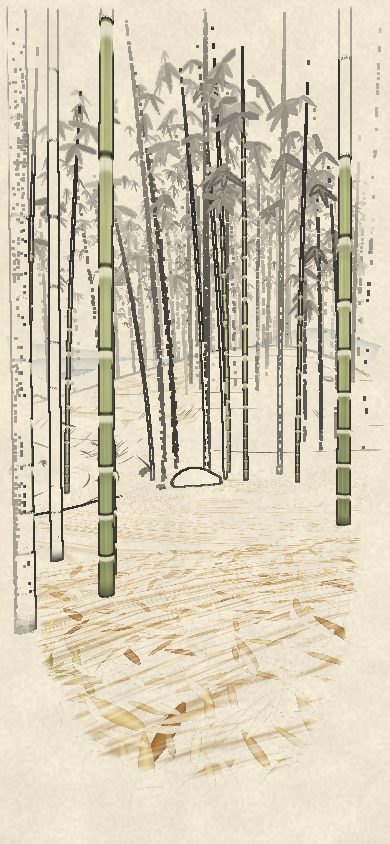
Judged against the board
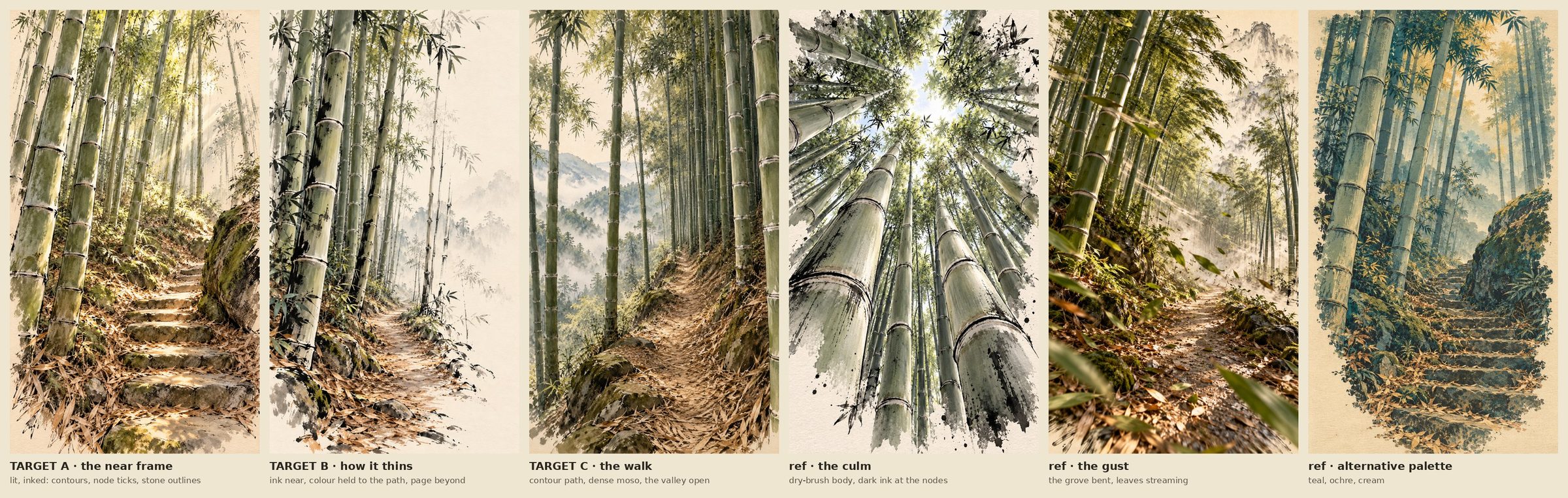
The look was found by image generation first (devtools/bamboo/explore.md: three rounds of prompts and what each taught). The reference frames are found on the mountain by what they need (?ref=a, the foot of a stair; ?ref=b, a trail with a fall beside it; ?ref=c, in the grove off the trails; ?ref=cliff, a rim; ?ref=run, mid-stride), and node cells/lab/devtools/bamboo-fidelity.mjs draws a, b and c and puts each beside its target. The views are made with node cells/lab/views.mjs bamboo.
The gates
The look is now hill-climbed against five target studies (devtools/bamboo/targets/, and gates.md there for what each is judged by: the contour run, culm scale, ink reach, the stair, a gust), in gates: 0, geometry and composition in plain colour with no marks; 1, the drawing alone, which must still carry the route and the bank; 2, the board as it's shown; 3, motion and finish. node cells/lab/devtools/bamboo-gates.mjs [gate…] draws each target beside its pinned scene (?cam=, never found afresh) three ways: picture, ink only, board.
Addresses
seed=<n>: the mountain.ref=a|b|c|cliff|run|up|gust: a frame found on the mountain by what it needs;cam=x,z,heading,pitch[,speed]: one pinned exactly.at=x,z,heading,pitchandt: start just there, at that time, and run on. The address keeps it up to date: when you come to rest, finish looking round, change a dial or leave the page (never while you run), it's rewritten with where you stand and what's set, so a link opens on just what you saw.look=house|picture|drawing|ink|page|dusk|night, and any dial by its own name (colourreach=0.3,cast=1.6,inkfade=1…): the layers (above).shadows=0: no culm shadows (cheaper).auto: run on by itself, wandering.debug=plan: the run's own working drawn into the scene (debug.ts; ribbons in the world, turned to the eye, still seen faint and hatched where something stands in front): on the ground ahead, your heading (blue), the body's way (orange) and the eye (green); what it sees along your heading (white where it runs on, amber a step, red a face); the plan (a ring at its takeoff, its flight as read, a post and a cross where it lands; pink if chained, its next fainter); in the air, the flight foreseen at takeoff against the one flown (teal); the last footfalls as small discs coloured by effort; and a line of text at the foot of the page (act, pace, held / stopped / at a limit, the plan, the stance left, how far the body's off your line).t=<seconds>andstill: time held.fov=<degrees>.clean: without the shafts and the paper's grain.marks=0: the picture without its ink.brush=sweep: a trial from the Splats lab: each culm laid as a brush lays one, a pull an internode on the side away from the sun, in place of its dry brush and its firm contour (see The sweep on a bamboo culm in the Splats notes). Without it nothing changes.strokes=all: every stroke the land has, at full weight, none left out (to see what's laid).clay: every surface one clay, its light kept (the sun on it, the culms' cast shadows, the sky), no paper, no ink: the forms alone.grove=0: the land alone, no bamboo (the gates' hard test: does the mountain and its path still read?).mute: no sound.