17 October: pattern table and outfits
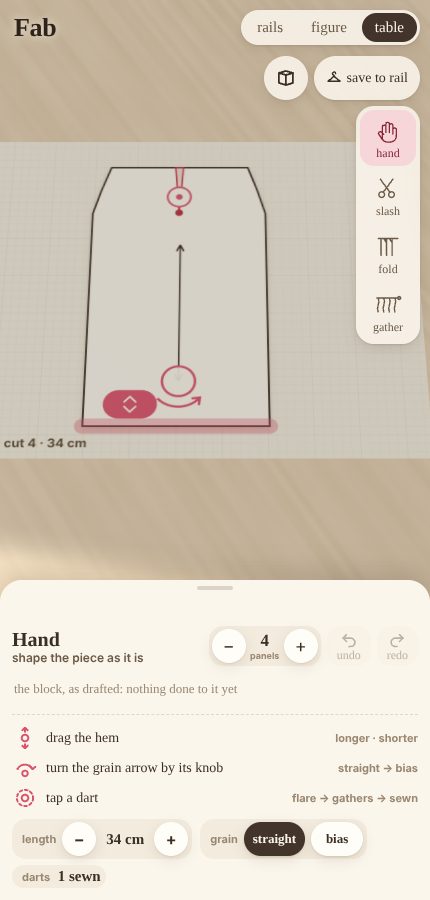
Construction now lives on the table: tap a piece on the paper to pick it (a tap on the paper round it, the whole pattern again), and drag its lit edges. The drawer speaks as it always did for the skirt's paper: what's picked and what it is in its header, with undo and redo; then, expanded, each edge it offers and what dragging it does, what each is set to, and its own choices (a neck, a collar, its sleeves; a sleeve's head; a skirt's tiers) as words to tap. A skirt panel tapped is the skirt's paper, with its cut, fold and gather tools. A versioned journal in recipe.journal records construction and material deltas with semantic targets, undo and redo; legacy recipe.moves remains the skirt compiler input. This is replayable parameter editing, not yet an arbitrary cut grammar for bodices or trousers.
At the rails, with something already on the figure, the card asks whether to put the next one on instead or as well. With more than one on, a tap on a garment on the figure is the one worked; the drawer lists what's worn, and takes the one in hand off. Outfits and operation histories persist locally, including reloads of the active design URL. Saving to a rail remains explicit. Ordered inter-garment contacts keep outer vertices off nearby inner surfaces; this is discrete contact, not continuous collision detection, and does not guarantee every possible outfit is intersection-free.
Cloth changes: 16 substeps, interleaved stretch/bending/seam constraints, mass-weighted tethers, velocity-aware body collision checks, and velocity-preserving warm starts matched by piece name. Print and colour edits no longer rebuild cloth. Large topology changes still resew.
Validation against the preceding build: pattern and garment checks pass; all 27 workshop garments still sew up; the stricter soundness count improves from 12/27 to 14/27. Maximum Cusick drape discrepancy falls from 0.27 to 0.15, still above the 0.10 acceptance target. Physics is improved, not declared settled. These are numerical harness results, not an iPhone performance or visual approval. Multiple garments increase simulation and contact cost.
Regression sources: devtools/fab-operations.test.ts, devtools/fab-ui.test.cjs, devtools/fab-evidence.ts. The UI harness uses jsdom with mocked canvas/WebGL; it checks interaction/state transitions and actual local-storage reload, not rendering quality.
Fab
A dressmaking workbench for children. A little wooden figure stands on a turned stand, mounted on a chromed pole up into its pelvis, and beside it lies a garment's paper pattern: a skirt, a top, a dress, trousers or a jumpsuit. Nothing is chosen from a list. A child decides what a dressmaker decides, the pattern that follows is drafted to the figure, and the cut cloth is sewn up round it and falls as that cloth falls.
The aim is for a child to find out that clothes are made, and can be reasoned about, constructed and transformed.
This page sets out what Fab claims, how it's built, and the evidence for and against it. The evidence comes from the evidence bench (?bench=evidence), which runs the same tests in the page as it does headless.
One garment family, deep, then five
The first Fab tried to dress the figure in a skirt, a top and a cape, each with the same six dials. The skirt worked. The top's sleeves never sat properly. Its pieces weren't real pattern pieces:
- the bodice had no armhole cut into it;
- each sleeve head was about 30% bigger than its armhole;
so no simulation could have made a garment of them. And dials like silhouette and drape claimed to set what should only ever be found.
So Fab went deep into one family first: the skirt. It's the simplest thing that's truly made: flat pieces cut, joined round a body and hung from one line, the waist. Nearly every move a dressmaker has shows in it:
- extend (length);
- flare (cut a panel as a sector);
- split (more panels);
- gather, pleat;
- dart, and shape a seam (to take in the waist);
- cut on the grain or the bias;
- join (side seams, waistband).
With the skirt sound, the same grammar now makes four more families. It follows GarmentCode (Korosteleva & Sorkine-Hornung 2023): a garment is components drafted to the body's measurements and sewn edge to edge by length. The first Fab's failures are now checks every pattern has to pass:
- Tops: a bodice whose armholes are cut, five necklines, sleeves whose heads are solved to their armholes, and three collars.
- Dresses: a bodice sewn to any skirt at the waist.
- Trousers: four panels with a crotch curve solved to the figure.
- Jumpsuits: a bodice sewn to trousers.
- Tiers on any skirt or dress.
The skirt's made by hand, on its paper, at the cutting table. The others are decided at the figure, in its drawer, with choices and dials. Moves on their paper are next (see Known limitations).
The cutting table: a grammar of moves
A skirt is a waistband and n panels round it, each sewn to the next, every panel cut the same. A panel isn't chosen from a family of shapes. It's the dressmaker's straight skirt block, drafted to the figure, plus the moves made on its paper, in order (cut.ts).
The block
Straight down from the hips. Its side seams curve in toward the waist as far as a seam can (2 cm). Darts take in the rest, as many as it needs, none deeper than 3 cm. Fewer panels means fewer seams, so more darts: a straight skirt in one piece needs darts all round.
The moves
| move | what a cutter does | gesture on the paper |
|---|---|---|
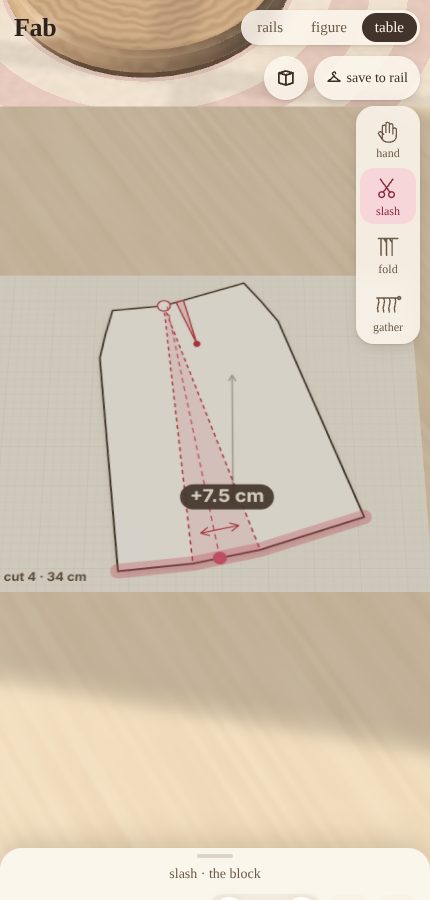
| spread | slash from the hem up to the waist, leaving a hinge, and open the hem | slash: touch the hem, drag sideways |
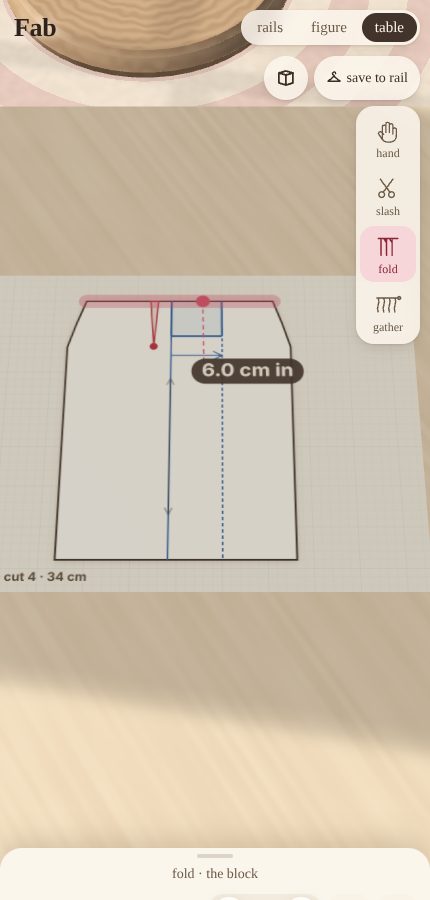
| pleat | slash down from the waist, spread it parallel, fold the new cloth into a knife pleat, stitched 5 cm down | fold: touch the waist, drag sideways |
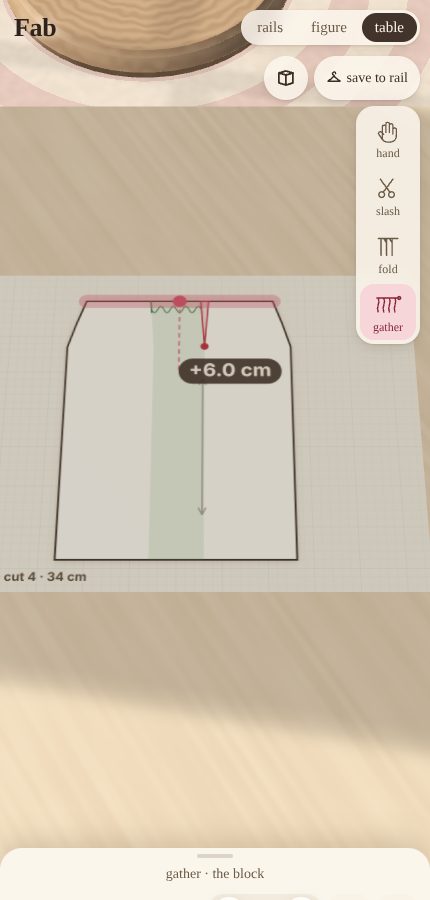
| gather | slash and spread parallel, and ease the new width into the band where it was added | gather: touch the waist, drag sideways |
| close a dart | pivot the cloth beside it about its point until its legs meet: the waist's taken in the same, the hem below opens | hand: tap the dart |
| release a dart | don't sew it; gather its width into the band instead | hand: tap it again (a third tap sews it again) |
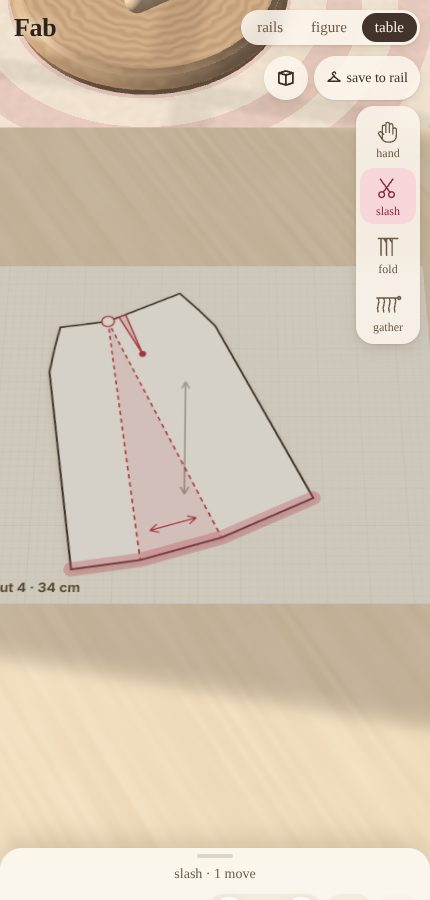
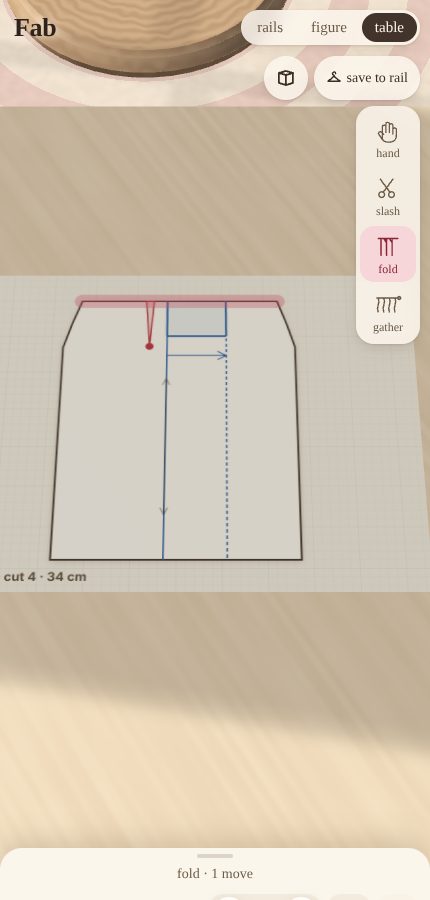
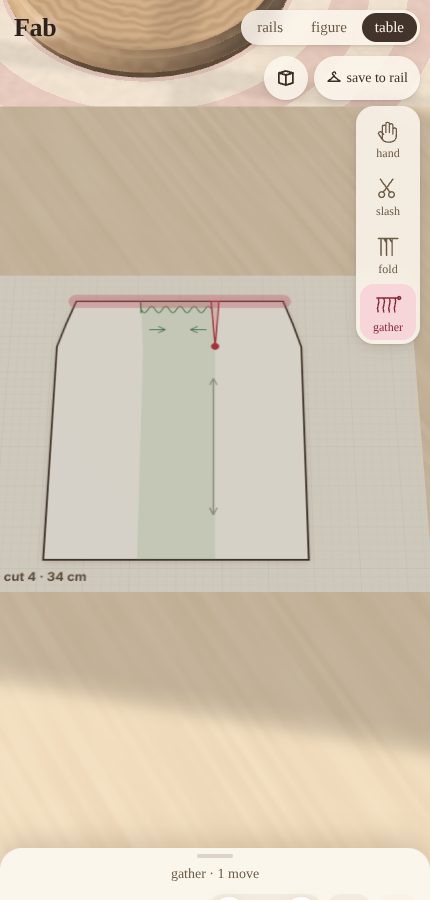
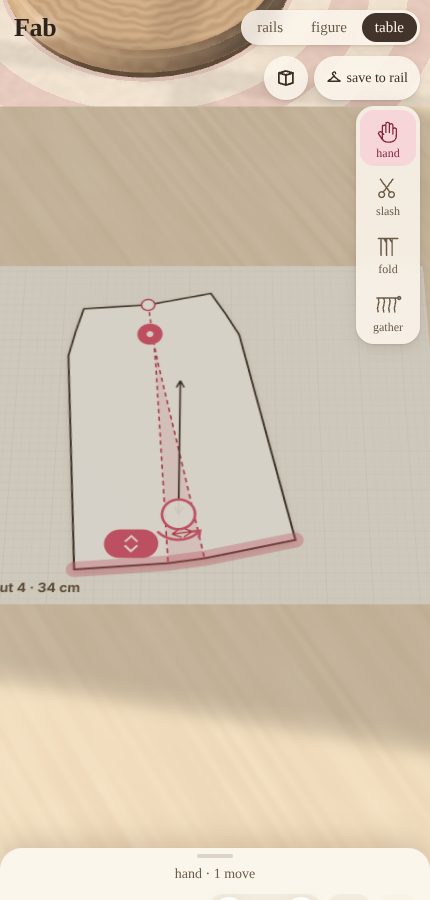
The rest are parameters on the same paper:
- length: drag the hem;
- grain: turn the grain arrow's handle;
- panels: the − / + beside the tools;
- cloth and print: the swatches.
Every move is a chip in the history under the paper. Tap one to take it back: the rest are made again, in order, and a move that now does nothing is struck through and says so. undo takes back the last.
The moves don't commute, and that's the point. A pleat folded and then slashed through opens toward the hem with the flare. Slashed first and then pleated, it hangs straight. Closing a dart first and then spreading isn't the same as the other way round. Positions are on the paper as it is when the move is made. Even the shortcuts below have to account for that: placing three pleats "a third of the way along each" bunched them up, because each one lengthens the waist the next is measured on.
How a panel is represented
A panel is a row of ribs: lines from waist to hem, bent once, at the hips at its sides or at a dart's point. Between the ribs are strips: cloth, a wedge someone spread, a pleat, a dart, or eased width. Moves insert ribs, and turn or slide everything to one side of them, so a strip is always exactly the paper it was. Each strip records the move that made it, so the history is the pattern's provenance.
What's sewn, and how the waist meets the band, follow from the strips:
- side seams;
- darts, tapering to their points;
- pleats' stitching, let out where the hips need the room;
- the waist: cloth sewn flat to the band; folds and darts closed to a point; eased width gathered in, the ease declared on that seam;
- a waist cut longer than its band with nothing to take it in is eased all round, and the check says so ("gather it, pleat it or dart it?").
Paper that's one piece (cloth, and what's been slashed and spread or a dart closed into it: a cutter tapes these back into one) is meshed as a single region, with rulings evenly spaced along the waist and the hem. Folds and darts still sewn keep their own columns, so their edges can be sewn.
What we took from GarmentCode, and what we didn't
GarmentCode (Korosteleva & Sorkine-Hornung 2023) programs parametric sewing patterns as panels of edges joined by stitches between named interfaces.
Taken:
- Seams as contracts between named edges, not point pairs: a panel's sides, its waist.
- Ease declared on the seam (GarmentCode's "ruffle" coefficient) rather than built into the cloth's shape.
- Every operation reports how old edges became new ones: a rib is copied before it's cut.
Not taken: its sampling of designs for datasets, its 3D placement, and its edges shared by reference between edits. That last is fragile under sequences of edits, as its own code comments note.
Where Fab goes beyond it, because the gestures need it:
- An operation history as the source of truth. GarmentCode regenerates a garment from its parameters and keeps no history.
- Pleats as folds with stitching. GarmentCode lists pleats and folds as future work.
The dials, kept as shortcuts (and as the comparison)
The first Fab's controls are still there (?ui=dials): length, fullness, flared/gathered/pleated, panels, grain. They no longer draw anything themselves; they write moves:
- flared: close the darts into the hem, then slash and spread the rest, evenly, as far as the paper lies flat;
- gathered: release the darts and add width at three places;
- pleated: fold pleats evenly along the waist.
The workshop's rail and the evidence bench go through the same shortcuts, so they exercise the same cutting. The dials stay as the other half of the comparison the next step needs: do children who make a skirt on the paper understand it better than children who turn dials?
What's never set (outcomes)
Silhouette, how many folds and how deep, whether the hem is level, how far it swings out in a twirl. These are what the simulated cloth does with the cut.
The other families
Every family is drafted from the figure itself, measured from its own shapes in body.ts, and every one passes the same checks: seams meet, pieces lie flat, pieces fit on the cloth. Each also has checks of its own.
Tops (bodice.ts)
A front and a back, each half the chest's round and its ease. The ease runs from snug (4 cm) to roomy (16 cm).
| control | what it is |
|---|---|
| length | cm below the waist; less than 0 is cropped above it |
| room | wearing ease round the chest |
| sleeves | cm down the arm, 0 for sleeveless; plain, puff or bell |
| neck | round, V, square, boat or scoop, and how much lower or higher than usual |
| swing | how much wider the hem is than the chest |
| collar | none, Peter Pan, band or frill |
What follows from those choices:
- The front is as long as the figure's surface. It runs as far as the figure's front does from the waist to the neck. The shoulder seam falls as the figure's shoulder does across its top, about 17°. The back's shoulder seam is cut to the front's length.
- The armhole runs from the shoulder's point straight down and meets the side seam under the arm.
- A sleeve is as wide as the arm plus its ease. Its head's height is solved so the head is 3% longer than its armhole (eased in), or 45% longer for a puff (gathered in).
- Each half of the head fits its own armhole, back and front. GarmentCode solves its sleeve caps the same way.
- An armhole too short for the sleeve is cut deeper, and the notes say by how much.
- A long sleeve must pass the hand.
- A puff is gathered into a cuff as round as the arm there.
- A bell flares, but no faster than its seams can lean.
- It has to go over the head. If the neckline won't, it opens down the back with buttons. A knit (jersey) stretches half again, and often needs no opening.
- A top that comes below the hips is cut wide enough to clear them.
- Collars:
- A Peter Pan collar is two flat ring sectors whose inner edge is the neckline. It's a small circle skirt, rounded at the front.
- A band collar is a strip as long as the neckline.
- A frill is 1.8 times as long, gathered on.
Dresses
A bodice cut to the waist, with a skirt sewn round its hem. The skirt is cut at the table like any skirt, but to the bodice's hem instead of a waistband: its recipe carries that round (band), so its paper, its dials and the dress all cut the same skirt. Its darts, pleats or gathers close into the hem: each point of the skirt's waist is sewn to its own place round it.
Trousers (trousers.ts)
Four panels, after GarmentCode's PantPanel: a front and a back for each leg.
| control | what it is |
|---|---|
| legs | cm of leg below the crotch: shorts (5) to full length (33) |
| width | room in the leg, slim to wide (culottes, palazzos) |
| flare | the hem over the knee: tapered, straight, flared |
What follows from those choices:
- Each panel is a quarter of the hips' round and its ease, straight up to the waist.
- The crotch curve's reach is solved. Each crotch seam must be as long as the figure's own surface from the waist, down under it, to between its legs, plus 2 cm.
- The waist is as wide as the hips and gathers into an elastic band, so it goes over them.
- A full-length leg must pass the foot.
Jumpsuits
A bodice to the waist, with trousers gathered onto its hem.
Tiers
Any skirt or dress can have two or three tiers. Each is a ring of straight panels 1.5 times the round of the hem above, gathered onto it, as GarmentCode's SkirtLevels are. The first tier still comes past the hips.
How it's represented
GarmentCode's edges are lines, circle arcs and Béziers whose control points are relative to their chord (edges.ts), so a curve keeps its shape whatever its ends do.
A piece is four runs of edges round it, with its cloth's grid laid over them as a Coons patch. Every corner between two edges falls on a grid point. So a bodice with its armholes and neckline, a sleeve with its head and a trouser leg with its crotch curve are all grids, as a skirt's panel is. (A skirt's panel is meshed as ruled regions from its paper's strips: see How a panel is represented. A piece cut from curves is a Coons patch.) The cloth needed only one new thing.
A seam sews two runs by length, as GarmentCode's stitches do. Every point of each run is sewn to the place the same fraction along the other: between two of its points, by a new interpolated XPBD stitch constraint in cloth.ts. Two runs of different lengths gather the longer onto the shorter. Gathered waists, puffed sleeve heads, tiers and frills are all that one rule.
The grid runs down each piece, so no edge along a piece's top or side may run in the grid's own direction. That would crush the cells. So:
- the armhole meets the side seam steeply, not level;
- a round neckline meets the shoulder at 45°, not straight up;
- a square neck's sides lean, as GarmentCode's trapezoid neck allows;
- the crotch curve meets the inseam at 45°.
Under an arm or a leg the difference is a few millimetres. The pieces lie flat check catches any grid that crushes.
The figure. Its torso is lathed through ellipses from between its legs up to its neck, and closes smoothly between its thighs where the pole goes in (it used to sit on a ball there, which stood out at the front as a bulge). The trousers' rise is still drafted for that fuller seat, so their patterns are unchanged and sit with a little ease. It's jointed at the waist: the chest, and the arms, neck and head with it, bends and turns over the hips, up to about 35°, taken gradually through the waist. Everything laid round the torso and held on it (a bodice's shoulders, a waistband) is placed on the figure as it's drafted and then bent with it; the cloth meets the torso in its own unbent frame.
It's posed for what it wears. Its arms stay up in a dancer's curve for skirts and trousers. For anything with a bodice they come down to 45° below its shoulders, as GarmentCode's bodies stand.
Pieces start laid out as GarmentCodeData lays its panels:
- flat and unstretched, on a gentle curve in front of the figure and behind it;
- sleeves as tubes on the arms;
- trouser panels round the legs.
The sewing and the shoulders' holds then draw them round. Tops hang from the tops of their shoulders. Pieces that aren't held, like sleeves, a dress's skirt and collars, are tethered to what they're sewn to.
The physical representation
Each piece is a grid over its flat shape, at about 2 cm, coarser for big skirts so the cloth stays near 1,800 points. The cloth is simulated with XPBD (extended position-based dynamics), in its "small steps" form: 8 substeps a frame. All units are centimetres, grams and seconds.
- Mass: each point gets a third of each triangle's flat area, times the fabric's weight.
- Stretch and shear: a spring along every mesh edge. Its stiffness is the cloth's orthotropic tensile stiffness in that edge's direction on the cloth: 1/E(φ) = cos⁴φ/E₁ + sin⁴φ/E₂ + (1/G − 2ν/E₁)·cos²φ·sin²φ So a woven cloth is stiff along its threads and soft on the bias, a knit is soft across its courses, and felt is the same every way. Turning the grain dial changes physics, not a texture. This is a spring network, not a finite-element membrane: that is the stated compromise.
- Bending: the quadratic isometric bending energy of Bergou et al. (2006). At each interior point it takes the cotangent Laplacian of the positions, which is zero on the flat pattern. It's weighted by the flexural rigidity, computed from the swatch's measured Peirce bending length and weight, over the point's area. It's solved as an XPBD constraint with its multipliers carried across three passes a substep, so extra passes converge on the true stiffness instead of adding to it.
- Long-range attachments (Kim, Chentanez & Müller 2012): each point is tied to its nearest held point, no further than the cloth between them plus what that much cloth would stretch hanging, in that direction. Without them a one-pass solver let woven cloth creep about 7% under its own weight.
- Seams are zero-length constraints, drawn closed over the first 0.8 s: the sewing. Darts are sewn and folded flat. The waistband is held, turning with the figure.
- Air drags on each point's speed through the cloth by area over mass, so chiffon floats and felt falls.
- The figure: an analytic distance field (lathed torso, capsules, balls) with Coulomb friction against its moving surface.
- The cloth against itself: a spatial hash, with each point's radius under half its nearest neighbour's distance. Points near seams and folds are exempt, since there they're meant to meet.
Assembly is shown, not hidden: pinned, then sewn. Each piece is first put round the figure as it stands, not as it would stand: the bodice and skirt round the torso on a surface of revolution where nothing is stretched (its round at each depth is the panels' width there), each sleeve round its own arm and each trouser leg round its own leg, along the bones wherever they've been posed. So an arm raised over the head still goes through its armhole, and a leg lifted at the knee through its leg. Nine pins (the coloured heads) hold each piece where it's placed, weightless, while the seams are drawn closed and the waist into the band; at 1.1 s the pins come out over half a second and the cloth falls. Press pin and sew it on again (in the pose's or the tug's drawer) to watch it again. (A garment changed in place, by a dial or a move, carries its cloth on unpinned.)
Why XPBD, and what else was considered
| approach | fits Fab because | against |
|---|---|---|
| XPBD, small steps (chosen) | stiffness in real units (compliance), unconditionally stable, cheap, deterministic, easy collisions and seams | stiff materials under-converge at few substeps: measured below |
| plain PBD (the first Fab) | simplest | stiffness depends on iteration count, so it can't be calibrated to a swatch |
| implicit mass-spring / Baraff–Witkin (the CLO and Browzwear lineage) | large stable steps, mature for garments | a sparse linear solve each step; heavy for a phone in JS |
| projective dynamics | fast, stable, prefactored system | refactor on every re-cut; collisions awkward |
| FEM shells (StVK / discrete shells, ARCSim) | the most faithful anisotropy and bending | far too slow for real time on a phone |
| GPU XPBD (WebGPU) | 10–100× the points: finer folds | not yet on every phone; the next step if folds need it |
GarmentCode (Korosteleva & Sorkine-Hornung 2023) programs parametric sewing patterns as components with interfaces. It's the closest relative of the grammar here. Fab takes its "pattern first, simulate second" stance at a scale a child can turn by hand.
Evidence
Each test states a narrow claim and, as plainly, what it doesn't establish. A verdict covers only its claim. None of the tests yet compares with real cloth, real sewn skirts or children. Run them at ?bench=evidence (&converged re-measures the slow converged drape references). The numbers below are from a headless run on the cutting engine.
| test | claim | result | doesn't establish |
|---|---|---|---|
| 1 pattern | 1,120 designs (every corner of the space, plus 400 at random), 6,824 checks: seams match, the waist fits its band, hips cleared with 4 cm of ease, pieces fit across the cloth, darts sewable, paper doesn't overlap itself, every move made | holds: all pass | makeability: no seam allowances, notches, opening or fastening, or order of construction; not cut and sewn by a dressmaker |
| 2a cantilever | the cloth reproduces each swatch's bending length | holds: converged within 10%, at the figure's settings within 18% | that the swatches' figures describe real silk or felt (they're representative); bending is one stiffness every way |
| 2b Cusick | the model drapes in the order, and over the range, drape testers find | holds: converged 0.29–0.94, ordered by stiffness; folds 12 → 5 | agreement with the same specimens measured |
| 2b′ real time | the cloth on the figure drapes as its converged self, within 0.10 | fails: gap up to 0.27 (lawn 0.35 vs 0.57) | how much that gap matters to a child's predictions |
| 2c bias | woven cloth stretches more on the bias than on the grain | holds: 2–3.5× more; felt the same either way | the size of real bias growth (creep isn't modelled) |
| 3a/3b expressiveness | one cut in four cloths, and one cloth in five cuts, are measurably distinct, and sound | holds: nearest pairs ≥ 1.02 apart; all sound | that a child sees them as different, or that they match real skirts |
| 4 speed | the cloth step under 12 ms, the same every time | fails here: 11–13 ms on this container's CPU; deterministic | the whole frame on a phone: use ?perf on the phone |
"Sound" now means more than not exploding:
- finite;
- 99% of springs within 12% stretch, and within 35% squash;
- under 1% of triangles collapsed (not counting ones held flat on purpose: a fold held to the band, or a dart's legs sewn together);
- no point inside the figure;
- every seam closed to 5 mm.
On the cutting engine the worst sound skirt (pleated) has 11% stretch at the 99th percentile and a 4.6 mm seam gap.
One construction (flared, 4 panels, 2.2× full) in contrasting cloths:
| cloth | hem out | fold depth | folds | hem level (sd) | swing |
|---|---|---|---|---|---|
| chiffon | 14.2 cm | 2.2 | 16 | 0.75 | +12.2 |
| cotton lawn | 15.1 | 2.4 | 13 | 0.85 | +11.8 |
| linen | 16.4 | 4.1 | 7 | 1.50 | +12.2 |
| felt | 14.3 | 5.1 | 4 | 1.31 | +14.3 |
One cloth (cotton lawn) in contrasting constructions:
| construction | hem out | fold depth | folds | swing |
|---|---|---|---|---|
| straight (the block, darted) | 12.2 | 1.3 | 3 | +0.5 |
| flared (darts closed, slashed and spread) | 15.1 | 2.4 | 13 | +11.8 |
| gathered (darts released, width added) | 17.5 | 2.2 | 13 | +10.9 |
| pleated | 15.9 | 2.8 | 11 | +12.8 |
| one piece, bias | 16.0 | 3.5 | 9 | +11.0 |
Building the cutting engine, the bench caught:
- slashes whose hinges added waist length;
- a waist-ease rule wrong for dirndls;
- a block whose hips came up 1.4 cm short of their ease;
- pleats bunched by order-dependent placement (7 mm of cloth between two folds, stretched 90%);
- a spring between two collapsed triangles with infinite compliance (NaN);
- a minimum mass that silently made fine test meshes 30% too floppy.
Children: paper or dials?
Not yet tested; it can't be tested here. The protocol is unchanged (predict, then try; explain; intention; observe), now as a comparison. Half the children use the paper (the default), half ?ui=dials, with the same skirts and questions.
The hypothesis to test: children who slash, fold and close darts on the paper predict and explain better (naming a construction, not a look) than children who turn dials to the same skirts.
Every garment
| test | claim | result | doesn't establish |
|---|---|---|---|
| 5 garments | 752 garments (every neckline × sleeve length × sleeve × collar of a top, a dress and a jumpsuit at both ends of their room and length; trousers' corners; tiered skirts and dresses; 300 at random), 4,308 checks: seams meet as they're meant to (eased, or gathered by as much as meant), pieces cut from curves lie flat, fit across the cloth, clear the body, go on (over the head, past the hand, past the foot) | holds: all pass | makeability, as test 1; that a sleeve set in this way hangs as a dressmaker's would |
| 6 sewn | every garment the workshop makes sews up on the figure: seams to within 2.5 cm (0.25 on average), finite, nothing inside it | holds: all 27 | that it's sound (6′) |
| 6′ sound | the same garments, by the skirt's bar for "sound" (above) | fails: 12 of 27 (every plain skirt; 4 of 5 trousers) | how much the stretch under a bodice matters to how it looks or to a child |
Under a bodice, under tiers and where gathers crowd the cloth it stretches more: 13–33% at the 99th percentile, seams within 1.1 cm rather than 5 mm. Building the families, the checks caught:
- sleeve heads split 24/8 cm between their halves (a bisection the wrong way round);
- grid cells crushed to 0° wherever an armhole, neckline or crotch curve ran level or upright;
- a shoulder seam at 45° when it should be 17°, from measuring the shoulder's point up the figure's side;
- tiers gathered 1.45× when they should be 1.5×, from loops that dropped each panel's last step;
- merging with the cutting table: a dress whose paper was cut to a waistband while it wore a skirt cut to its bodice (now the recipe carries the round), and a seam-gap measure that read a gathered seam as open.
Known limitations
- The real-time cloth is limper than its own converged self in drape: coefficients up to 0.27 lower, from too few substeps for stiff bending. The next step is more substeps on capable devices, or WebGPU.
- Up to 11% stretch at the 99th percentile of springs near the waist in pleated skirts (4–8% elsewhere), where folds and darts crowd the cloth. Real woven cloth would buckle more and stretch less.
- The grain's laid along the panel's middle as it is after the moves. After one slash on one side, the block's own part ends up slightly off-grain. A cutter might keep the grain on the block's centre instead. The arrow can be turned either way.
- The swatch figures are representative, not measured. Measuring real swatches (a cantilever, a drapemeter, a strip tensile test) and putting the numbers into
fabric.tswould make test 2 a comparison with reality rather than with the literature's ranges. - Only a skirt is made by hand on its paper. A top's, a dress's bodice, trousers are decided by choices and dials in the figure's drawer: the gap the cutting table was built to close. The next step is moves on every piece, as the pattern books make them: slash and spread a sleeve into a puff or a bell, turn a bodice's dart, fold a trouser leg's waist. The garments' blocks (bodice.ts, trousers.ts) are where that paper starts.
- Tiers are a stepper, not a move on the paper.
- Only knife pleats, a single layer. Box pleats, petticoats and linings are natural next operations in the same grammar.
- Under a bodice the cloth stretches more at its 99th percentile (18–34%, against 6–7% in a skirt). Gathered heads and the shoulders' holds crowd it. More substeps, or a finer grid at seams, would let it buckle instead.
- The grid can't follow every curve. Armholes, necklines and crotch curves meet their neighbours at an angle rather than level (see How it's represented). GarmentCode meshes its panels freely; a grid can't.
- No fitted darts in bodices yet, and no princess seams. A child's figure barely needs them; a grown one would.
- A dress on its hanger settles a little crumpled where its gathered skirt meets the bodice.
- The Peter Pan collar is hard to see in the same cloth. A contrast collar would show it.
- Seams are hinges. A real seam allowance stiffens the cloth along it.
- See-through cloth (chiffon) shows a faint ladder where folds meet at a seam behind it.
The rails
Fab opens on the workshop's wall: a row of clothes rails, each hung with garments on hangers. The figure itself only turns when it's turned (by a drag, a flick, or a double tap); it doesn't drift round on its own.
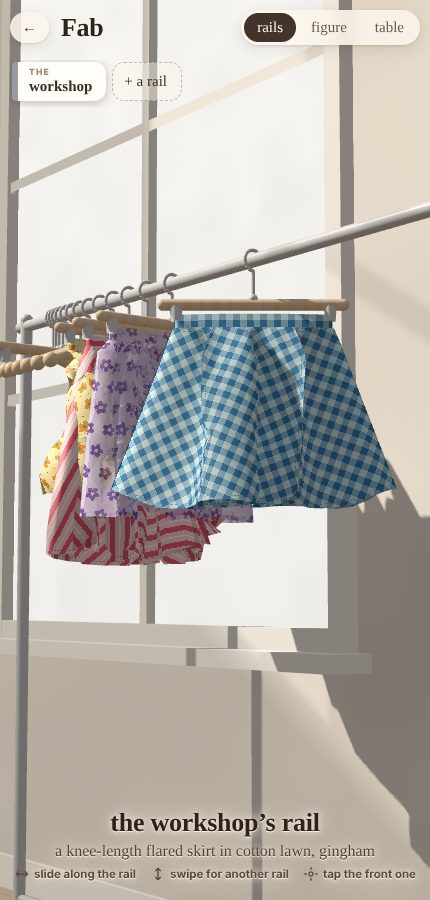
- The workshop's rail is chromed, and there's one: fourteen garments to start from, a few of each kind (skirts, dresses, tops, trousers and a jumpsuit), each made a different way in a contrasting cloth. (The evidence bench still sews all 27 of the workshop's makes.)
- Each person has their own rail, powder-coated in their own colour, with what they've made. Tap + a rail and give it a name.
Using the rails:
- Drag the garments along a rail and they slide like real hangers (a skirt or trousers on clips, anything with a bodice on a coat hanger). They run on, slow down, and settle with one in front. They bunch up toward the bar's ends, and each swings on its hook as it's pushed.
- Swipe up or down, or tap a name tag, to move to another rail.
- Tap the one in front to put it on the figure. (On a bare hanger, A New Creation starts a new skirt from the block.) It comes off its hanger, the camera crosses the room to the bench, and it's laid out flat and sewn onto the figure.
- A person's rail starts with a bare hanger, for something new.
Saving:
- save to rail at the bench hangs it back on its owner's rail, its design and its paper's recipe both. One that came from the workshop's rail goes on the rail in use instead, and if nobody has a rail yet, Fab asks whose it is.
- Going back to the rails hangs it up too, if it's changed.
- Long-press one of your own to take it off the rail.
- Tap your own rail's name tag to rename it. Clear the name to take the rail away.
Every skirt on a rail is the real thing. Its pattern is drafted from its design, a little coarser than at the bench (about 650 points). It's sewn and let fall from the hanger's two clips, which hold its waistband flat, by the same cloth simulation. Each one settles once, a few at a time, nearest first. After that it hangs still, and only its swing moves it.
The rails live in this browser (localStorage), so a rail is a person on this device: a family's tablet, or a classroom's. Nothing leaves the device. Sharing rails between devices would need storage behind the cell, which this static lab cell doesn't have.
The room
The workshop is one room, closed on all four sides. Each wall faces in and is drawn only from inside, so wherever the view goes, even out past a wall, nothing stands between it and what's in the room.
The light comes in through windows. Tall frosted windows in painted frames, with sills, are set in the back wall (behind the rails, the figure and the cutting table) and the right wall. They glow with the daylight through them. The key light, the one that casts shadows, comes from windows behind the viewer, high and to the left. It falls as those windows' shape, panes and glazing bars and all, with the wall's shade between them. So there are patches of window light across the floor, the rug, the figure and the paper. (windowLight in render.ts: the key light's shadow map times the windows' pattern, laid out across the light's own direction, a window centred on the figure.) The walls and windows cast no shadow of their own, so the light comes in where the windows are.
A little furniture, for context:
- a round wool rug under the figure's stand;
- a stool beside it, three splayed legs and a ring;
- a plant in a terracotta pot by the window;
- a shelf of cloth on the bolt, behind the cutting table.
The furniture casts shadows and catches the light like everything else.
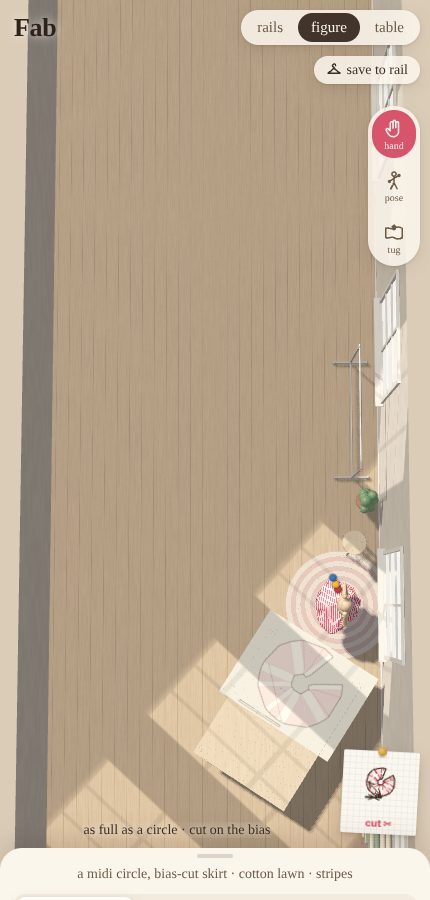
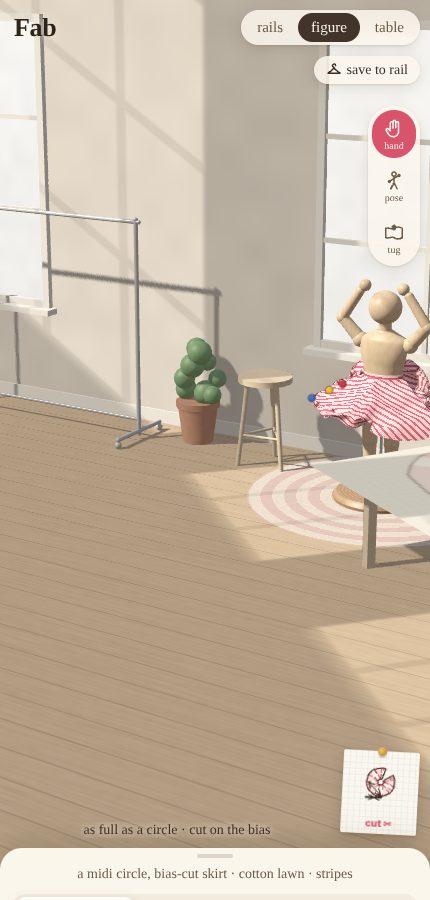
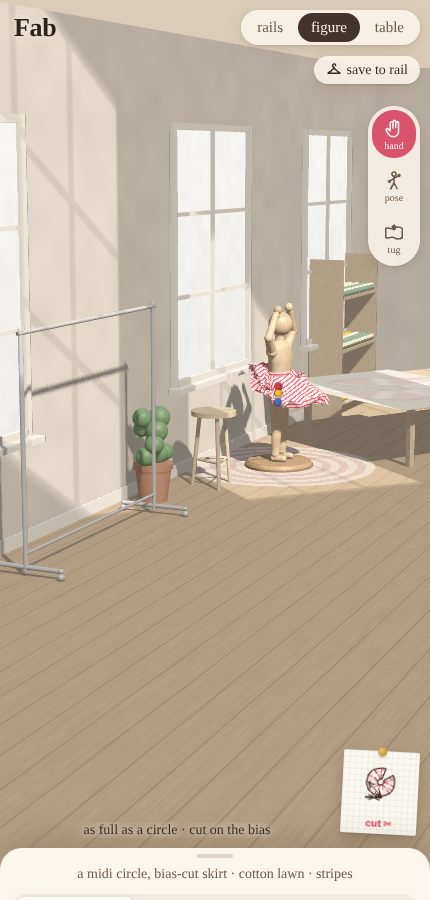
Three places in one room
The workshop is one room, and the camera walks between three places in it. They're the three buttons along the top (rails · figure · table), and the one you're at is dark. What can be done there sits in a row under them.
| place | where | its drawer | along the top |
|---|---|---|---|
| the rails | along the wall, to the left | the rails' name tags; put a skirt on the figure | |
| the figure | on its stand, in the middle | what it is (make: skirt, top, dress, trousers, jumpsuit; tiers), the bodice (neckline, sleeves, collar; length, room, swing) and the legs, when it has them; fabric, print and colour | the tools down the right (hand, pose, tug), each with its own drawer; save to rail |
| the cutting table | to one side, facing the figure | the tool in hand: what it does, the gestures it answers to, what it's set to; panels, tiers, undo, the history (the tools themselves are a palette down the right). A top's or trousers' whole pattern lies there to be looked at, without tools | cloth (an icon), save to rail |
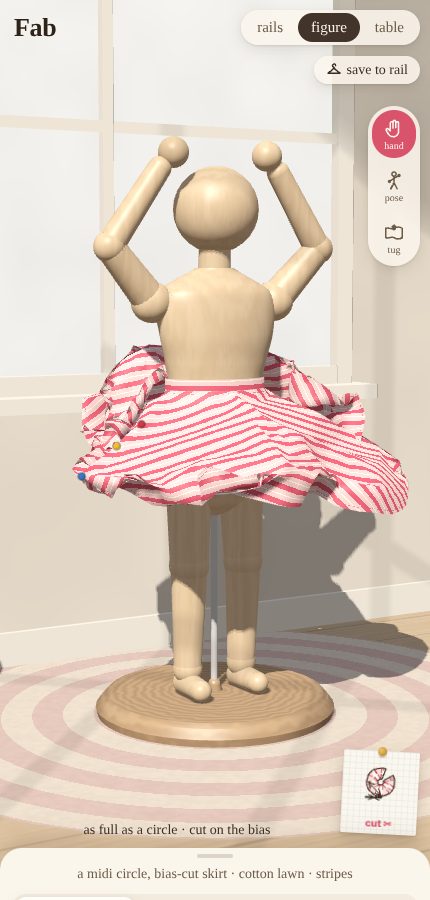
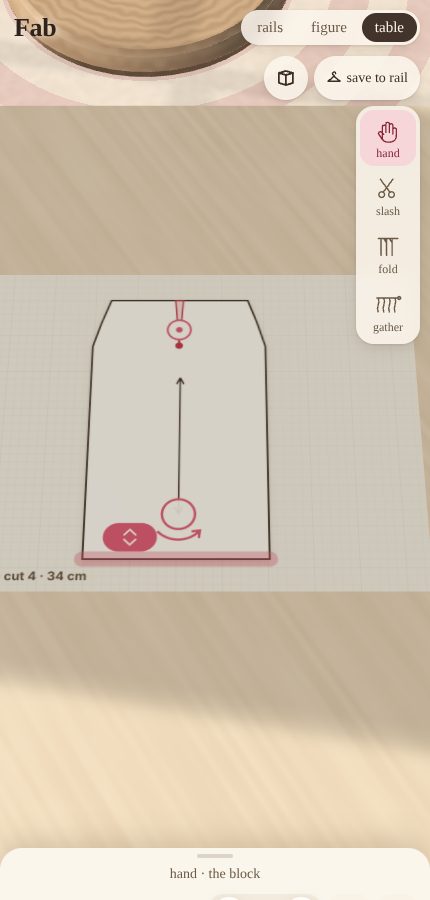
The drawer has three states, each the one before with more below it:
- closed: its handle, and what's chosen in a line ("cotton lawn · stripes · strawberry");
- focused: at the figure, a section's tabs (Make · Bodice · Legs · Fabric · Print · Colour) and its choices; at the table, the tool in hand, panels, undo and the history;
- expanded: at the figure, the section in focus made your own (below); at the table, the tool's gestures and what it's set to.
Its handle is tactile. The drawer follows a finger on its handle, so what's below comes into view before it's let go, and it gives a little past either end. When it's let go it settles, sliding there: dragged a quarter of the way to the next state it goes there (and on, past each further quarter); flicked, it goes one further the way it was flicked; short of a quarter, it springs back. A tap steps it: closed → focused → expanded → focused. (⚙ by the tabs expands the section in focus, and closes it again.)
The room never moves with it. The drawer lies over the room rather than taking space from it, and each place keeps the bottom of the screen for its drawer whatever state it's in, the scene drawn centred above that by moving the lens. Opening, closing or dragging the drawer doesn't move or resize the scene.
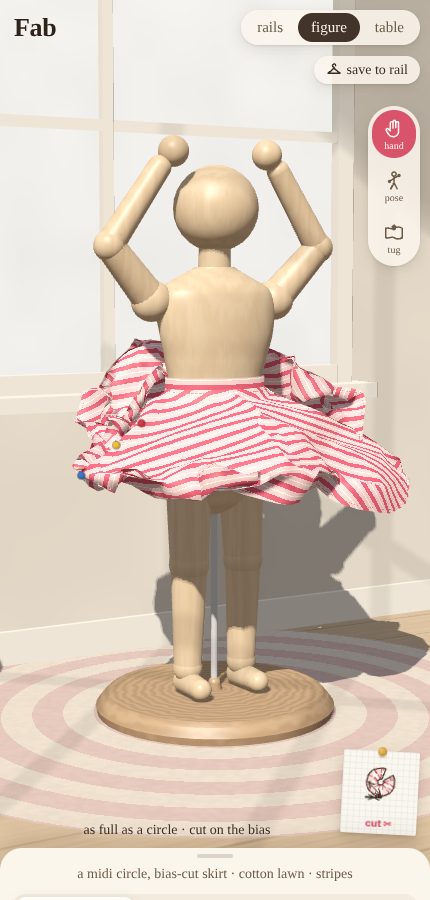
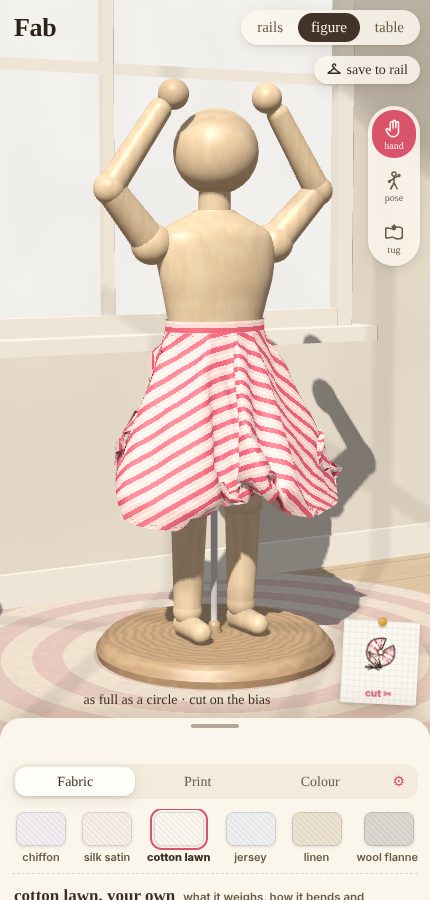
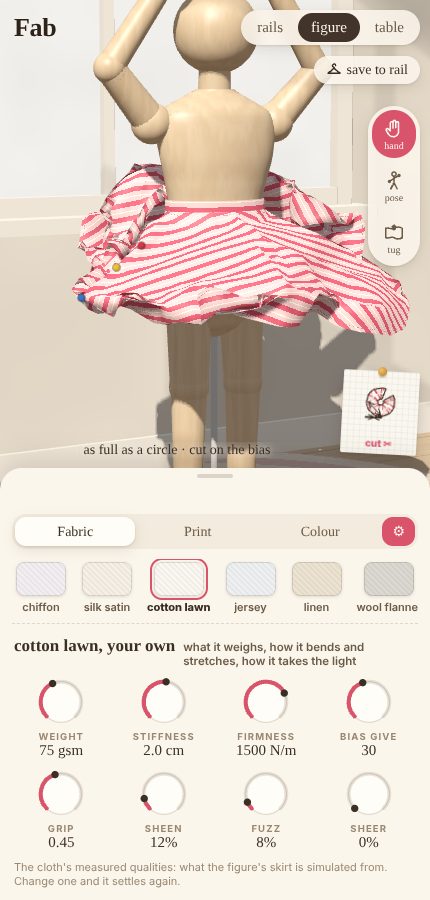
Expanded, a section is made your own. What's changed is kept with the skirt (on its recipe, so it's on the rail with it, and in the link):
- cloth: its measured qualities, dial by dial, starting from the swatch's: weight (gsm), stiffness (Peirce bending length), firmness (tensile stiffness, warp and weft together), bias give (shear stiffness), grip (friction), and how it takes the light (sheen, fuzz, sheer). The first five are what the skirt is simulated from: change one and it settles again;
- print: how big it's printed;
- colour: the palette's three inks (ground, ink, accent), each picked.
At the figure, the Bodice and Legs tabs work the same way: focused, their picks (neck, sleeve, collar; the legs' length, width and shape: shorts · cropped · full, slim · straight · wide, tapered · straight · flared); expanded, their dials, exactly. The notes line over the figure is one line; the whole of it is in the expanded drawer.
as it was puts the section back as its swatch has it, and choosing another swatch starts afresh from that one.
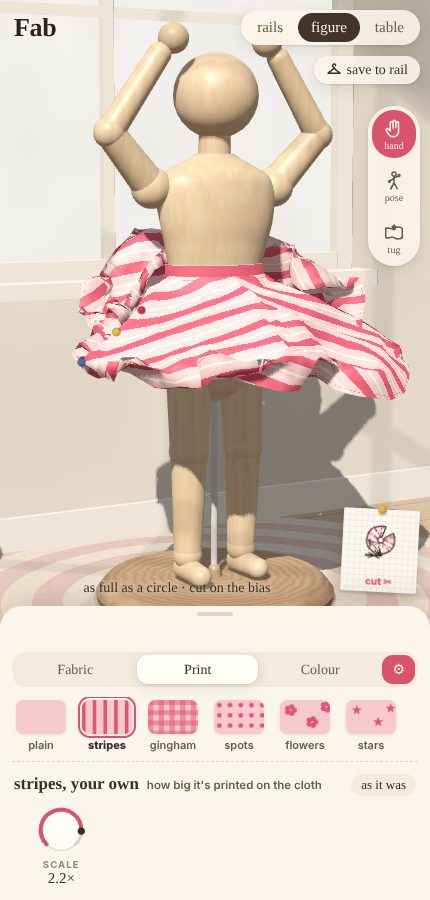
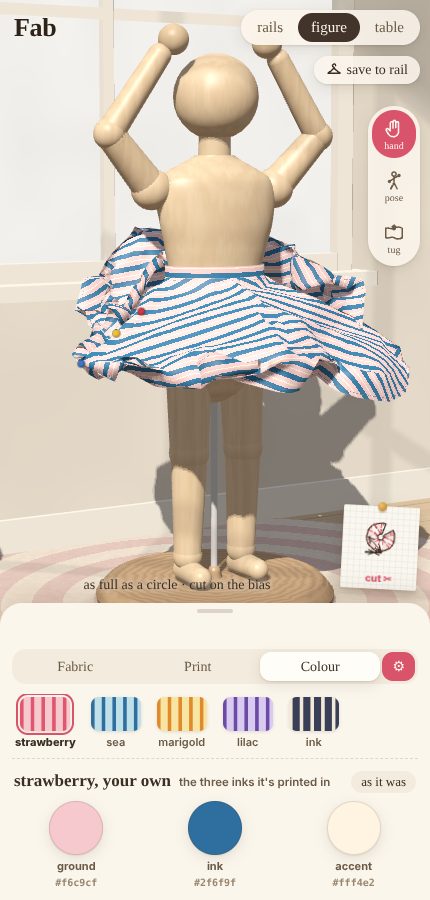
At the figure, a drag on it spins it; a drag off it goes round it. Spinning is the same as from the table: its front follows the finger, and a flick runs down on its own. A pinch, or scrolling, comes close or goes well back.
Every place can be reached by tapping it. From any of the three, tap another where it stands in the room (a rail, the figure, the cutting table) and the camera walks there. It's one list in the code (PLACES in main.ts): each place says how a touch finds it (a box round each rail and what hangs on it; the figure out to its arms and the reach of its skirt; the tabletop), and the nearest one along the touch wins, so whatever's in front hides what's behind it. A tap the place you're at uses itself (a garment on the rails, the paper's piece at the table) is never passed on. A new place in the room is one more entry.
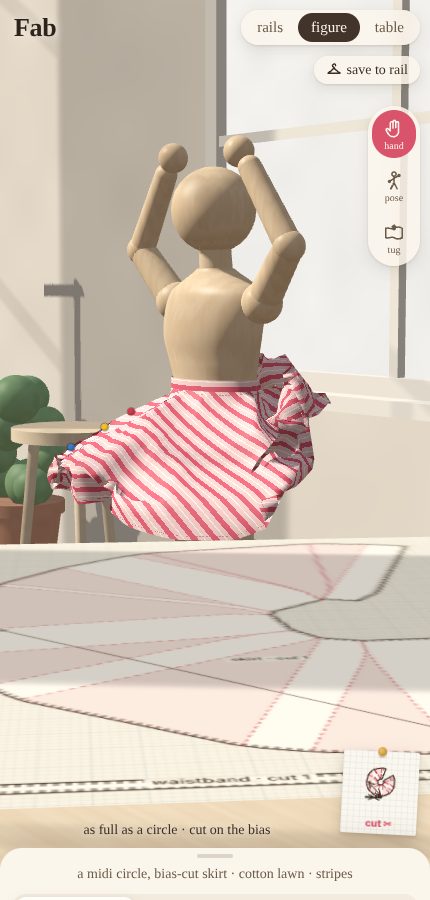
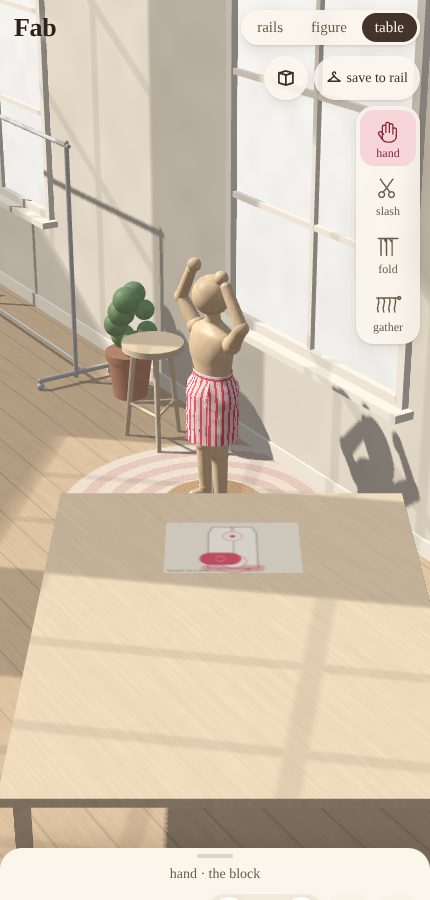
The pattern is pinned up beside the figure, bottom right. It's a little note with the pieces drawn on it, what the skirt is, how long, and how far round its hem is. Tap it, or tap the cutting table itself where it stands in the room, to go to the table. It's redrawn with every change, and stays by the figure.
At the table, the figure's still across the room. Tap it to go over to it. Drag across it to spin it on its stand: its front follows your finger, and a flick runs down on its own.
The paper is plain by default. A piece is drawn as pattern tissue, so its marks (slashes, folds, darts, gathers) stand out. The cloth icon lays the chosen cloth and print on it, running with the grain, as it'll be cut. The note by the figure follows the same choice. (?cloth starts with it on.)
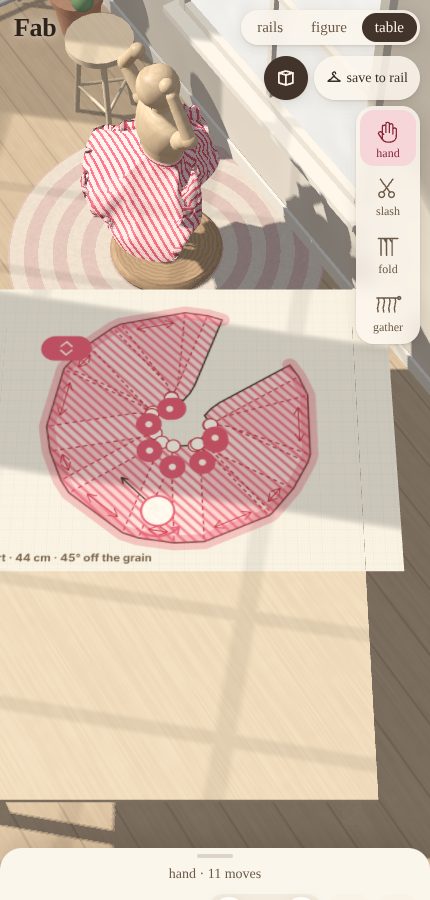
?sheet)At the table, the pattern lies on it at true size. A centimetre of the paper is a centimetre on the figure, so a piece that's spread grows on the table. The figure stands across the room behind it, wearing each move as it's made.
A touch on the screen is cast down onto the tabletop and lands on the paper. Every gesture works on the paper there, and a fingertip is a fingertip's size wherever the paper is seen from.
The paper shows what the tool in hand can do. The edge it works lights up: the hem for the hand and the scissors, the waist for fold and gather. The hand also gets a tab on the hem to drag, a ring at the foot of the grain arrow to turn it, and a badge on each dart to tap (white while it's sewn, rose once it's flared or gathered). The moment a cut or fold is touched, a dashed ghost shows where it'll go. While a finger's on the paper, a label beside it says how much ("+4.5 cm", "37 cm (+3)", "22°"), and the drawer keeps up with it.
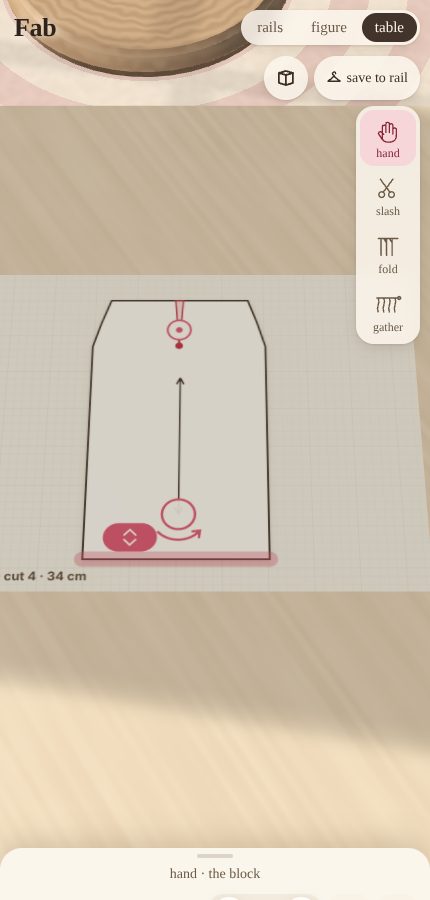
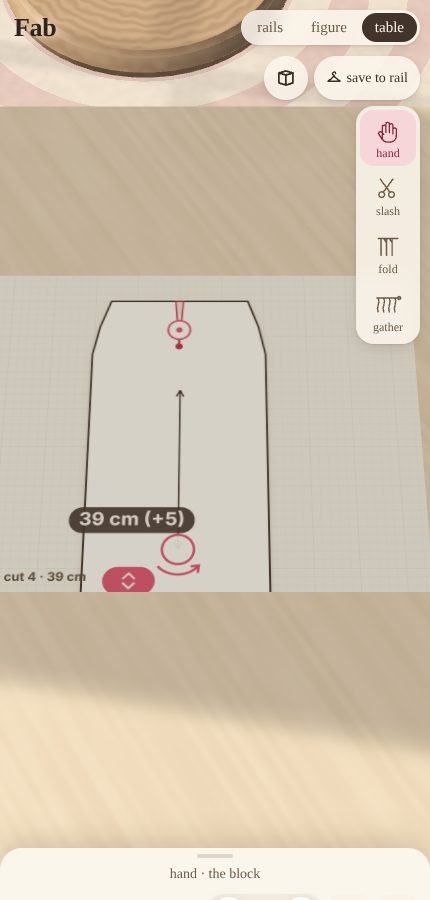
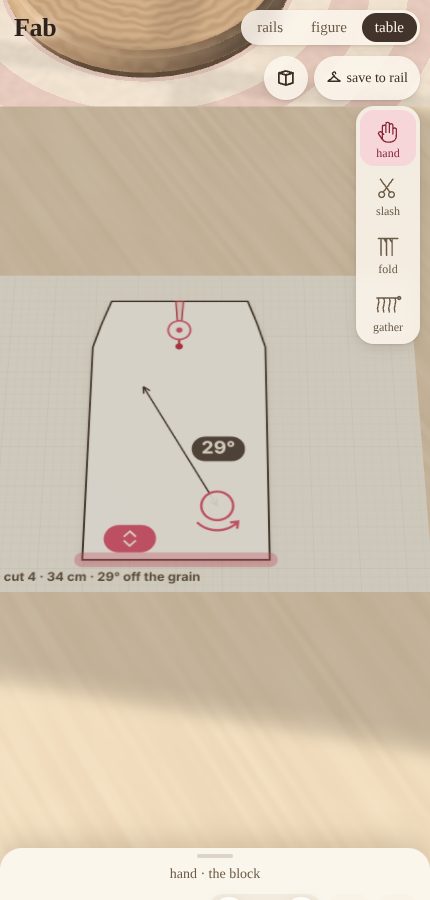
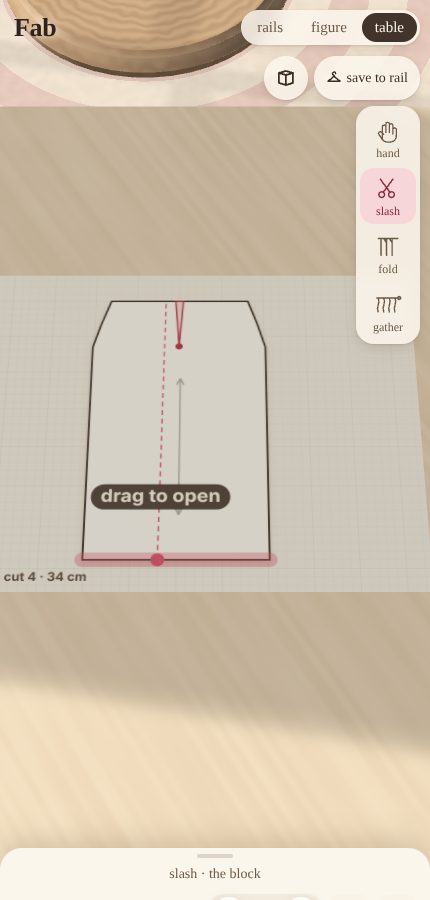
Each move is marked as a dressmaker marks it:
- a slash: its two edges dashed and the opening shaded, the point it swung open about ringed, an arrow across the opening;
- a pleat: the fold line solid and where it's laid dashed, an arrow from one to the other (the way it's folded), and its stitching down from the waist boxed off at a bar;
- gathers: a notch either side on the waist, a wavy running stitch between them, and arrows drawing it in;
- a dart: its two legs to a dot at its point.
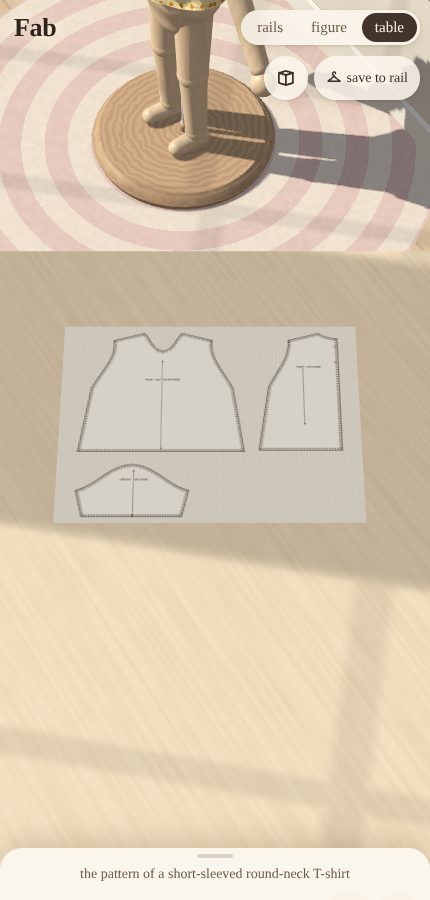
A top, trousers, a dress or a jumpsuit at the table. The pattern is laid out whole; a tap on a piece picks it, and it's drawn alone, larger, its edges lit: a hem to drag longer or shorter (a top's, a sleeve's, a leg's), a side to drag roomier or slimmer, a neck deeper, a hem's corner out to swing or flare it, the grain arrow round to bias. Each is the design's own dial, so the figure wears it as it's dragged, and the amount is by the finger. The drawer says what's picked; expanded, it lists each edge and what it does, each value with a step either way, and the piece's own choices as words (a front's neck, collar and sleeves; a sleeve's head; a tier's count). A tap on the paper round it, or anywhere off it, is the whole pattern again. A dress's skirt panel tapped is the skirt's paper, with its tools.
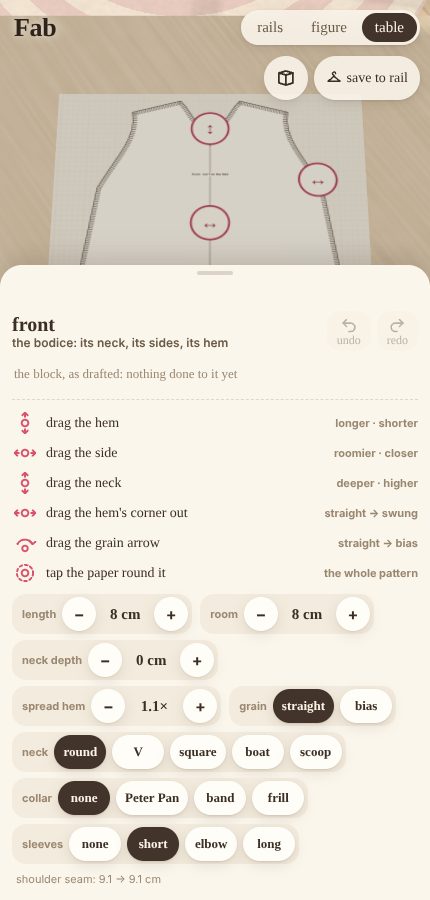
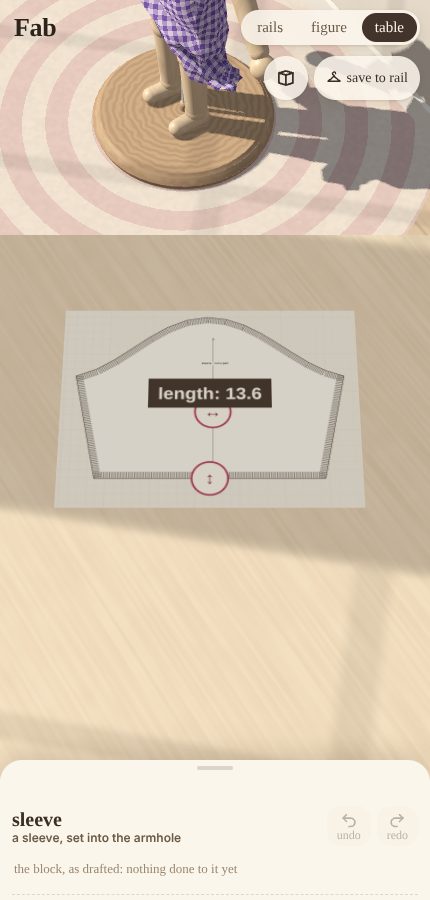
Only the piece takes the tools. A touch on the pattern (or within a fingertip of its edge) cuts, folds, gathers or pulls. A touch anywhere else (empty paper, the tabletop, the room) moves the eye:
- drag up, pinch together or scroll to look up from the paper, across the room, to the figure;
- drag down, pinch apart or scroll back to come back down to the paper;
- drag sideways to look a little round;
- two fingers moved together slide the view across the table, for working close in on one part of the piece.
It goes further than over the piece both ways: down close to the paper (to a third of the distance), and back past the figure to see the room round it.
The room's walls are one-sided (see The room).
Looking past halfway, the paper is just part of the view, and a touch on it moves the eye too. Come back down to cut.
The paper stays where it was laid. The piece is only moved, and the sheet re-cut, when it no longer fits on its sheet or has shrunk into a corner of it. That never happens while a finger is on it. The camera follows the piece smoothly, so nothing jumps between one gesture and the next.
Using it
- The paper (on the cutting table: tap the pattern note, or table along the top) is one panel of the pattern. Pick a tool and work it (see the moves above); the figure wears every move as it's made, and follows while your finger is still on the paper.
- At the figure, the tools down the right say what a finger on the scene does; the one in hand is lit, and the drawer follows it.
- hand (to start with): drag across the figure to spin it on its stand; flick it, or tap it twice, to twirl it; drag off it to go round it; pinch, or scroll, to come close or go back. With more than one thing on, a tap on one is the one worked. The drawer is the garment's: what it is, its bodice or legs, fabric, print and colour.
- pose: the figure's joints are marked (see below). Its drawer: stand it as it was, and pin and sew it on again (to dress it afresh in the pose it's in).
- tug: take hold of the cloth anywhere and pull. A pinch of it (what's within 3 cm of where it's touched, on the same piece) follows the finger; let go, and it falls as it would. Its drawer: pin and sew it on again.
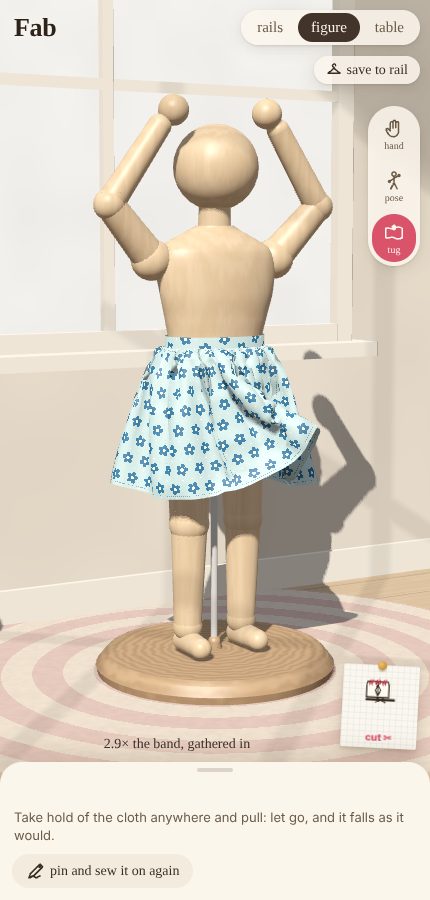
- save to rail, along the top, is the one action: it says so.
- Tap the title three times (or
?perf) for a frame readout: fps, frame, cloth and drawing time, and whether the cloth is keeping up with the clock. The cloth runs in fixed 1/60 s steps, at most two a frame: on a slow device it slows down, rather than falling further and further behind. - pose: its joints are marked: take hold of an elbow, a hand, a knee, an ankle, the head, or the chest (the larger ring) and move it, and the limb turns where it joins the one above (an elbow at the shoulder, a hand at the elbow, a knee at the hip, an ankle at the knee; the head nods on its neck; the chest bends and turns at the waist, taking the arms and head with it), a little at a time, so what it wears is pushed along with it. Nothing goes below the stand. A pose is kept on this device for each way it stands (arms up for a skirt, down for a bodice); stand it as it was in the drawer undoes it.
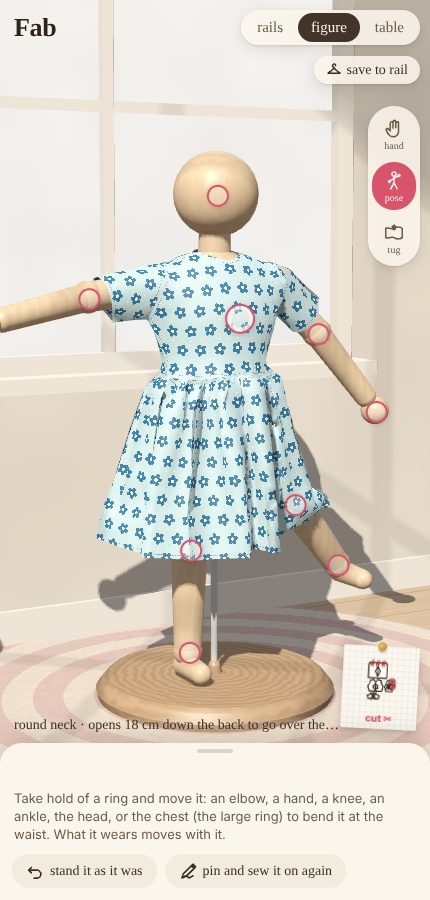
- pin and sew it on again: pins the pieces round the figure as it's posed, sews them up, and takes the pins out.
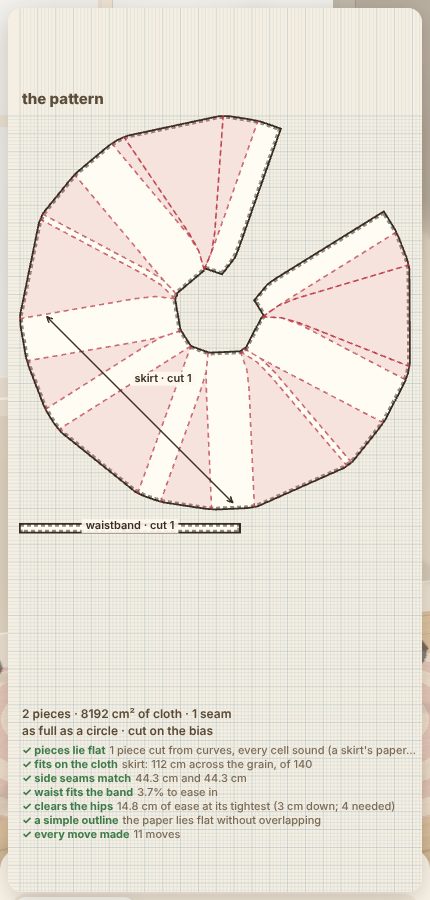
?sheetopens the whole pattern: the pieces with their grain lines, darts and pleats, how many to cut, the notes the cut made, and the pattern's checks. (It's no longer a button: the pinned note and the table are the pattern now.)?drawer=closed|focus|fulland&sec=fabric|print|colouropen the drawer as a link left it;&own=carries what's been made your own ({"c": {cloth qualities}, "i": [three inks], "s": print scale}), and the page writes it as it changes.
Before a deploy
node cells/lab/devtools/fab-smoke.mjs opens each family at the figure (in frame above the drawer, nothing thrown), the cutting table (the piece in frame, a hem drag that lengthens it; a top's and trousers' hems dragged and slashed), and the rails (a garment in front), and fails on anything wrong. Run it, and node cells/lab/devtools/fab.test.mjs --quick, before every deploy: two sessions deploy this cell, and a regression shipped once that this would have caught.
How it's built
The pictures are made, not taken. Every one in this page is made by driving the page as a child would, and the whole set is made again with one command: node cells/lab/views.mjs fab (name some, or a group, to make only those; --list for what's registered). Each view is registered in client/fab/views.mjs: a name, a group, a title and caption, the page's query, and the steps that drive it (pick up a tool, touch the hem, drag), the shot taken at the right moment, often with the finger still down. They're static/fab/v-<name>.jpg, committed and deployed with the page. The whole set is under pictures at the top of this page, apart from the prose (and static/fab/views.md on GitHub); here, a view goes where it's talked about.
All of it is in client/fab/:
| file | what it does |
|---|---|
garment.ts | every garment from one design: its family, its components, how they're sewn together, the shared checks |
edges.ts | the geometry: lines, arcs, Béziers (chord-relative), Coons-patch pieces, sewing runs by length |
shared.ts | what every garment's cut shares: the figure measured, waistbands, holds, hangers, the shared checks |
bodice.ts | tops: bodice, necklines, sleeves, collars |
trousers.ts | trousers |
cut.ts | the cutting table: the block, and the moves made on it |
pattern.ts | from a recipe (block + moves) to what's sewn and held, and the pattern's checks; the dials' shortcuts |
paper.ts | the paper on the cutting table: its sheet, tools and gestures |
fabric.ts | the swatches |
cloth.ts | the XPBD cloth |
body.ts | the figure and its distance field |
render.ts | WebGL2, shadow-mapped, the print laid on the flat pieces along the grain |
sheet.ts | the pattern, drawn as a dressmaker would |
rails.ts | the rails: the carousel, the swing, hanging skirts settled on their hangers |
store.ts | the rails kept in this browser, and the workshop's own skirts |
evidence.ts | the evidence bench |
URL parameters
| parameter | values |
|---|---|
fam | skirt, top, dress, trousers or jumpsuit |
len | a skirt's length, cm |
m | the moves, e.g. c0_s500.150_p250.15 (close dart 0; spread at 0.5 of the hem by 15.0 cm; pleat at 0.25 of the waist, 1.5 cm deep) |
full, cut | an older link's fullness and flare, gather or pleat: written as moves |
ui | dials: the dials instead of the paper |
at | table: start at the cutting table |
perf | the frame readout |
panels | number of panels |
grain | degrees |
tiers | 1–3 |
blen, ease, swing | a top's length below the waist, its room round the chest (cm), its swing |
neck, ndepth | round, v, square, boat or scoop; cm lower (or higher, below 0) |
slen, sleeve | sleeve length (cm; 0 sleeveless); plain, puff or bell |
collar | none, peterpan, band or frill |
llen, lwidth, flare | trousers' leg below the crotch (cm), room (1–2), hem over knee (0.8–1.8) |
fabric | chiffon, satin, lawn, jersey, linen, flannel, organza or felt |
print | 0–5 |
colour | 0–4 |
settle | frames run before the first draw |
twirl | spin the figure on load |
sheet | open the pattern on load |
preview | no controls |
rails | start at the rails (a design in the query starts at the bench) |
warm | settle the rails' skirts before the first frame |
bench | evidence opens the evidence bench |
Sources
- Korosteleva & Sorkine-Hornung, GarmentCode: Programming Parametric Sewing Patterns, ACM TOG 42(6), 2023: arXiv:2306.03642.
- Macklin, Müller & Chentanez, XPBD: Position-Based Simulation of Compliant Constrained Dynamics, MIG 2016. Macklin et al., Small Steps in Physics Simulation, SCA 2019.
- Bergou, Wardetzky, Harmon, Zorin & Grinspun, A Quadratic Bending Model for Inextensible Surfaces, SGP 2006.
- Kim, Chentanez & Müller, Long Range Attachments: A Method to Simulate Inextensible Clothing in Computer Games, SCA 2012.
- Peirce, The "handle" of cloth as a measurable quantity, J. Textile Inst. 1930. ASTM D1388 (the cantilever test). On the formula's known overestimate of stiffness: MetaTOC summary.
- Cusick, The dependence of fabric drape on bending and shear stiffness, J. Textile Inst. 1965. BS 5058 / ISO 9073-9. The 30–98% range of drape coefficients is from the Materials Science (Medžiagotyra) drape study. That stiffness dominates drapeability is from the JTATM study.