Taohua · 桃花
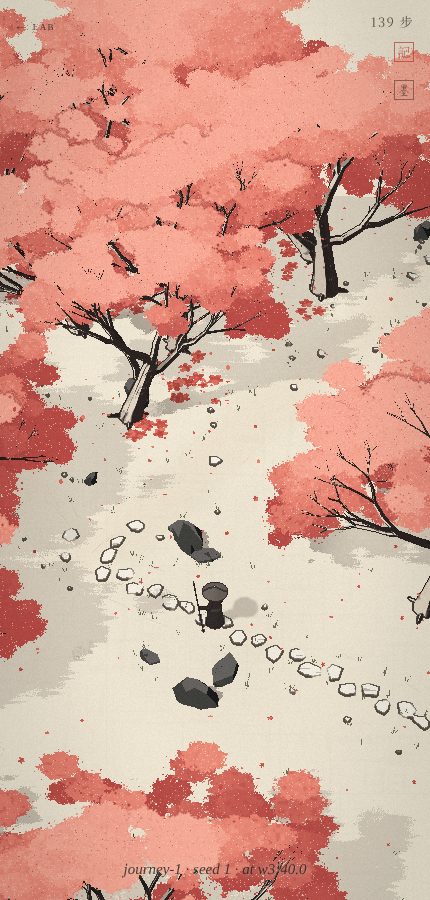
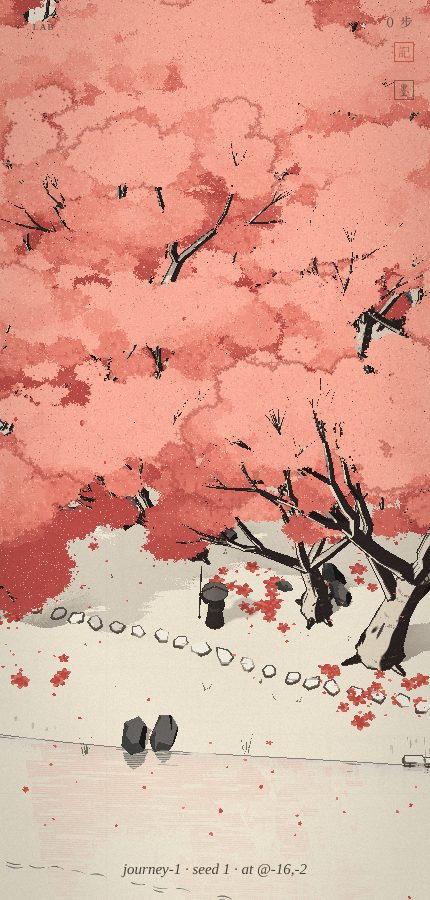
A journey up a hillside of peach blossom, on forever. There's no one path: ways cross the hill, parting and meeting, past mountain temples and casts from Changes written on the hillside. After a print: peach trees in flower, black standing stones, stone steps where the way is steep, a temple of teal tiles and red columns, a walker in a straw hat with a staff, the paper's cream under it all.
Tap a way and the walker goes there, by whichever ways lead there, up the hill or back down (a branch that ends goes nowhere else, so to see another, come back to the fork). A tap anywhere else (the hillside, a temple, a tree, blossom over a way, a cast) is taken down through whatever stands there to the ground under it, as if it weren't there, and sends them to the nearest place on a way to that, whether it can be seen or not: a tap on blossom over a way goes to that way, under it, and the walker may go out of sight under the crowns, as the way does. A tap on open ground that's seen (the ground itself, not blossom over it; not a rock, a terrace, a cast's sheet, water, or a bank cut steep) within fifteen metres of a way takes them off the ways, there: they leave the way and pick their way across the open ground, round whatever's in it, a little more carefully than on a way. From there, a tap on a way (or the keys) takes them back across the open ground to the nearest way, and on by the ways. Off the ways, the address keeps where they stand (?at=@x,z). The place a tap found is answered in the scene: a ring of vermilion, left open as a brush draws it, for a moment. Only a tap walks: a drag, wherever it starts, even on a way, looks about a little; let go, and the view comes back. With keys, ↑ or W walks on (at a fork, by the way most nearly ahead), ↓ or S back. Pinch (or the wheel) to come nearer in the print, and nearest of all to see through the walker's eyes: the view lifts to look out along their way while the camera's still well over and behind them, so they drop out of the bottom of the shot, and only then does it come down to their eyes (blossom right before the eye thinning away in dabs); there, it looks along their way as they turn, and a drag looks about; in the composition view, to stand further off still, up to twice as far. Each view keeps its own. The steps climbed are counted at the top.
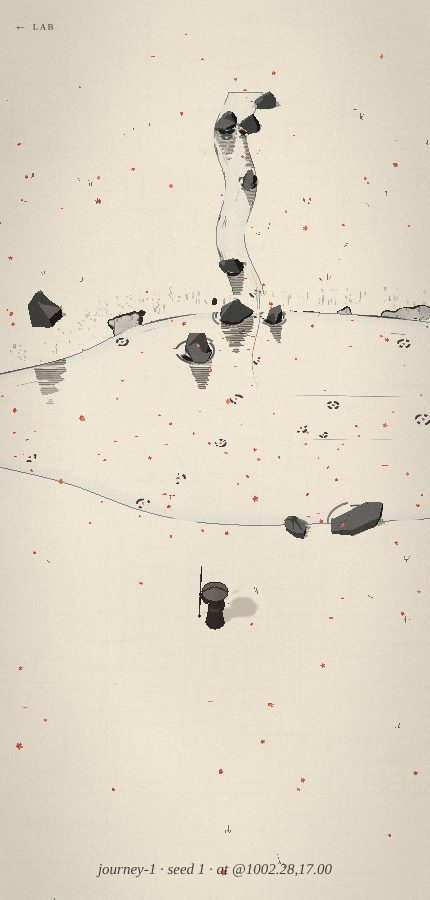
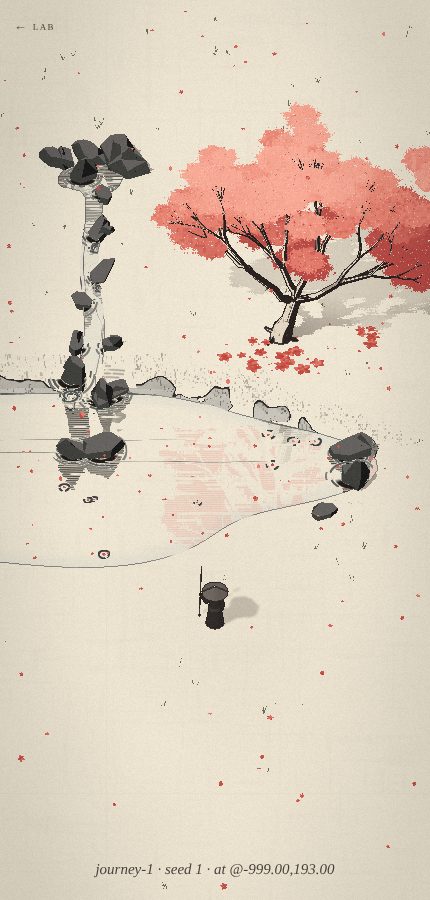
The journey starts on the river, as 桃花源记 has it: a fisherman, rowing up a stream, comes on a forest of peach blossom lining its banks, and leaves his boat to go in. Across the foot of the hill runs a river in long bends, so its banks run across the picture, not along it; upstream it opens out into broad water whose far bank is lost to the eye, and narrows coming down to the hill. Its banks are held by black rocks in clumps, half in the water (more along its near bank, up the picture), reeds here and there between. Out from its near bank, below the first way, a pier of stone, as the stairs and bridges are: a deck of pale slabs laid across, on piers of squared stone standing in the water, a stone post at each corner of its end to tie up to, a red paper lantern on a pole there; beside it stone steps go down into the water, the bank along there faced with dressed stone; from there a landing paved in cracked ice goes up to the first way, and over it, part way up, a gate as a temple's (two red columns on stone bases, a red beam with a dark board on it, a little roof of teal tiles): the threshold from the river to the hill. A boat is moored at the pier, lying a little across it, bow in, tied at bow and stern: a sampan, drawn in ink as the prints draw a boat on the water (its hull dark, its canopy's matting grey), a pole laid along it and a red lantern at its stern. It rocks a little, and rides on its lines in the current: pushed down the river as the current comes and goes in slow gusts, easing off a hand's breadth and back, swinging a little about them. The walker, too, is a figure in ink: robe and sash nearly black, the hat a mid grey so it reads.
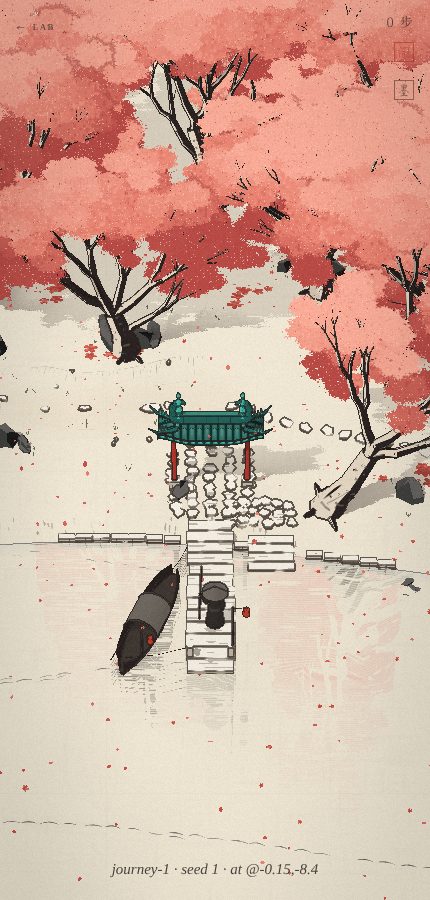
The river runs: its current (Water.riverFlow) goes down it along its course, quick in the narrows, slow on the broad water above (the same water through a wider way), quickest down its middle and slack along its banks, and behind the pier an eddy, where it idles and turns a little back on itself. Its marks are drawn from it, so the drawing shows where the water's moving.
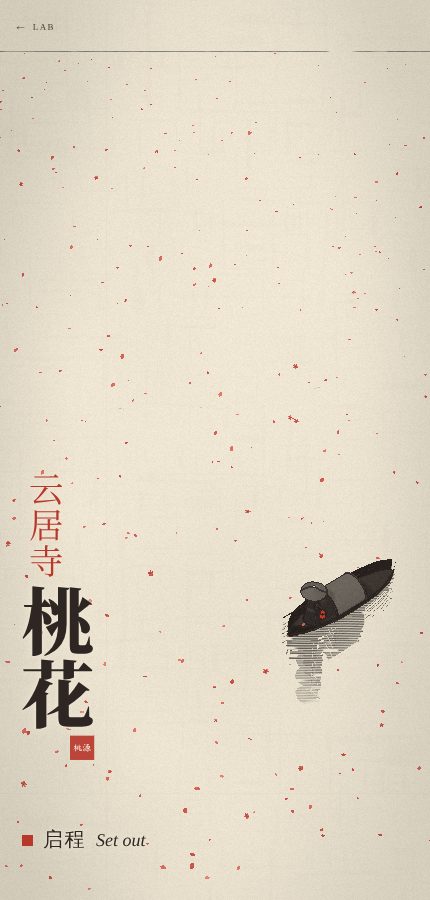
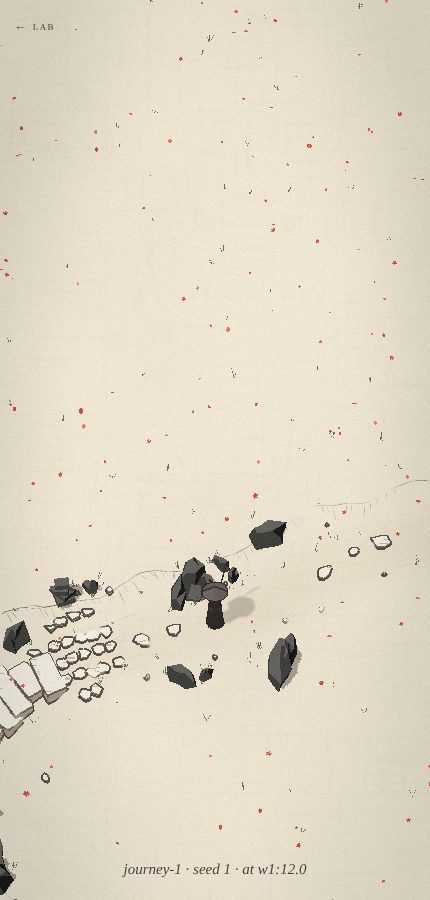
Unless the address says where to be, the journey starts out on the broad water, far up the river and out from the hill, so that none of it's in view: nothing but the paper and a few marks on it, the boat set to the right, the walker sitting low in it behind its canopy, and on the open water to the left the title, in ink: the name of the first temple up the hill, in vermilion, over 桃花, large, and the seal, 桃源, stamped in vermilion. Under it, 启程 · Set out, and, if a journey's kept in this browser, 续行 · Continue (back to where it was left: its seed and its place, kept as it goes, as the address keeps them). Taps on the print do nothing yet; Enter sets out.
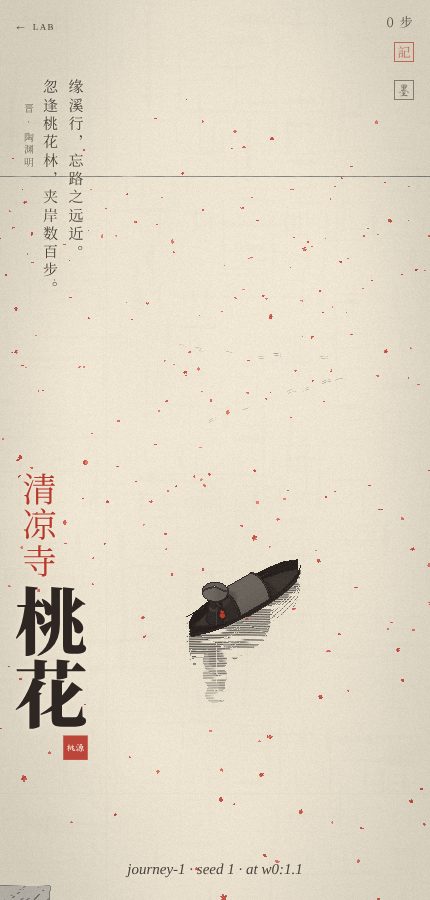
Set out, and the boat gets under way: down the broad water quickly, then through the narrows at about the river's own pace, a metre a second; the banks come in, rocks first, then the blossom; it eases over its last few metres, turns in and comes alongside the jetty, and the walker steps off onto its deck, facing up the hill (a tap ends the arrival at once; it takes under a minute). The title stays on the water where it began, and beside it now, as the prints set a verse, the lines it comes from: 缘溪行,忘 路之远近。忽逢桃花林,夹岸数百步。 (晋 · 陶渊明); both are left behind. Where the address says where to be (a link, a reload, Continue), there's no title: it's of the start. The walker can come back down to the jetty's deck (it's open ground, over the water).
The river's drawn as the hill's water is, the paper and marks where something happens. Its current as the prints draw a river's: long trails of small crests, each a little arc of its own with the paper between, following the river's course a few at a time across it, one near each bank and one or two between, each coming and going along it; where it runs quick, the crests longer and closer and more of the trails there; where it's slow (on the broad water above, along the banks, in the eddy behind the pier), few and short. Its bank at the hill's side is a line now and then between its rocks, the bank showing in the water under it here and there; its other bank, nearer the eye, left open. Reflections are the drawing's own, not laid on the water: for every place on the water, the drawing follows the line of sight turned up off it (flatter than a mirror's, so they run long down the water, as the prints draw them) back across the picture to whatever stands over the water there (a post, the boat, the walker, a rock, a crown) and draws it as the prints do, not a mirror but its ink (dark wood and stone and figures dark, pale things paler, blossom a soft pale pink), laid in level bars fixed to the water: long and calm on still water, short, broken and fainter where it runs; and only near where the thing meets the water, fading going down. So whatever moves (the boat, the walker on the pier, a deer at a pond) has its reflection with it, and anything new has one. (?refl=old brings back the old, hand-laid reflections, to compare.)
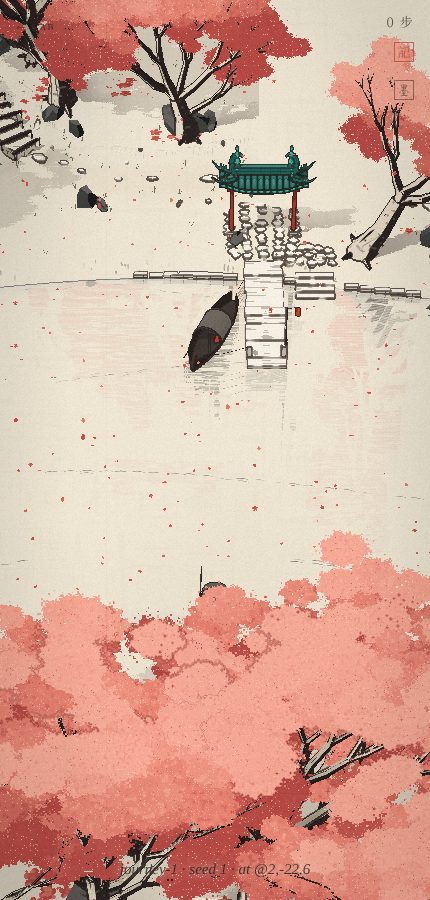
Ripples come of what happens: where the pole goes in, rings spreading, broken into arcs, one inside another; while the boat's moving through the water, its wake, crests off either side of its bow, spreading behind it. Each is carried off down the river by the current, spreads, thins and goes.
The boat can be taken out. A tap on it walks the walker to the deck beside it (if they're not already there) and they step in; it's cast off and pushed out from the pier. On the water the current carries it: what the walker does is through the water, and the water's moving. Its way through the water eases off (the water drags on it), so left alone it comes to go with the current, down the river. A tap on the water is a stroke of the pole toward there: more way through the water, that way, though there's only so much one can make; taps one after another, up the river, row it against the current, slowly (easier along the banks, where the water's slack). Its heading goes its own way: it turns to where it's being moved through the water, and drifting, it swings slowly as the current takes it. It keeps off the banks and the pier. A tap on the jetty (or the landing, the water by it) takes it home: it's brought in and comes alongside by itself, slowing as it comes, and the walker steps out onto the deck. Moored, the lines are made fast again. Fallen petals gather along the banks, behind the pier and about the boat; few float out on the river. Every hill keeps the same ways it had: the river lies below where they start.
?bench=river&scene=jetty|far|bank|arrive|open|start (best with review) shows places at the foot of one hill (seed 1): on the jetty by the boat; on the far bank, looking back across the river to the hill; on the near bank a way along; the arrival held part way; its beginning, out on the broad water; and the start, waiting. ?intro=t holds the arrival t seconds in; ?splash holds the start.
The title belongs to the water where the journey starts, not to the screen, so it moves with the water and is left behind, and doesn't come back unless you come back up the river to it.
The hill and its ways
The hill comes first. It rises up the slope, gently in some bands and steeply in others, the same all across it.
On it, the ways grow from the foot of the hill like a tree laid on the slope: a branch at a time, always the lowest first. From where it's reached, each branch goes on (a long reach, 34 to 64 metres, slanting well across the hill, as often back the way it came across as on, so a way climbs the hill in long zigzags, pulled back toward the middle when it strays far to one side), or forks in two, the forks heading off to either side; now and then a short spur leaves it, up to a building or a clearing of its own on the slope; now and then a branch ends, at a building or a clearing. Rarely, two branches that have drawn near meet again. And where a branch comes near another (16 to 44 metres across the hill) that it's far from by the ways (more than four times as far, and a hundred metres or more, back down to where they parted and up again), most often a short path runs across between them, gently wandering, between plain places on both (never a building's, a gate's or a clearing's, nor a fork that's already three ways, nor near a terrace), so a way you can see close by is close by to walk to as well. There are never more than three branches at once, and never fewer than one: with one, it forks more often; with three, a branch is more likely to end. No way crosses another, nor runs within eight metres of one, and no two junctions come within sixteen metres; where a branch has no room to go on, it ends there, in a quiet clearing. A way through a gate always goes on, by whichever way up the hill it fits; if none fits, the gate was never a gate, and a hall stands at the end of its branch instead.
No reach is straight: each wanders along its way, a long sway to one side, a turn back, smaller bends over that, all its own, settling straight only where it comes to a building's stair or leaves a gate's back. Each way takes the hill's height as it goes: where its going is steep (the hill steep there, or the way heading straight up it) it climbs in steps, each a pale slab of its own, ragged at its ends, turning as the way bends, now and then a short wall of squared blocks beside it; where it's gentle, it's a trail, a few flat stones and a worn line of grey strokes. The ground just downhill of a way is kept open of trees, so a way running across the hill isn't lost under the crowns in front of it. All of it from the seed: the same seed, the same hillside.
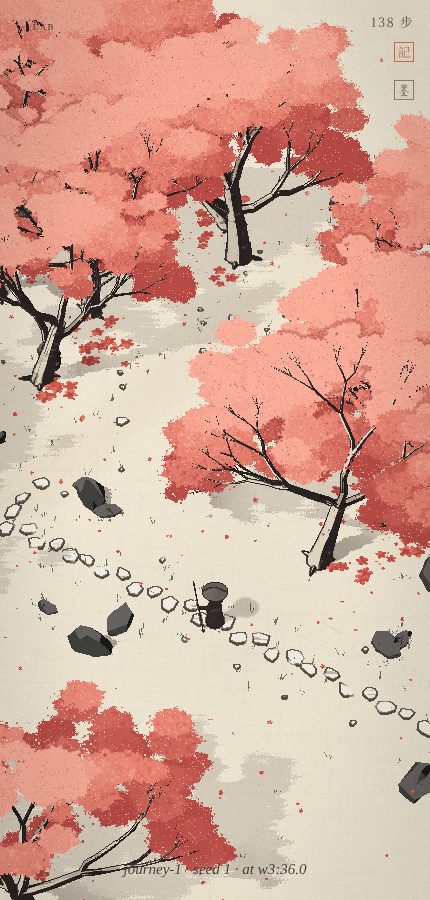
The world is made in tiles, sixteen metres across and twelve deep, about wherever the walker is, as far across as the view reaches, as they come into view and dropped as they're left, each from the seed and its place: the ground, the steps and stones, standing stones along the ways and in outcrops behind the trees, tufts of grass, the trees, fallen blossom, and the buildings. Crowns stand as they grow, over a way too: nothing is cut out of a crown to show what's under it.
The ways, close to
A way meets the hill by degrees, not at a line. Each is benched into the hill: across it and a little either side, the ground lies level with its middle; uphill of that, a cut bank rises quickly to the hill, and downhill a fill slope falls more gently to it, the bench's edge and the banks' widths ragged along the way. From the way's edge out, a fringe of loose pebbles, tufts and drifted petals thins away into the open hill, in loose groups; by a stair, a few stones spilt from it lie half sunk in the bank. The worn earth of a trail spreads unevenly either side of it.
Stairs weather: now and then a slab's cracked across, in two; sunk a little and tipped; or broken at an end, the piece lying beside it. Moss and grass grow in the joint at the back of a tread, where the next step rises, and fallen petals drift against the risers.
Each stretch is of its own kind. A stair is most often of pale slabs; now and then cut in the black rock, the outcrop it climbs through standing either side; or earth steps, each held at its front by a log, pegged at its ends. Before a temple, slabs. A gentle stretch is most often a worn earth trail with a few flat stones in it; now and then stepping stones through the grass, a stride apart, alternating; and coming to a temple, flags laid in a cracked-ice pattern (冰裂纹), kerbed along either edge. Over a marsh, a boardwalk of planks on posts.
At the head of a stair, now and then, there's a landing: a broader place, paved in cracked ice, to stand and look; by it, a stone lantern (石灯籠), a bench, or a cairn.
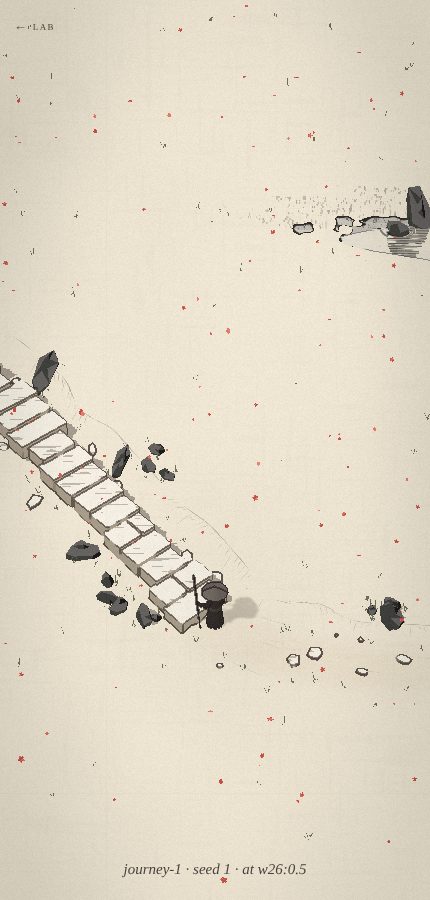
The ways are drawn as the water is: the paper, and marks only where something happens, each its own geometry with its reason (pathmarks.ts), lying on the ground as it's laid. Where a way's cut into the hill, a line along the top of the cut, where it begins, broken, heavier the higher it stands; and hanging from it, strokes down the bank, in groups, each leaning its own way, mostly short, now and then one long, closer where it's steep, fewer where the way turns sharply (strokes square to it there would fan out). Its bed's edge is a fine line, broken: more of it under a cut than down the hill, where the way's built out and meets the hill by degrees; none beside a stair or flags, whose slabs and kerbs are their edge. A trail's trodden earth is a faint warm wash, gone toward its edges, with now and then a long stroke along it where feet have worn it, crowding the inside of a bend, and where it's steep, a short wandering runnel. On a stair of slabs, the worn edge of a tread, at the flight's foot and head and now and then between. All are heavier where something happens (a flight's foot or head, a way's ends, a crossing) and lighter between. In the marks view (?marks) they're coloured by what made them: edge teal, cut magenta, bank brown, wear blue, tread orange, runnel green.
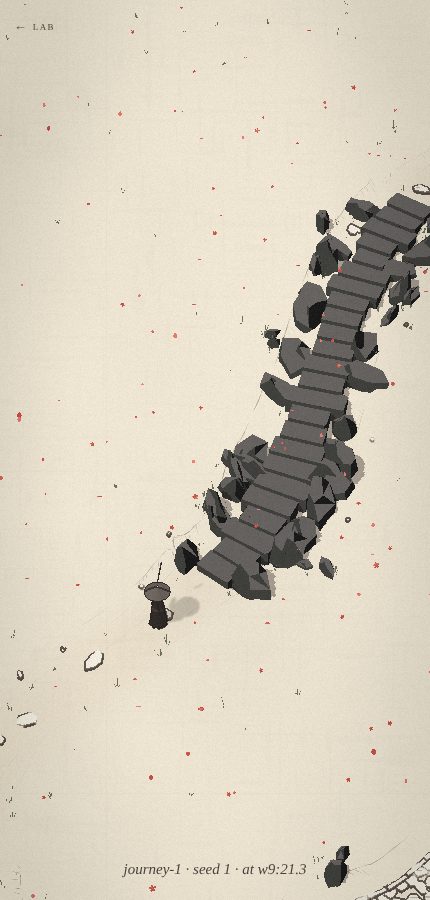
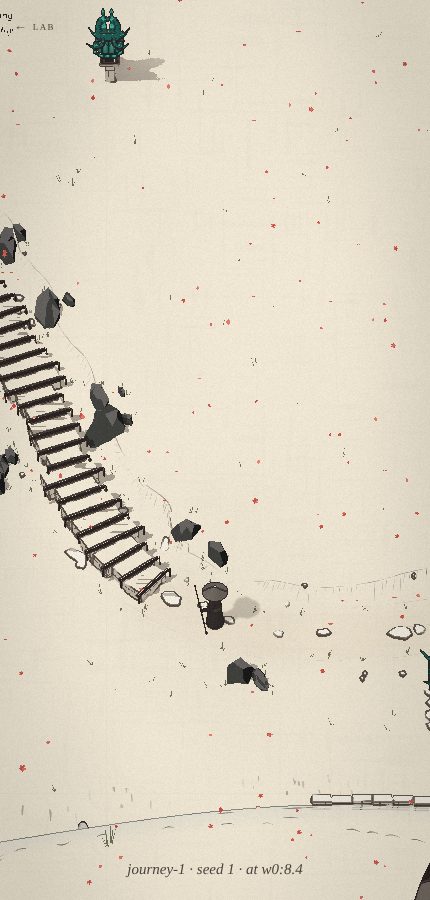
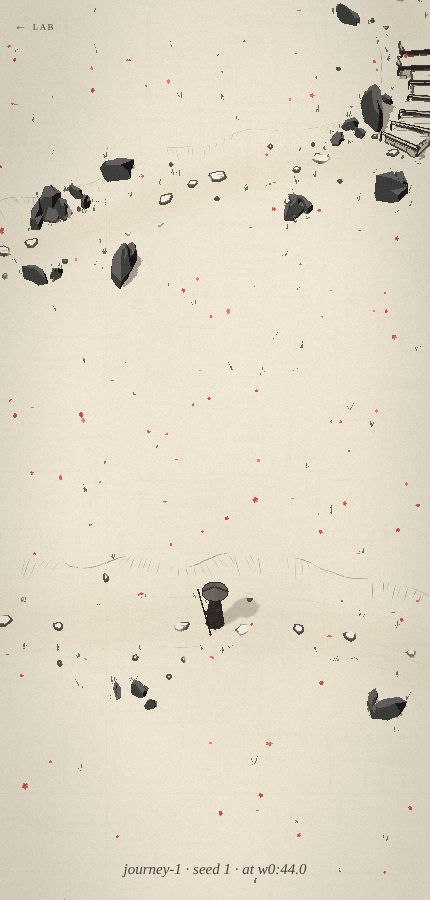
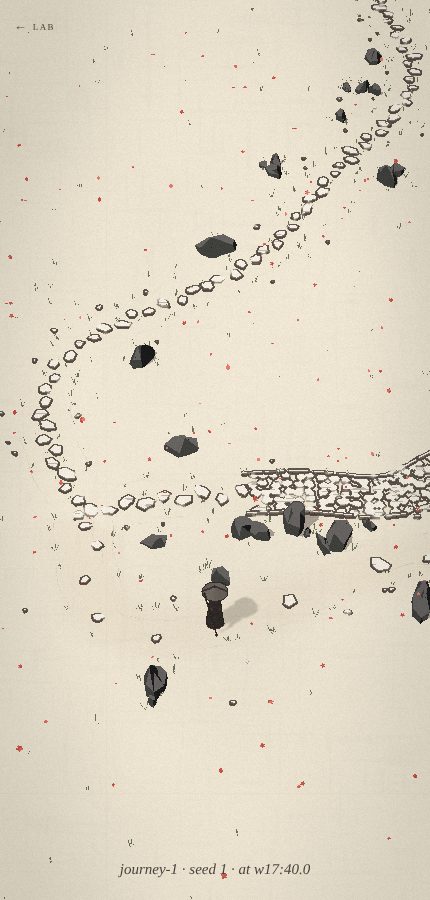
?bench=ways&scene=flight|rock|timber|cut|bend|steep (best with review) shows a place on one hill (seed 1) where a kind of way can be studied, looking up it, with the trees left out: the longest flight of each kind of stair, the deepest cut beside a trail, its sharpest bend, its steepest stretch.
The water
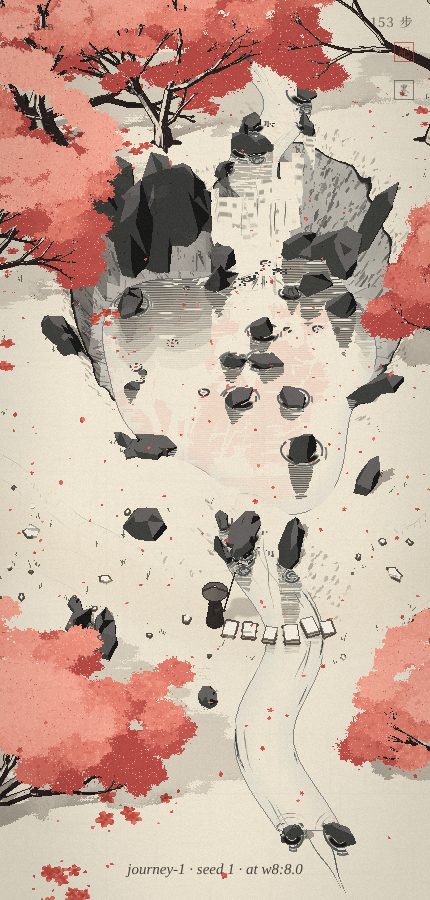
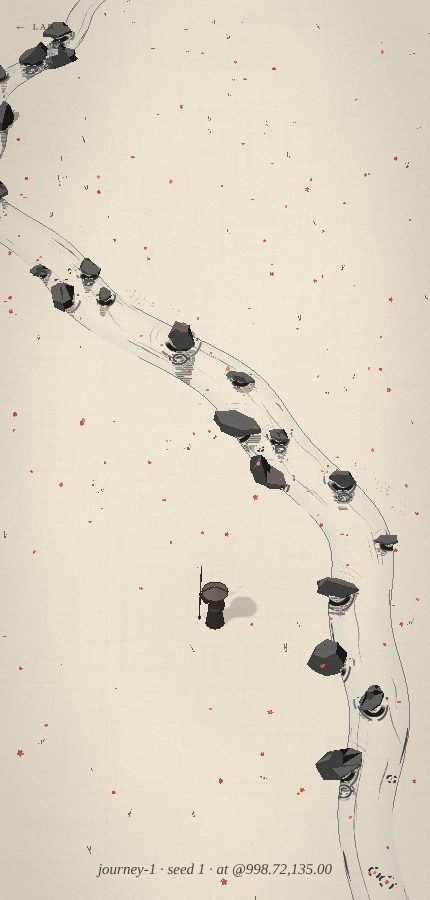
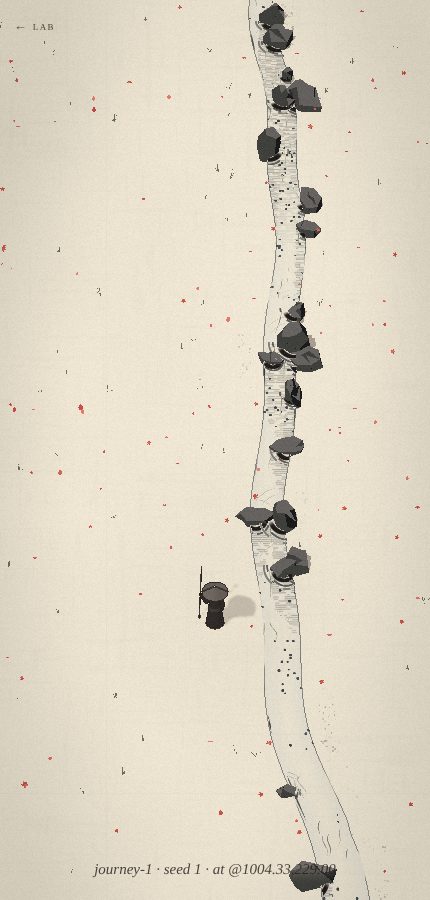
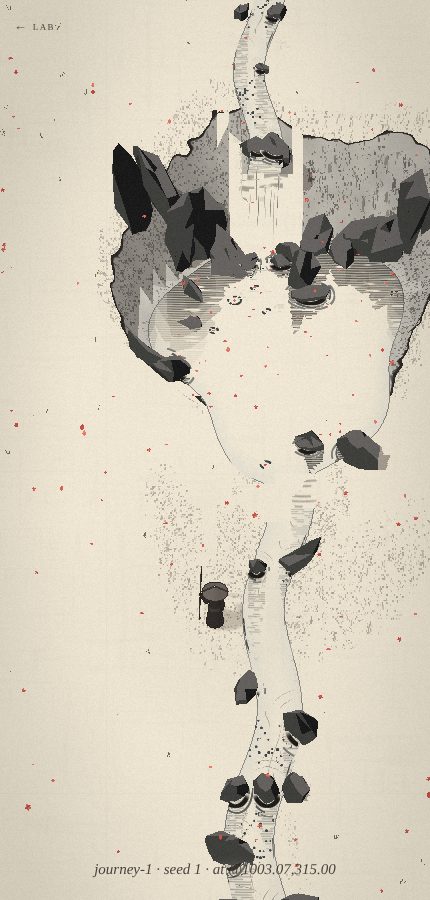
Now and then a stream comes down the hill: one every few hundred metres up it, each two to three hundred metres long. It's laid out before the ways, from the seed alone, a stream at a time up the hill, so any part of it can be made without the rest. From a spring among rocks it runs down the hill, wandering across it in long bends and shorter ones, and short wiggles of its own every few metres, as a stream winds among stones, narrow at its spring and wider below, to a pond at its foot (or a marsh, its reeds in clumps), where the hill's gentlest thereabouts. Where the hill's gentle it slows, and now and then pools; where it's steep it runs white over rocks, or falls: in steps, from pool to pool, each held at its lip by a ledge of rock; or all at once, from as high as four metres, into a deep pool cut into the hill under a bowl of cliff.
Its water lies level across it; down it, the level follows the hill, or stands level in a pool (held at the pool's downhill rim, so the pool's cut into the hill behind rather than banked up before it), or drops at a fall. The ground's carved to hold it: a bed under it, deeper toward its middle; banks rising from its edge to meet the hill, steep and rocky by falls and pools cut deep; raised a little where the hill lies below the water's level, except where another water runs out through it. Where two waters meet, the ground's carved by both. Its rocks: along its banks, more where it runs fast, and in it there; ledges at each fall's lip; rocks about each spring and pond.
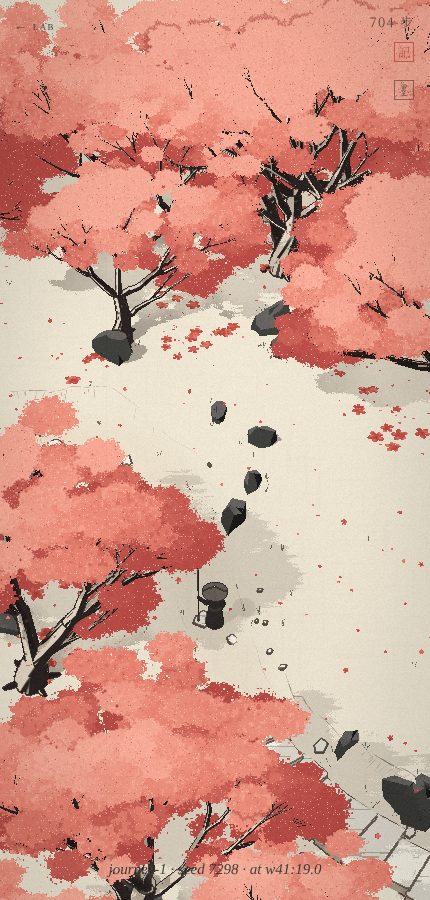
The ways cross it where they can: once, fairly square to it, where it runs or over a marsh; never through a pool or at a fall, and no junction, terrace or cast stands by the water. Where both banks are about the water's level, a crossing is stepping stones (pale, squarish, a stride apart, just above the water) or a bridge; where the way's steep there, or the water's white, or the banks are cut high, a bridge: a deck of stone slabs, arched a little, a kerb along either side, a pier at either bank. No tree stands in the water, on a bank cut steep, nor just downhill of the water, where its crown would stand between the eye and it: the water's an open mass, as the print's are.
It's drawn as the prints draw water: the paper itself, and ink only where something happens. Its edge is always there, quietly, since it can't be walked into: a fine line where it meets the hill, lighter than the ink and broken now and then in long lengths, and just inside it a faint cool wash, gone half a metre in, as the prints grade water from its bank. Its marks aren't a texture laid over it but geometry of their own (marks.ts), each with a reason to be there, read from the water: where a stream bends, its current crowds in short strokes against the outer bank and draws out long along the inner; where it runs gently, now and then one long low stroke along it; where it runs fast, short strokes, slanted, crossing; where a stone stands in it, the current splits about it upstream and trails a wake behind; where it falls, a broken lip across the top, lines down the sheet of different lengths, and at its foot strokes flung out downstream, the heaviest marks on the water, and rings spreading, fainter as they go; where it comes into a pool, rings spreading from the inlet; and on still water, almost nothing: a long line or two across, far apart. Its banks are a broken line, about half drawn, heavier where they're cut steep or the current's against them; a pond's far shore (up the hill, where the bank's cut) is drawn, broken, with a few short level strokes just below it on the water where the bank shows in it, and its near shore left open. Each mark is a ribbon laid on the water (or down a fall), tapered to a hair at both ends, its width and weight its own, its edge drawn smooth however thin, broken now and then as a dry brush breaks; it stays where it is as the view moves. Foam is a stipple at the foot of each drop and in patches where it runs fast; stones in the water have their rings, and on still water their reflections. A crown over still water shows in it as a soft pale mass, the crown's shape mirrored, its edge ragged, broken across by level streaks of the paper. Petals float on its stiller water.
?bench=water&scene=pond|bend|rapid|fall (best with review) is a hill of its own, far off across the hill from any way, its four streams laid as given: the same geometry every time, so the drawing of the water can be compared against itself. ?marks shows only the water's marks, each coloured by what made it (current blue, stone red, bank green, fall purple, impact orange, still grey), the rest faded.
Where its banks are cut deep into the hill (about a fall's pool, in a run of falls) they're rock walls, as the prints wash them: a grey wash, paler where it faces the light and deeper turned from it, with dry strokes dragged down it and an ink line along its top where the cut begins.
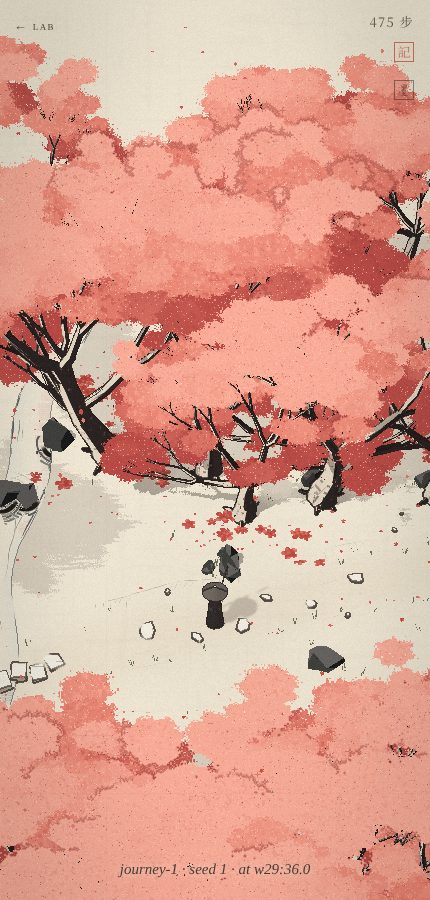
Over slow water, a crossing that's a bridge is now and then a stone arch: hump-backed, one round opening over the water, its faces of squared stone, a low parapet either side; on still water its reflection rounds the opening into a ring. In the composition view, water's open paper, faintly cooler.
The deer
Now and then, not often (in about two stretches of three, each some three hundred metres up the hill), a few sika deer stand somewhere a little off a way: 梅花鹿, the plum-blossom deer, a warm russet coat spotted white along the back, a pale belly and a white rump, the stag's antlers branched. One to three: a stag, a doe, a fawn. Most often, if there's a pool in the stretch, at its edge, drinking; else out in the open, four to eight metres off a way. No tree stands where they do, nor in front of them as the eye sees them, so they're seen, as the print sees its figures, in the middle distance. They're drawn in the print's flat inks and lined in ink like everything else, each made of parts turned about its joints (the body, the neck, the head, each leg).
They graze (or drink), head down, nibbling, and now and then lift their heads to look about. As the walker comes within some twenty-four metres they lift their heads and watch, turning a little toward them; within fourteen, they bound away together (forelegs reaching, hind legs pushing, the body rising and pitching with each leap), up the hill and off from the ways, turning aside from water, and stop a good thirty metres off to look back, watching for as long as the walker stays near; left alone, they graze again. They never come close.
The temples
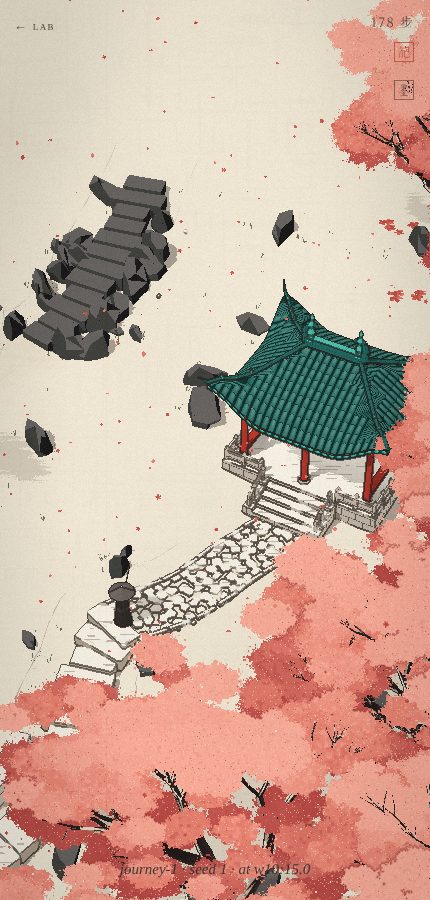
Buildings stand where the ways give them a place, each of its kind and from its parts, on a stone terrace railed round with a stair down its front to the way, facing back down the way it's reached by and down the hill:
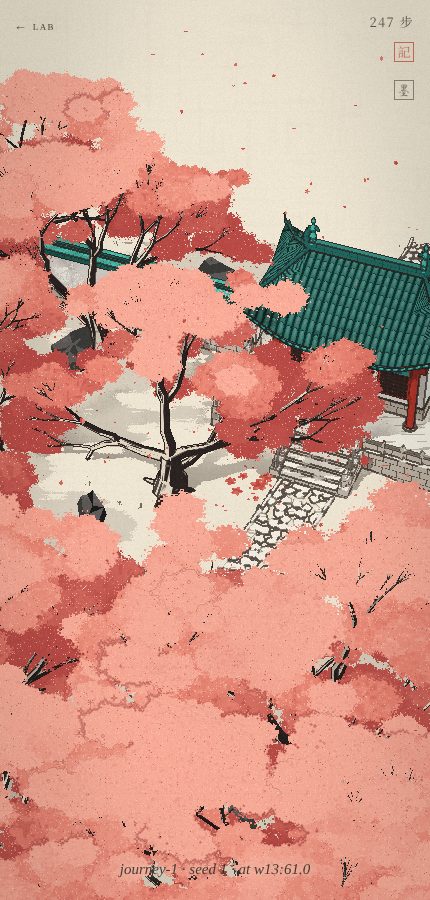
- a gate hall across a way now and then: the way climbs its front stair, goes in at its open door and out the back, down its back stair, and on; white walls run off to either side;
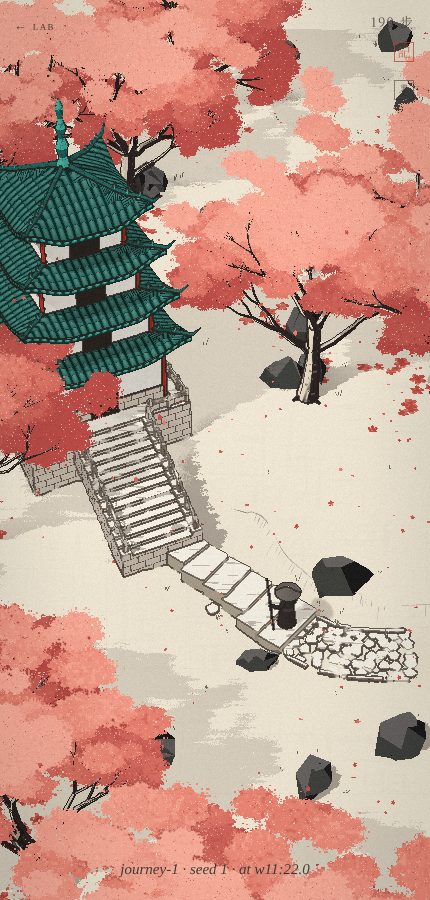
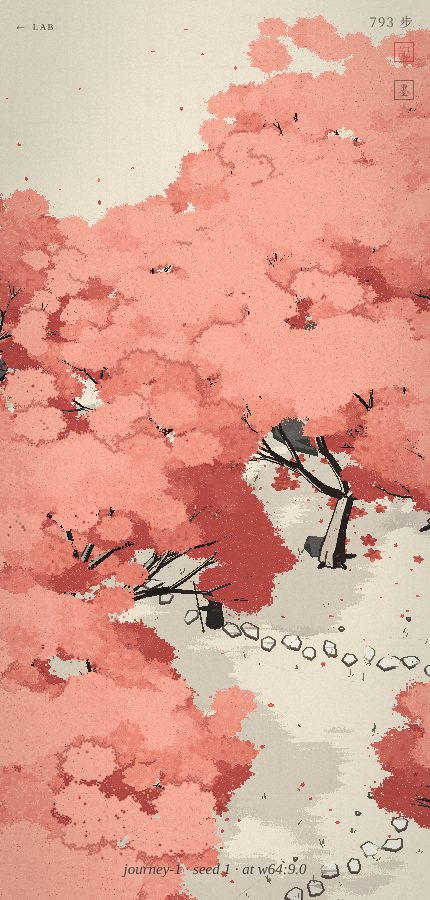
- at a branch's end, or up a spur: a hall (three bays or five; a hip-and-gable roof or a hipped one; single eaves or double, with an upper storey; sometimes walls out to its sides), an open pavilion (columns, benches between, a pyramid roof or a short ridge, its eaves swept high), a pagoda (three to five tiers, each narrower, each under a skirt of tiles, a tall spire), or a small shrine.
White walls on a grey stone plinth; red columns on round stone bases; a red beam with painted panels of teal and blue under it, a row of brackets; a red door, lattice windows; the plaque with the temple's name in gold on dark wood. Every roof's tiles are drawn, barrel tiles in rows down whichever way each slope falls, round tile-ends along the eaves, ridges down the hips with knobs along them, curled ridge ends or a finial at the peak.
The trees
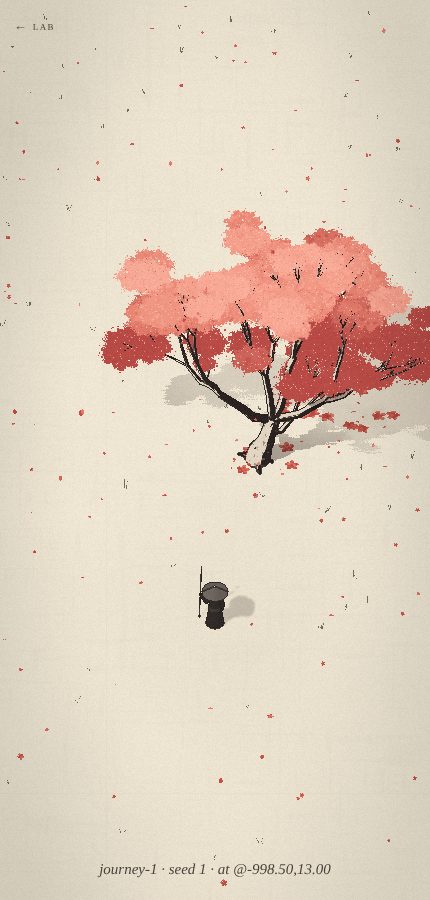
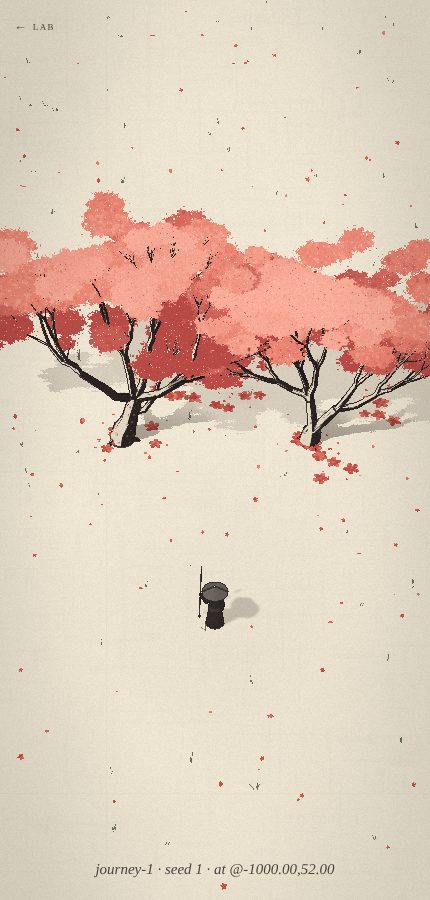
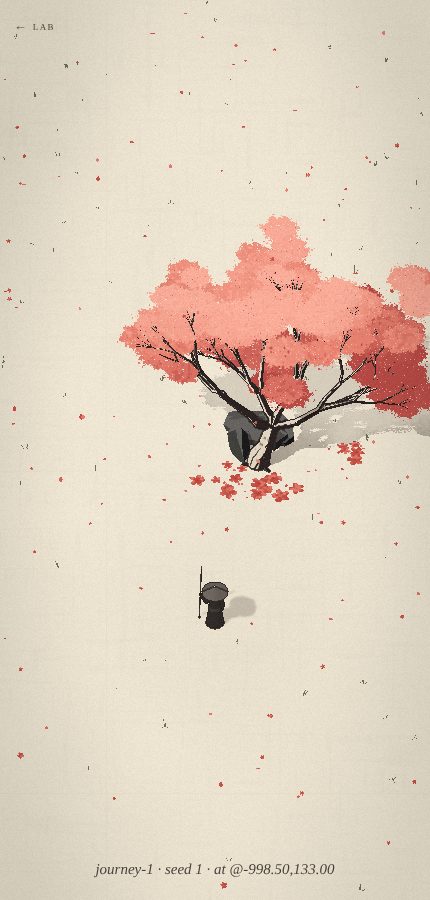
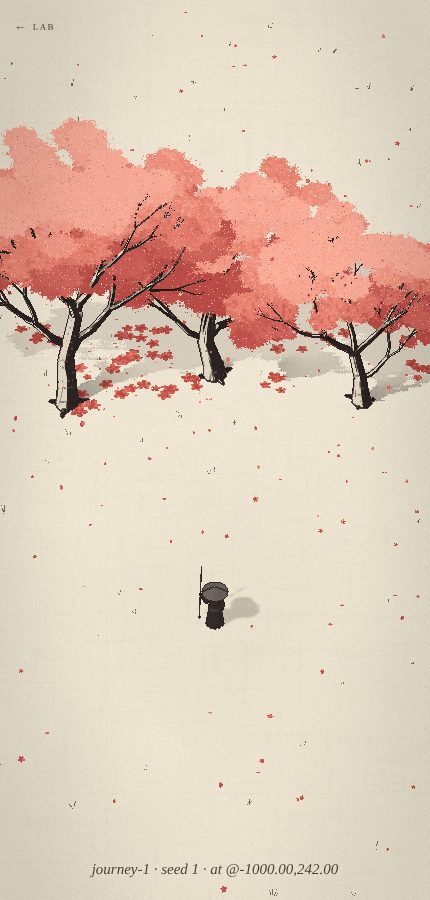
Each peach tree is grown as the print draws one: a bold trunk you can see, leaning, kinked, before it opens into three or four limbs that spread up and out to either side across the picture. Each has its own form: most open from a short trunk into a vase of limbs; some keep a leader, their limbs from it in two tiers; some fork low into two stems; some lean hard, their limbs thrown out the way they lean; some are low and broad, their limbs spreading wide and level. Every limb is a long run thinning steadily, wandering a little along its way, then forking two or three ways at a narrow angle, and again, four times over, ending in a lace of hairline twigs out to the crown's edge, with spurs out of the turns along the way. The branching spreads across the view, with little depth toward the eye or away; what depth it has leans a little away, so the near side of each crown is open and its limbs are seen. Each limb is drawn as one stroke of a brush, from where it leaves its parent to its tip: its marks run on unbroken through its turns, and its contour is laid along its edge as the brush would lay it, landing pressed where the limb leaves its parent (so every fork is marked), running on, lifting toward the tip, firmer the bigger the wood (trunk, limb, branch, twig), and broken now and then where the brush runs dry; on the lit side it draws the limb against the paper, on the dark it's lost in the dark. A limb's turns are quicker the further out it is: long steady runs in the limbs, quicker ones in the branches, a sharp turn in each twig. The trunk's foot flares out to the ground, and a few roots show as low dark ridges where they leave it and dive in, so the tree stands on the hill.
Trunk and limbs are round, and seamless where they turn. Bark is black, the side toward the light laid in the paper's cream as a dry brush leaves it (飞白, "flying white"): pale streaks along the stroke, its edge toward the shade ragged and broken, now and then a dark hairline in it, the cream down one edge of a limb, not its middle; here and there on it a dark dot, a knot or moss, as a brush dots a branch. On the trunk, the peach's bark: short level dashes across it, a hand apart, broken round it, pale on the dark and dark on the pale (fading out where they'd be finer than the screen can show).
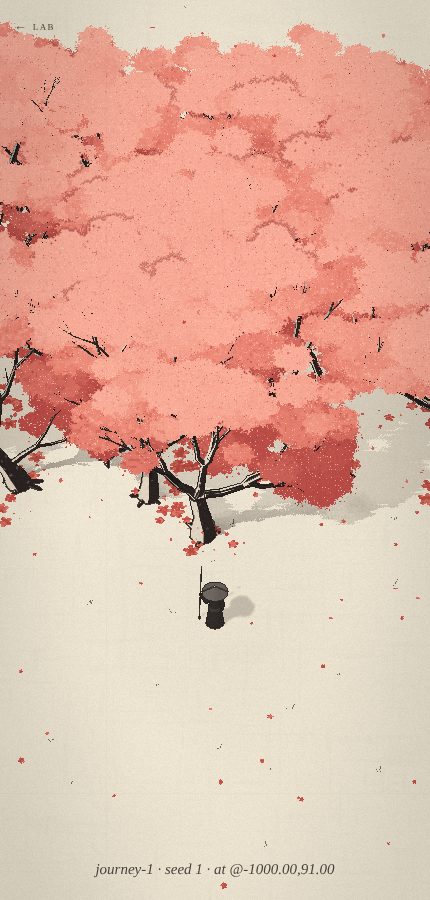
The blossom gathers in clumps about the twigs' ends, each set a little behind its twigs along the eye's line, and the dome is filled out with more clumps further back, so the crown is one full mass. The limbs are never drawn through it: they show where the tree's growth and its blossom's density leave them open, past the crown's edge, on the near side of a crown low down, and through the thinner crowns (most trees are full, some thinner, each its own). The blossom's tone keeps the crown's structure, pale where it's lit and high, deep beneath, dappled with pale dabs and deep recesses in clusters; each tree is its own pink. Inside a crown, as the eye sees it, a clump stands before its twigs; only toward the crown's rim do the twigs stand before their blossom, a lace out to the edge (more of it on a tree standing alone): inside, the limbs that hold them are hidden, and a fan of twigs on its own reads as stubble. No clump of blossom is left adrift: as the eye sees a crown, a clump or two off by themselves, held up by twigs too fine to see, would read as blobs, so they're not grown, and their twigs show bare past the crown. Where one crown stands before another (well before it, not only a clump of it among the other's), the one behind is drawn deeper along the edge, a band a few pixels wide, as the prints part crown from crown: a grove is crowns among crowns, not one pink mass.
?bench=tree&scene=lone|pair|grove|rocks|water|lineup&tree=N (best with review) is a hill of its own, no ways on it and one pond, with trees set out as given, each grown from its own seed (tree chooses which): one tree alone; the same tree twice, as the orchard draws it (right) and as it's drawn standing alone (left); a grove, crowns among crowns; a tree with an outcrop behind it; a tree above a still pond, close enough to the shore that its blossom shows in the water; and three side by side, each its own. The same trees every time, so the drawing of a tree can be changed and compared against itself, and against what stands about it.
The print
It's drawn as a print, in two steps. First the scene, in its inks: flat colours, hardly lit. With it, for each pixel, which way its surface faces and what it's made of, and its depth. Then a pass over the screen prints it, with lines only where the print has them: black ink where things stand against each other (branches, the hall, the walker); on stone a thinner line, warm grey and broken as a dry brush leaves it; none about the rocks or the blossom, which stand by their fills alone, but for a deeper pink where one crown stands before another. Lines are one pixel, on the nearer side of an edge. Everything that belongs to a thing (where a stone's line breaks, the dabs at a crown's edge, its washes) is worked out where that thing is on the hill, so it stays put as the view moves; only the paper's own grain belongs to the sheet. Under it all the paper: its mottle, its fibres, its grain, the print's edge a shade darker, and the far hill fading into it.
Few inks, flat, as a block prints them. The blossom is one field of pink per crown, not a heap of balls, in a narrow range of pink inks: each puff takes its tone from where it is on its tree (lit, high, or under) and from washes that pool across the whole crown, and where one pink meets the next the edge is ragged; over that, fine pale flecks. Stone is two: pale tops, one darker face. Shade and the strokes on the ground are one grey. Its edge crumbles into the paper in little square dabs, a few loose beyond it, as a worn block prints. Each tree is its own pink, a little deeper or paler than the next.
Rocks are standing stones, slabs and wedges on end, leaning a little, their faces flat: black turned from the light, charcoal toward it, grey on top, pocked with small pits. Steps are pale slabs with grey strokes along their tops and warmer faces. Fallen blossom is coral red, the reddest thing in the print: stamped five-lobed flowers in drifts under the trees, and specks of red between; petals turning as they fall about the walker.
The walker: a grey-blue robe with wide sleeves and a red sash, black hair gathered under a straw hat, a staff taller than they are, and a stroke of shadow beside them. As they walk, a foot goes forward and the other back with each step, the staff swings forward, is planted, and they pass it; the body sways from foot to foot and twists a little with each step, leans into a climb, the free arm swings against the stride, and the pace surges and eases within each step. They turn to face their way gradually. Standing, they breathe, and look about, now one way, now another.
One sun lights it all, high to the front and right: the print's light and its shade both come from it. Shade is the drawing's, not patches laid on the ground: the scene is drawn once more as the sun sees it, and wherever the sun's hidden a grey is laid over what's there, as a dry brush lays it, in strokes across that thin out at its edge, with every line and mark still drawn on it. So it falls on whatever's there: the ground, a way's treads and steps, a trunk, the walker, a deer, the boat; and it moves with what casts it. It is deep close to what casts it (at a rock's foot, under the walker) and pale far from it (under a crown, high over the ground), sharp-edged close and soft far off. A crown casts its clumps, with holes where the sun comes through, so its shade is dappled. The blossom and the water take none; a face turned from the sun is darkened by its own ink, not the shade. What moves (the walker, a deer, the boat) casts a softer, paler wash, smooth at its edge, not strokes held to the ground it passes over, which would flicker as it went. The hill's view from the sun is drawn again only when the hill changes or the view has moved on; what moves on it, each frame. ?shade=old brings back the old patches, to compare.
Broad, asymmetric openings beside the route alternate with denser wooded shoulders, each opening held by one tree standing alone toward its far side. These composition fields span streaming bands; jittered trees belong to the band containing their final position. Trees vary in stature. The broad blossom wash is fixed to cluster centres; fine marks remain attached to the illustrated lobes. Distant paper fade starts beyond the usual focal distance.
The journey's movements
The way up is told in movements, as a scroll is: every stretch of about 170 metres along the climb has its own character, from the seed and the stretch's number, and the hill eases from one to the next over the last thirty metres of each. An orchard is the hill as it has always been; a grove draws the trees close and deep; an open stretch lets the paper through, a tree here and there; a lone stretch is nearly empty, a single tree or two standing out at its openings; a stretch of stones thins the trees and sets rocks about the hillside. The first stretch is always orchard, so every journey begins among the blossom.
A tree that stands alone is drawn as a print draws one it means you to look at: a little taller, with more twigs at the ends of its limbs, and its blossom held back so the branching shows through. Trees in a grove stay as they were, one full mass among many.
Changes along the way
Before any tree is grown, the ways are given their places for Changes, each a space kept open on the paper, as the prints keep paper clear for their verse: where a branch ends in a clearing, there, just past its end; at some forks, in the space up the hill between the forks; and beside about a quarter of the longer ways, on whichever side has room. Each is clear of every way and well apart from the others. Each holds a cast from Changes, from the seed and the station's number: six lines, each as three coins fall, so old lines come as often as they would. The cast is written in its clearing, as a print sets its verse in the paper it keeps open: the hexagram's six lines, its moving lines vermilion; its name in a column beside them, and, if it moves, 之 and the name of what it becomes; under them, small, the numbers and names in English. The words stand on a sheet at the uphill side of the clearing, always turned to face the eye (the drawing turns each corner of it about its foot), so they read square however the view moves; but they're of the hill, so whatever stands before them (a crown, a rock) stands before them, and nothing has to make room for them. They come from a sheet of words, ink on nothing: where there's no ink, the hill shows through. They only read (a tap on them walks, like a tap on the hillside). Beside it, a small built thing ties it to the place: a cairn of flat stones, each smaller than the last (always where Mountain or Earth is in the cast), or a wayside shrine, a stone post with a little white niche under a roof of teal tiles.
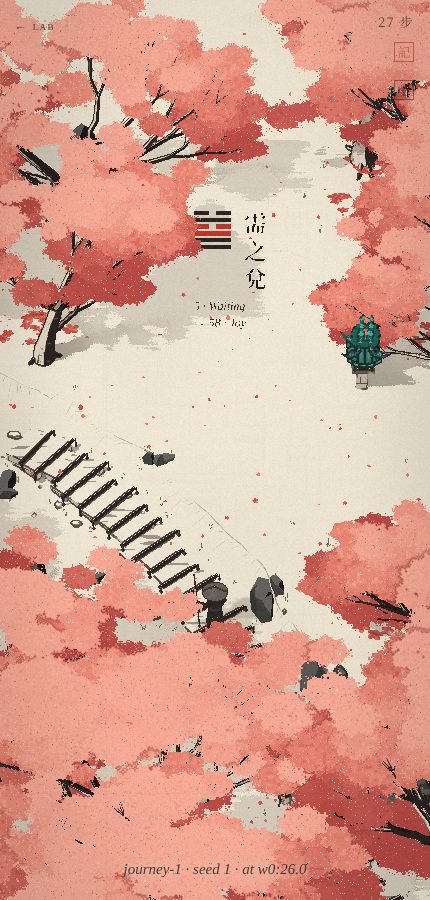
A tap on a cast's words opens its page: a sheet of paper over the painting, near the whole screen, to read it by (the painting set aside under it, not drawn, and the walker staying where they are). On it, the figure (its moving lines vermilion), its number, its name and, if it moves, 之 and the name of what it becomes, in English and pinyin; Legge's Judgment and Image (1882); its changing lines, from the bottom up, and all six behind a fold; a question to sit with; and where on the hill it was cast, the hill's own, the same each time it's read.
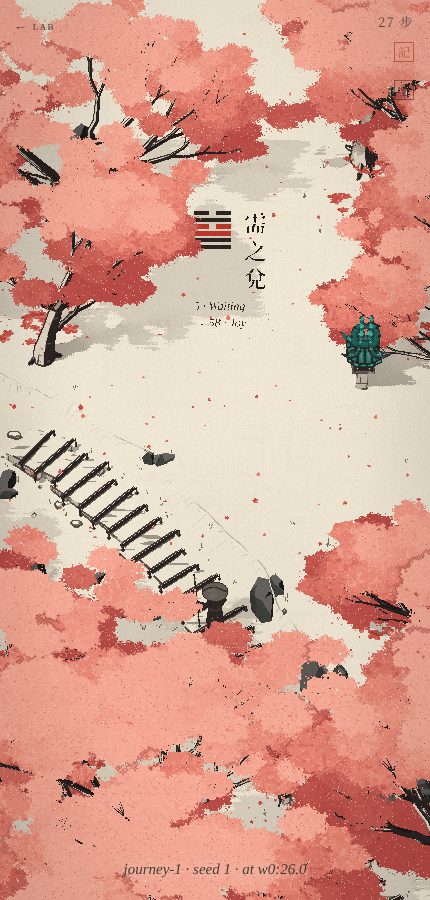
The page is one of three paper surfaces (surfaces.ts), each a sheet of the same paper (warm ivory, a fine fibre in it, its edge rough as handmade paper's is, cut afresh to each sheet's size, its shadow following the edge): the page, for reading; the drawer, from the foot of the screen, for doing something there, the painting still seen above it; and the side sheet, from the right and on past the edges, for finding one's way, the painting kept beside it. What's shown is kept apart from how it's shown. ✕, a tap beside the sheet, or Escape puts it away; while one's open, taps and keys are its.
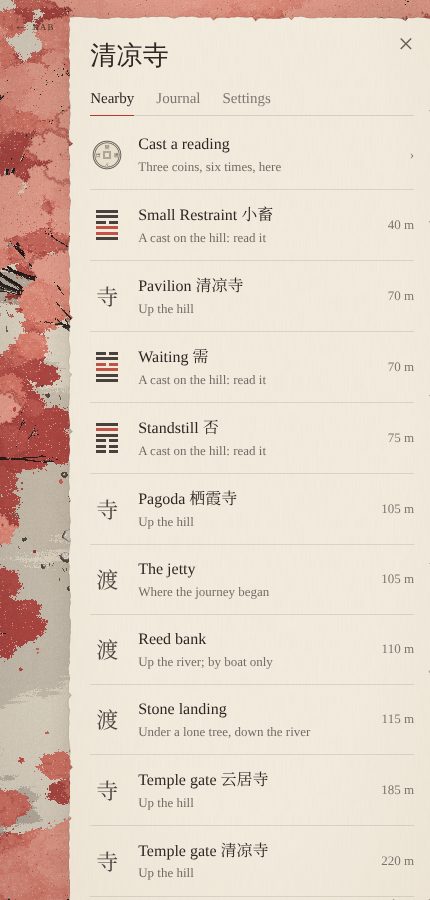
The seal 記 (travel notes), at the top right above 墨, opens the side sheet: headed with the nearest temple's name, in three tabs. Nearby: the temples, the casts on the hill and the river's landings about the walker, nearest first, with how far (a temple or a landing tapped, the walker goes there; a cast, its page); and at its head, Cast a reading. The journal: what's been read on the hill, and cast, kept in this browser only; a tap reads it again. Settings: the composition view, the steps counted, these notes, and Benches: each bench (water, ways, trees, river) with a link to each of its scenes, so that every scene a bench sets out can be found without knowing its name.
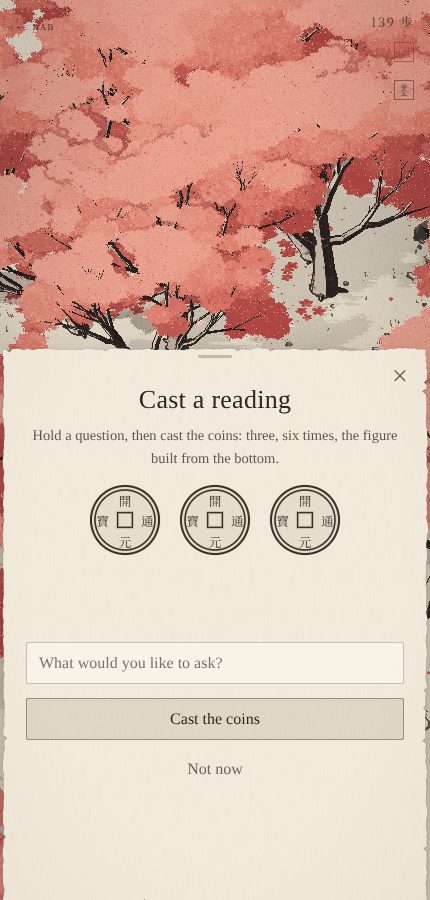
Cast a reading opens the drawer: a question (or none), then three coins (開元通寶, the Tang's), thrown six times, the figure built line by line from the bottom; each line the coins' sum, a face two and a plain back three, so a six is three faces and a nine three backs. It's cast as the Changes experiment casts: the question and the hour give the lines, so the same question in the same hour casts the same figure. Then its names, and Read it opens its page (the question at its head, and when it was cast); it's kept in the journal. A cast of one's own is its own, apart from the hill's.
The cast shapes its space too. Its upper trigram is what stands behind it: Mountain, standing stones along its upper edge; Wind, a grove close behind; Thunder, one tree well out at its far side, framing it. Its lower trigram is what lies in it: Water, stepping stones across it; Lake, a ring of flat stones; Fire, fallen blossom heaped red; Mountain, one low stone; Wind, grass in tufts; Thunder, a stone split in two. Heaven and Earth leave it open. Trees stand well back from a station's edge (a crown spreads four metres and more, so its trunk stands that much further off), further on its downhill side, where a crown would stand over the space as the eye sees it; every tile near a station keeps it open, not only the one it stands in.
The composition view
?ink (or C on a keyboard, or the small seal 墨 under the steps, which is stamped vermilion while it's on) steps back from the print to show only its arrangement, in broad strokes with nothing recognisable (going in, the camera eases back over a little over half a second and then the print gives way to its masses, so each thing is seen to become its mass; coming out, the other way): the camera stands nearly twice as far off and sees further up the hill; each part of the print is gathered over a wide brush and laid down as a few inks (blossom a grey wash, deeper where it's dense; rock and trunks black; buildings vermilion; the rest paper); each way is brushed over it as a stroke, heavy where it's steps, dry and broken where it's a trail; the walker is a dot of vermilion; the title, while it's in view, shows faintly over the masses it sits on; each station is marked by its hexagram, small, in its middle. Every way is brushed, so the forks and meetings read at a glance. It works with review and while walking, for judging how the arrangement holds as it unrolls, and for deciding where things along the way should fall.
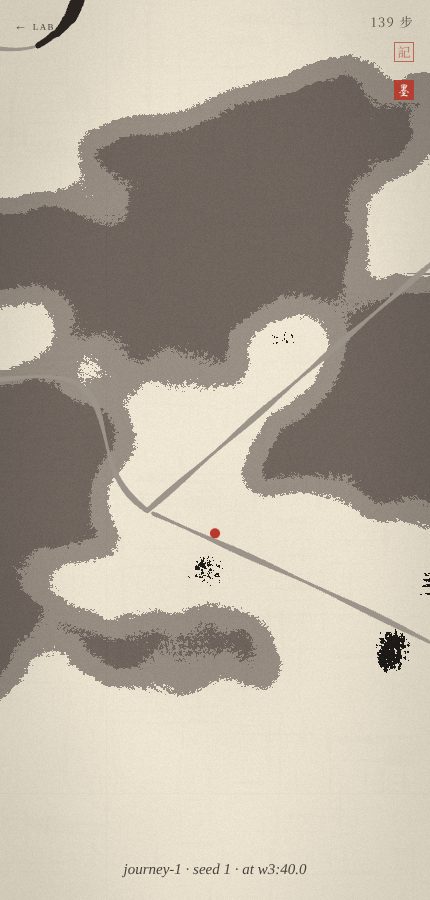
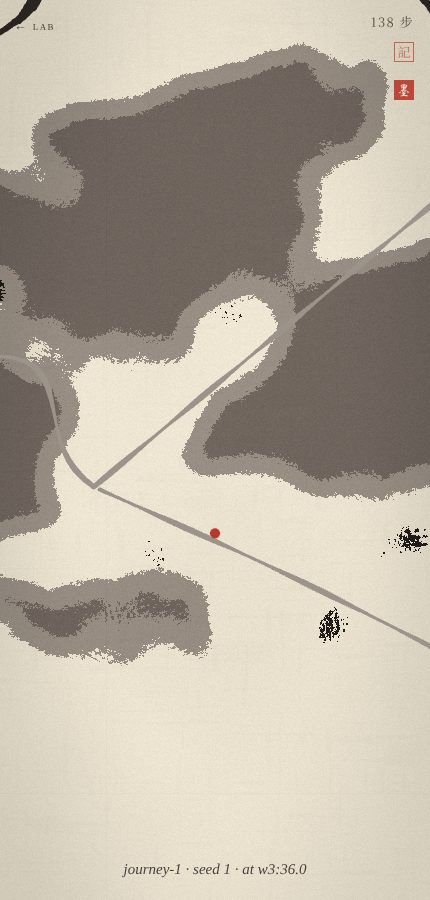
?seed=… a hillside; ?preview climbs by itself, quietly; ?pace=… times the walker's pace (for trying things out quickly). The address keeps the seed and where the walker is (?at=way:metres), updated as they go, so a reload or a shared link comes back to the same place. ?seed=1&at=w3:40&review freezes the walker, camera and falling petals for a repeatable comparison at full rendering resolution. The footer identifies the pass, seed and where on the ways. Remove review to walk normally. On seed 1: at=w3:36 (a fork), at=w10:15 (a pavilion), at=w11:22 (a pagoda), at=w19:44 (a cast where a branch ends), at=w13:61 (a gate), at=w64:9 (a hall), at=w8:8 (a waterfall's pool, and stepping stones below), at=w29:36 (a stone arch). On still-ford-7, at=w41:19 (stepping stones over a winding stream, a waterfall above). (The ways' ids follow from how the hill grows, so these change when it does.)
Composition pass 2 broke crown edges into irregular sprays and brought clipped stone treads, lower tapered rocks, verse in parallel vertical columns and the large title at lower left. Pass 3 keeps those and brings back what pass 2 flattened: the ink branches (through their own crowns only), the crowns' light and depth, and the starker stair; its camera sits between the two.
Poling and staff articulation
Tap-to-pole retains deliberate individual strokes and the two-stroke queue. Recovery takes 0.7 seconds; the drive retains its previous timing and force. Water-relative drag is 0.22 per second, giving each stroke a longer glide without changing the river current or speed cap.
The walker has articulated upper arms, forearms and hands. The walking staff plants on the ground for the support phase, then lifts forward outside the hat. Both hands grip the boat pole at separated points; its planted tip stays in world space while the boat moves past it. Fixed-length two-bone arm solves follow those contacts. A conservative clearance volume around the hat and arm reach limits end an impossible plant early. The poler and pole use the same boat-and-body transform through rocking and turns.
The poling body now follows stroke position: reaching at the catch, moving through the drive and settling at the finish. Force peaks between those poses. A directional tap updates the next catch; the current plant keeps its committed direction. Steering torque acts during the push, with thrust kept near the bow direction to avoid sideways skating. Arms are proportioned at 0.34 m per segment, with downward elbow bends, smaller sleeves and hands, and a relaxed free arm beside the robe. The pole is held diagonally ahead of the shoulder so both hands can reach without elongated arms.
The push now builds earlier after the catch with a fuller initial force envelope (1.8 base thrust, unchanged 1.5 speed cap). An early pole release no longer jumps the stroke phase: body motion continues, and the pole recovers from its actual release position, easing into rest. On ascending stairs the walking staff reaches farther ahead and samples the tread height; travel gathers during the staff-support phase with a matching climbing lean.